


Typed assessment of George Holleyman`s collections by Dr Euan MacKie.
Typed assessment of George Holleyman`s collections by Dr Euan MacKie (2 copies).

Typed assessment of George Holleyman`s collections by Dr Euan MacKie.
Typed assessment of George Holleyman`s collections by Dr Euan MacKie (2 copies).
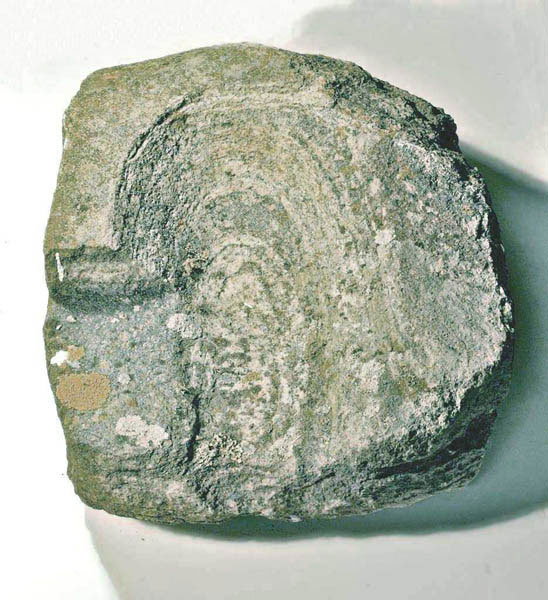
Saddle quern found in Moss.
Courtesy of Catriona McLeod
Saddle querns are the most ancient and widely used type of quern-stone. This one was found in Moss in the mid-1980s and may date back to Neolithic times. It was used with a rubbing stone held in the hand, a process that crushed the grain rather than ground it.
Considered women’s work, preparing grain using a saddle quern would have taken many hours and placed great strain on the body, particularly the toes, knees, hips and lower back. They continued in use into the medieval period and were superseded by rotary querns.
Turnbull, in a report on Tiree written in 1768, wrote that meal was made ‘with querns or hand mills which appears to be an expensive and troublesome method. Two women at once, or sometimes three, are commonly employed. By this means there is so much of their time taken up that it greatly retards them from other industry.’
Wooden case containing 60 Iron Age pottery shards.
(Documented on E00033) Wooden case (350 x 300 mm) containing 60 Iron Age pottery shards collected by George Holleyman from a sand-hill site at Balevullin during 1941-3. Two shards are accessioned separately with photos: 2000.91.12 & 2000.91.13
Fragment of an Iron Age vase
Photograph of a fragment of an Iron Age vase.

Courtesy of Mr George Holleyman
The fragment consists of three adjoining pieces of the rim of a finely made Vaul ware vase, plain except for a single horizontal incised line apparently running right round the vessel. The sherds are orange-brown in colour and have a light grey core.
The vase would have stood about 180-200 mm high with a rim diameter of about 130-150 mm and was made by the First Iron Age, or perhaps the Late Bronze Age, inhabitants of Tiree.
The sherds were found in a sand-hill site at Balephuil in the early 1940s by George Holleyman, later a Fellow of the Society of Antiquaries of London, who was posted to RAF Tiree during World War II.
Wooden case containing 66 pottery shards.
Wooden case (550 x 325 mm) containing 66 pottery shards collected by George Holleyman from a sand-hill site at Balevullin during 1941-3. Documented on E00033. Reviewed by Dr Euan MacKie in summer 2000 (see 2000.167). Items further identified by Dr Ewan Campbell, Senior Lecturer in Archaeology in Glasgow, in July 2018: Norse ‘platter; early medieval; 16th-18th century.

Photocopied journal extract about an Iron Age excavation at Balevullin submitted by Dr Euan Mackie.
Journal article by Dr Euan Mackie about the excavation of an Iron Age site at Balevullin by A. Henderson Bishop in 1912.

Printout from National Museums of Scotland Archaeology Dept holdings for Tiree.
Printout from the National Museums of Scotland Archaeology Dept holdings for Tiree.
Report on the excavation of Dun Mor Vaul by Dr Euan Mackie.
Report of the excavation of Dun Mor, an Iron Age broch in Vaul, during 1962-4 by Dr Euan MacKie.
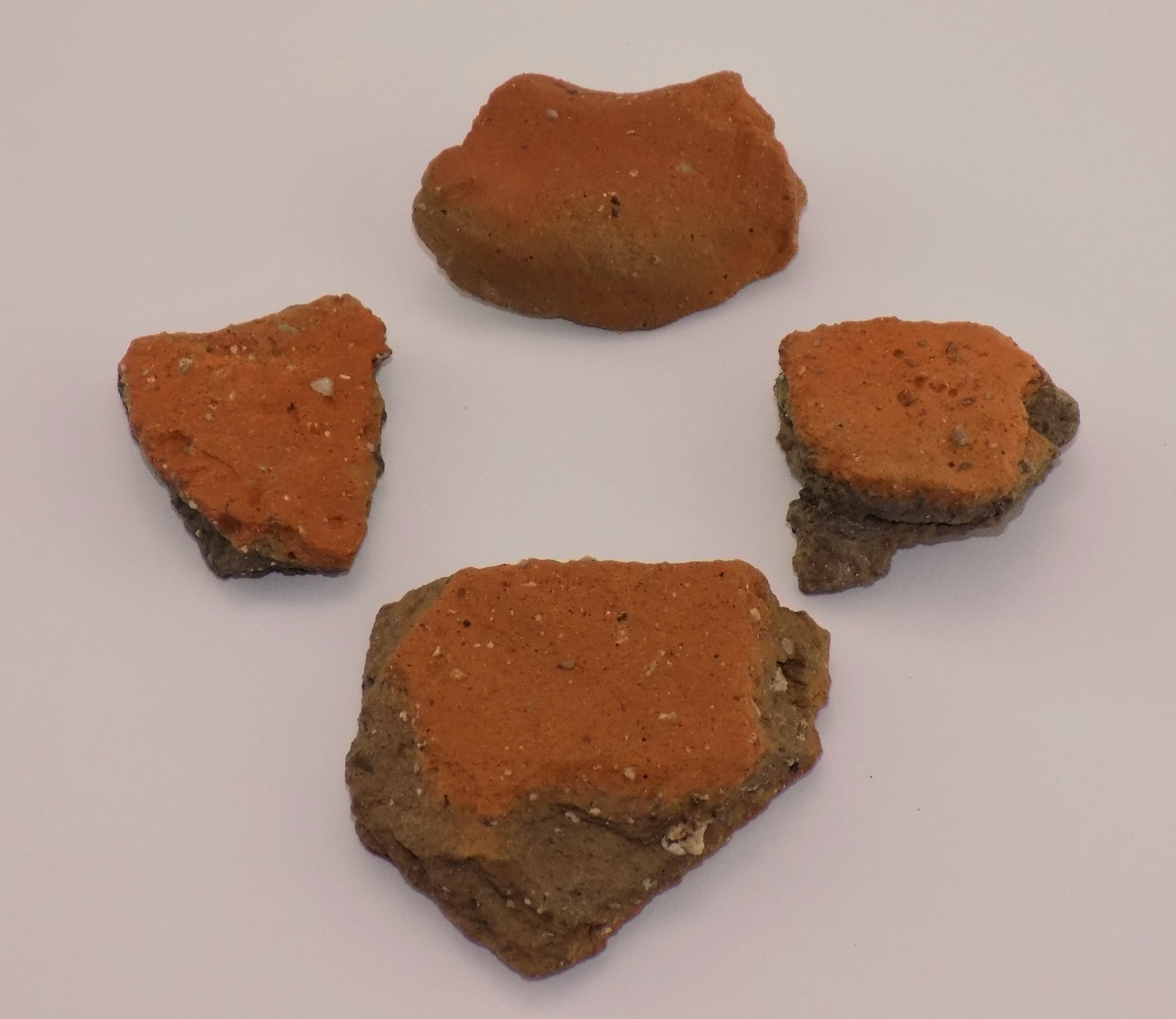
Four Iron Age pottery shards.
Four Iron Age pottery shards found on the surface of a sand dune in Balephuil towards Ceann a` Bharra on 9/4/2003 by Malcolm MacNeill of Glasgow who assisted in the excavation of Dun Mor Bhalla in the 1960s.
Photocopied extract `Notes on the Antiquities of the Island of Tiree` by J Sands from `Proceedings of the Society of Antiquaries of Scotland, 1881-2, Vol. XVI, pp 459-63.
Article about cup-markings or crotagan, ancient forts or duns, ancient churches, chapels, church-yards, graveyards and burial-grounds
click here for a link to the text displayed by the Society of Antiquaries of Scotland