Local news and events including the debut CD by the band Skerryvore, an update by the Development Partnership, the local councillor`s views on `wild camping` and CalMac services, the Iron Age strike-a-light in An Iodhlann, the Tiree Archaeology Day sponsored by the Heritage Society, free energy audits for businesses, Glasgow Children`s Holiday Scheme, CEDP funds for Community Projects, and the Highlands and Islands Croft Entrants Scheme and news from the church.
Audio cassette recording of a lecture about brochs given by Dr Euan Mackie in Vaul Golf Clubhouse in July 2000.
Recording of a lecture illustrated with slides given by Dr Euan Mackie in Vaul Golf Clubhouse in July 2000. Dr Mackie talks about the construction and architectural features of brochs across Scotland, the deterioration of many sites and current theories about their evolution from earlier structures. Their uses as defensive structures or as housing for an elite are discussed in a short Q&A session.
Audio cassette recording of Dr Euan Mackie talking to Dr John Holliday in April 2000.
Dr Euan Mackie, Honorary Research Fellow of the Hunterian Museum at the University of Glasgow talks to Dr John Holliday in April 2000 about his career in archaeology, the excavation of Dùn Mòr at Vaul 1962-1964, daily life on the dig, his work as director, the changes in thinking of British archaeologists since the 1960s, the history of the occupation of the broch and the likelihood of Stone Age occupation of Tiree. (Continues on AC213)
Dr Euan Mackie, Honorary Research Fellow of the Hunterian Museum at the University of Glasgow and director of the excavation of Dùn Mòr in Vaul, talks to Dr John Holliday in April 2000 about the implications of the dig for Scottish archaeology and for himself personally.
Initially Dr Mackie requested permission from Argyll Estates to excavate a machair site at Balevullin where A. Henderson Bishop had found Iron Age pottery and other artefacts in 1912. This was refused because the area was used for grazing cattle.
An alternative site of the broch at Vaul was acceptable. Dr Mackie directed the excavations there over three seasons in the early 1960s which produced a wealth of material from the late 6th or 5th century B.C. to the 2nd or 3rd century A.D. The finds are stored in the Hunterian Museum in Glasgow.
Former chemistry teacher Harry Kelly of Glasgow was recorded in April 2000 talking to Dr John Holliday about the time he spent in the early 1960s as a volunteer at the excavation of the Iron Age broch at Vaul.
When his tent was washed out by rain soon after his arrival, Harry was offered lodgings by Catriona MacKinnon of Rhum View in Vaul. Catriona was a mine of information about life on Tiree in the 1930s.
Much to Harry’s surprise, she had made her own pottery from local clay and dyed cloth with lichens. In this clip, Harry talks about the method she used to make pots.
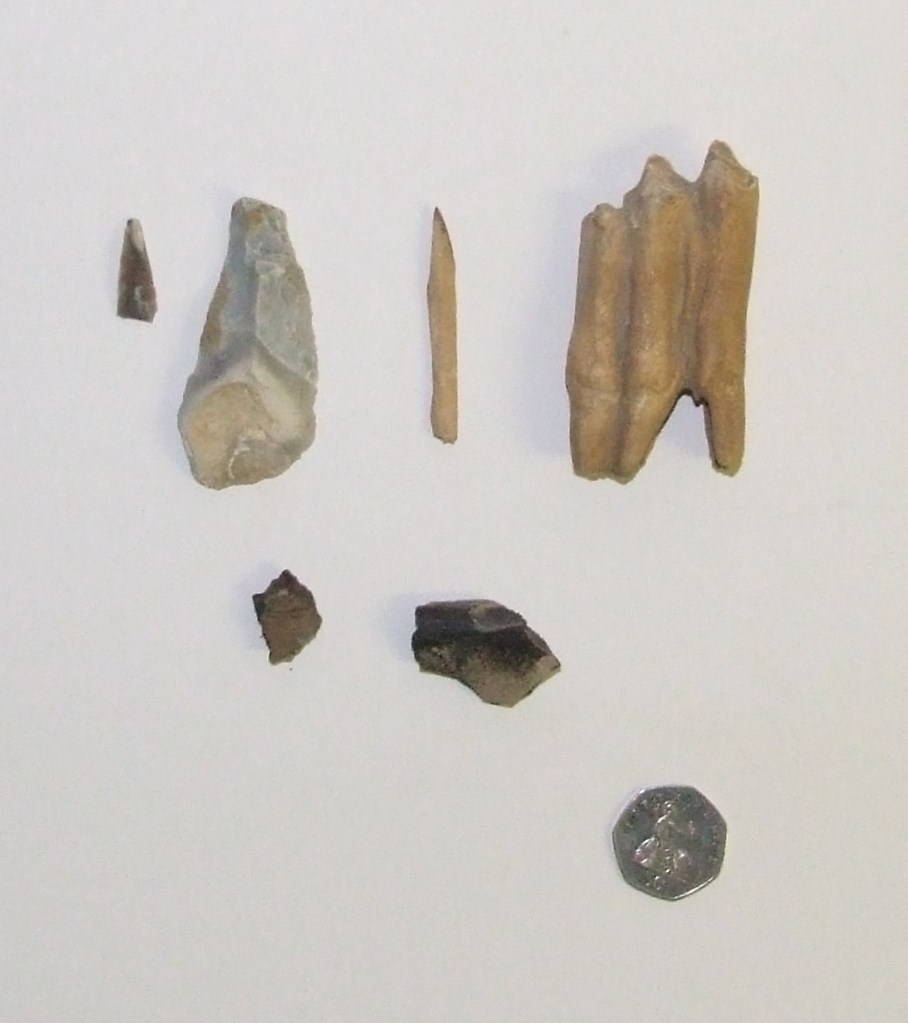
Bag with two pieces of flint and one small pottery shard found by Dr John Holliday in September 2004 on Balephuil machair where John Bowler made his original finds.
Red deer bone awl found by Dr Morton Boyd in Balephuil in 1995.
Red deer bone 125 mm long and 25-35 mm wide with one end shaped into a point, found by Dr Morton Boyd on 27/1/1995 on the bank of the stream at Balephuil embedded in a layer of limpet shells and sand/soil at a depth of around 3 m in the dunes.
Audio cassette recording of a talk `The Archaeology of Tiree` by Professor Steven Mithen in An Talla, Crossapol on 26/8/2004.
Talk ‘The Archaeology of Tiree’ given by Professor Steven Mithen of Reading University in An Talla in August 2004 and introduced by Dr John Holliday. Prof. Mithen talks about the earliest settlers in the Southern Hebrides around 6000BC, their probable lifestyle and tools, the traces they’ve left such as flints, bone tools, middens and charcoal deposits, the survey work the Reading team have been conducting on Tiree including ground penetrating radar and peat cores and the work they hope to do on Tiree in the future.