


Black and white photograph of Chrissie MacDonald of Balemartine and others in the 1930s.
Scarinish harbour with the Mary Stewart in the 1930s. On the extreme right is Chrissie MacDonald of Balemartine who worked in the Scarinish Hotel.
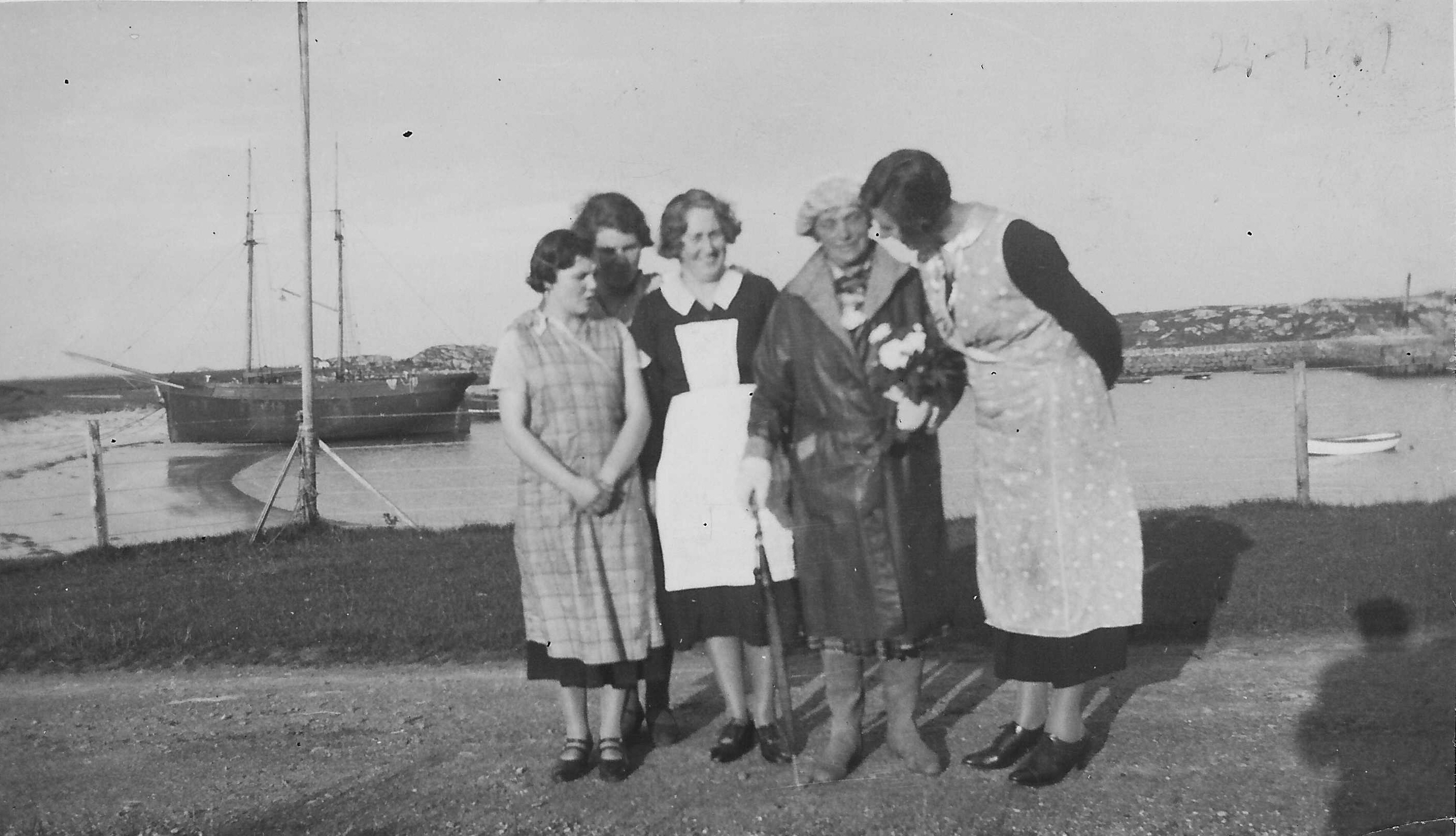

Black and white photograph of Chrissie MacDonald of Balemartine and others in the 1930s.
Scarinish harbour with the Mary Stewart in the 1930s. On the extreme right is Chrissie MacDonald of Balemartine who worked in the Scarinish Hotel.
The ‘Mary Stewart’ in Scarinish harbour.
Photograph of the schooner ‘Mary Stewart’ in Scarinish harbour in the early 20th century.

Courtesy of Mr Angus Munn
This photograph taken in the 1920s or 1930s shows the ‘Mary Stewart’ in Scarinish harbour with the Temperance Hotel on the right and MacArthurs’ general store on the left. Built by Barclay in Ardrossan in 1868, the sixty-four foot long ‘Mary Stewart’ was rigged as double-topsail schooner and had a tonnage of sixty-five.
Originally trading on the Irish coast, she was bought in 1908 for Donald MacLean of Scarinish by his relation, Dugald MacKinnon. Dugald was known as Dùghall an Òir (Dugald of the gold) because he had had been successful in the Australian Gold Rush.
Donald MacLean, with his sons as crew, traded up and down the West Coast of Scotland carrying coal and other cargo until the late 1930s when steam superseded sail. The remains of the ‘Mary Stewart’ can still be seen in Scarinish harbour.
Black and white photograph of the Mary Stewart in Scarinish harbour.
The Mary Stewart in Scarinish harbour with MacArthur`s Store in the background at the left and the Scarinish Hotel on the right, photographed in the early 20th century.
Black and white photograph of Scarinish.
View of Scarinish from outside the harbour. The building in the middle was originally a church, then used intermittently as a prison and latterly as a store by the owners of the Mary Stewart. It was pulled down to make roads during World War II. The Scarinish Hotel is on the extreme right.

Clydesdale horses at Scarinish harbour
Photograph of Clydesdale horses at Scarinish harbour in the late 19th or early 20th century.

Courtesy of Mr Angus Munn
This photograph, taken before Gott Bay pier was finished in 1913 shows Clydesdale horses from Tom Barr’s farm at Balephetrish being loaded on to a lighter at Scarinish for transportation to the steamer standing off in deeper water outside the harbour.
The horses would be loaded by ramp on to the main deck of the steamer, an operation that could only be attempted in calm weather. Passengers were likewise ferried to and from the steamer by lighter, sometimes sharing the boat with livestock.
Tom Barr, the son of an Ayrshire farmer and the tenant of Balephetrish farm from 1864 to 1913, introduced the first Clydesdale stallions to Tiree in the 1870s. Cross-bred with native ponies, the Tiree Clydesdale was in great demand in the early 20th century.
Black and white photograph of horses being loaded into a lighter at Scarinish harbour.
Horses from Tom Barr`s farm at Balephetrish being loaded into a lighter at Scarinish pier for transportation to the ferry in the early 20th century.
Black and white photograph of Scarinish harbour in 1946.
A Tiree regatta in Scarinish harbour in 1946 with the hotel in the background.
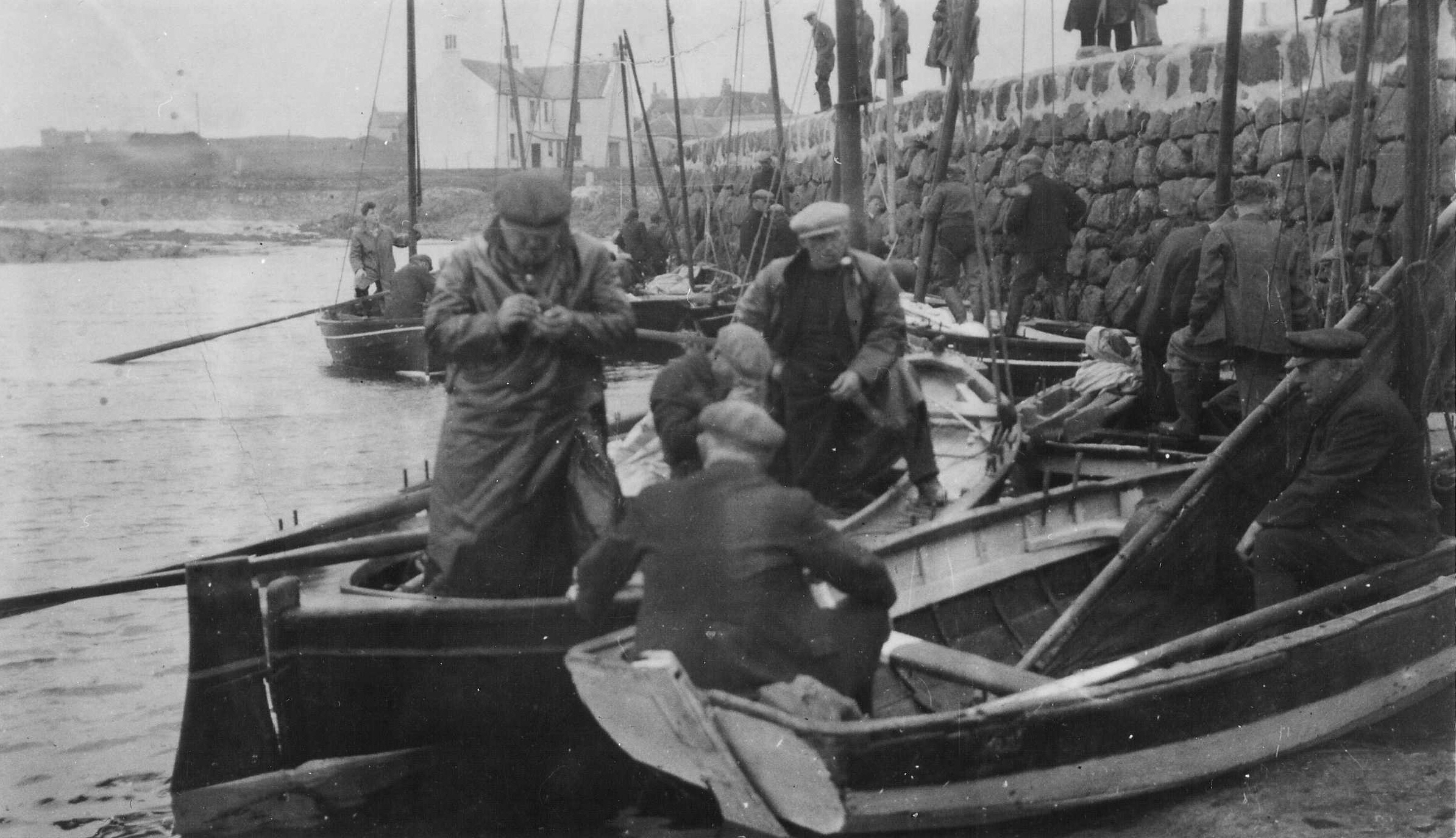
Black and white photograph of a regatta in 1946.
The competitors in a Tiree regatta of 1946 at Scarinish pier. The hotel is in the background. (Original in Filing Cabinet 5 drawer 2)

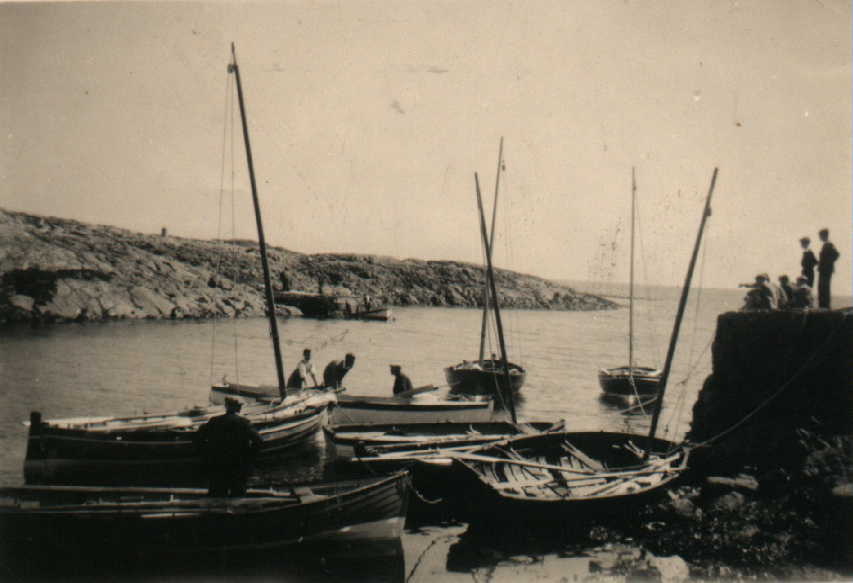
Black and white photograph of Scarinish harbour in 1950.
Lugboats at Scarinish pier before the start of a regatta in 1950. Standing on the left in oilskins and lighting his pipe is `Doan` of Balemartine.
Photocopied newspaper article about Tiree.
Local news about repairs to the Mary Stewart in Scarinish hrabour, school board elections and an obituary for Archibald MacKinnon of Milton who died aged 27.
Audio cassette recording of John Fletcher of Balemartine talking to Maggie Campbell on 22/1/2004
John Fletcher of Balemartine talks to Maggie Campbell in January 2004 about talks about his memories of fishing as a young boy, helping launch the boats from Port an Tobair, fishing with the lion mhòr and the lion bheag, the different types of fish caught, good fishing spots, hooks, bait, rods and nets, how fish were preserved, seafood, creel fishing for crayfish and some of the fishermen on Tiree in past times. Iain Mac an Fhleisdeir o Baile Màrtainn a’ bruidhinn ri Mairead Chaimbeul anns am Faoilteach 2004 a’ cuimhneachadh mu dheidhinn a bhith ag iasgach na bhalach beag – cuideachadh na bodaich a’ cuir na bàtaichean don mhuir aig Port an Tobair, ag iasgach le lion mhòr agus lion bheag, na h-iasg a bhitheadh iad a’ glacadh agus mar a’ bhitheadh iad a’ glèidheadh an iasg, àiteachan comharraichean, dubhain, bior-èisg, ag iasgach airson giomaich Spàinnteach agus sgeulach neo dha mu dheidhinn na h-iasgairean ann a Tiriodh fo chionn fhada.
Colour photograph of Donald Iain Kennedy, Duncan MacArthur and David Hepburn in 2000.
Donald Iain Kennedy, Duncan MacArthur and David Hepburn, the crew of the `Eilean Thiriodh`, in Scarinish harbour after a Tiree regatta in July 2000.
