Audio cassette recording of a Gaelic Radio interview with Niall Brownlie of Barrapol in January 1998.
Radio interview with Niall Brownlie of Barrapol talking about his bilingual book Township and Echoes, the Viking influence on place-names, the difficulty of translating poems and songs into English, Tiree bards, conservation orders, early religion, St Columba and the churches on Tiree, the airport, links with Barra and World War II, Tiree seers and songs he himself has written.
Newsletter of Tiree Heritage Society, No.2, August 2001.
Newsletter of Tiree heritage Society with news about the Tiree Chapels Project, the children`s book `Nud`s Notebook`, the pilgrimage route and fund-raising.
Photograph of the remains of St Patrick’s Chapel on Kennavara.
Courtesy of Mr Donald MacKinnon
St Patrick’s Chapel, or Teampull Phàraig as it is known in Gaelic, lies on the Balephuil side of Kennavara within an irregular enclosure measuring one third of an acre. On the north and east boundaries are four scarped platforms, possibly the sites of huts. The site was probably a cashel or monastery of the Early Christian period.
The chapel stands in the south-west quarter of the enclosure and measures some 8 by 3.4 metres. Only part of the east gable survives; the rest of the walls are turf-covered footings. Against the centre of the east wall are the remains of an altar-base roughly one metre square. The visible masonry is of lime-mortared local rubble.
The Statistical Account of 1794 recorded that the walls stood 1.7 metres high. According to Ada Goodrich-Freer in her book ‘Outer Isles’, in 1898 the walls were ‘ruthlessly thrown down by two idle lads “for amusement”’.
Black and white photograph of St Patrick`s Chapel on Kennavara.
Illustrated colour guide to a 30 mile walk around Tiree linking many places of Christian and pre-Christian significance and introducing visitors to the island`s rich natural heritage abundant in bird and plant life.
Photocopied extract `The Buildings of Scotland – Argyll and Bute` by Frank Arneil Walker, pp 594-600.
Descriptions of townships and buildings, churches and chapels, burial grounds and cemeteries, monuments and memorials, duns, forts and broch, standing stones, airport and piers, Sandaig museum, Skerryvore and the Hynish complex.
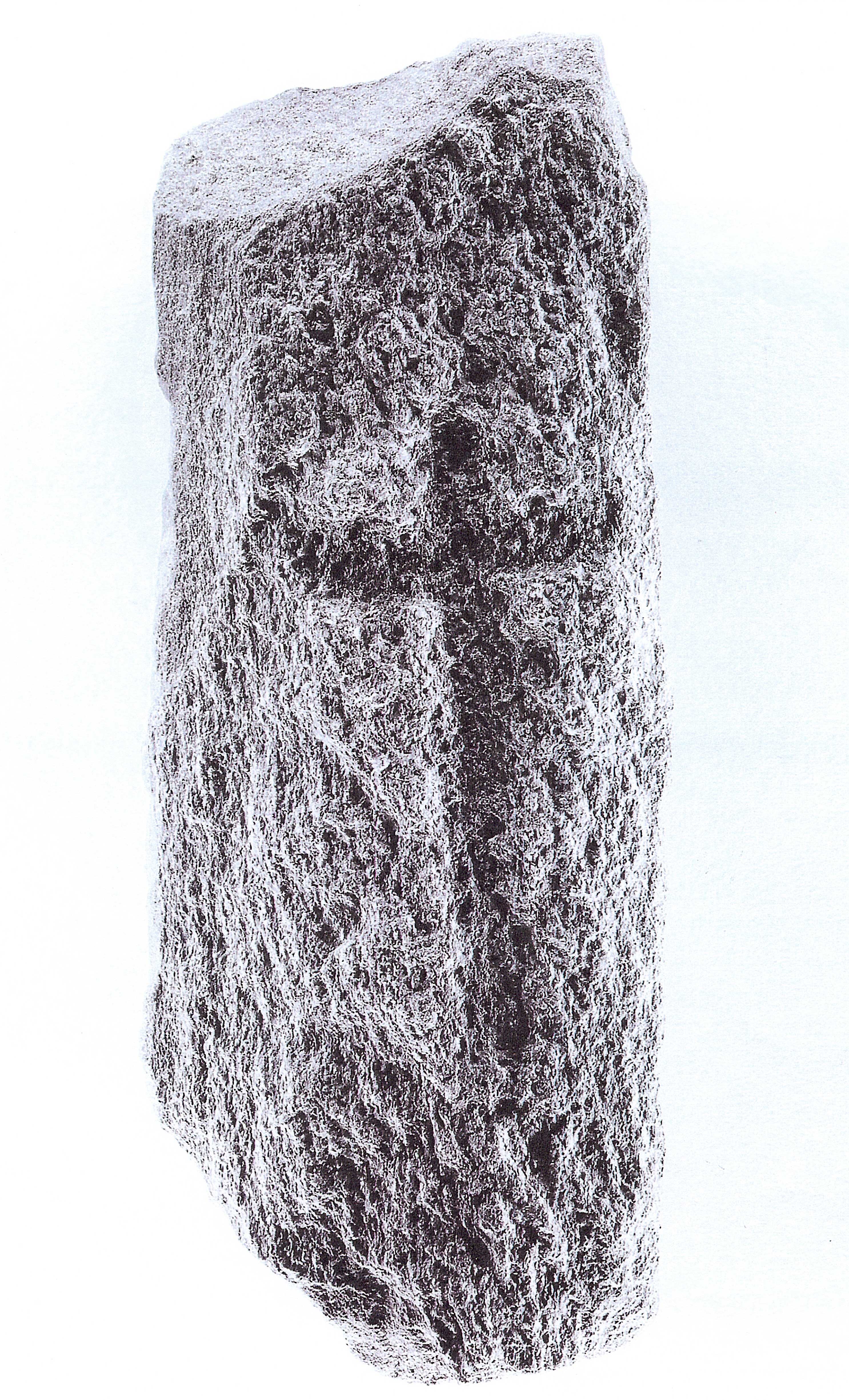
Photograph of a cross-incised stone at St Patrick’s Chapel on Kennavara.
Courtesy of Mrs Grace Campbell
Up on Kennavara for a picnic, the young man in this photograph of 1920 is hiding behind the smaller of two incised stones at St Patrick’s Chapel which bear Latin crosses on both faces. Another cross is carved into a boulder to the south-east of the chapel.
On the shoreline below the chapel is a naturally formed swallow-hole sixty centimetres in diameter and over one metre deep which is known locally as St Patrick’s Vat or Well. It is traditionally regarded as a baptismal font.
There is no evidence that St Patrick ever came to Tiree but there is a Tiree tale that St Comgall, the founder of Bangor Abbey in Northern Ireland and a contemporary of St Columba, founded a monastery on Kennavara.
Black and white photograph of St Patrick`s Chapel on Kennavara in 1920.
The cross-marked stone at St Patrick`s Chapel on Kennavara in 1920.