Black and white photograph of the MacPhail in Cromarty, Ontario.
The MacPhail family who emigrated to Cromarty, Ontario in June 1903 on board the S.S. Sardinian.
L-R: (standing) Allan (1897-1968), Hector (1892-1984), Archie (1895-1963), Flora Ann or Flo (1891-1992), (seated) father John MacPhail (1867-1940), Catherine or Kate (1898-1972), Mary Catherine or Mary (1900-1987), mother Flora MacLean (1863-1934).
John was the son of Hector MacPhail and Catherine Lamont in Cornaigmore; Flora was the daughter of Archie MacLean and Mary Campbell in Kenovay (Flora had a twin brother Allan). John and Flora were married in Tobermory on 26th September 1889.
View of Scarinish from outside the harbour. The building in the middle was originally a church, then used intermittently as a prison and latterly as a store by the owners of the Mary Stewart. It was pulled down to make roads during World War II. The Scarinish Hotel is on the extreme right.
Photograph of the schooner ‘Mary Stewart’ in Scarinish harbour in the early 20th century.
Courtesy of Mr Angus Munn
This photograph taken in the 1920s or 1930s shows the ‘Mary Stewart’ in Scarinish harbour with the Temperance Hotel on the right and MacArthurs’ general store on the left. Built by Barclay in Ardrossan in 1868, the sixty-four foot long ‘Mary Stewart’ was rigged as double-topsail schooner and had a tonnage of sixty-five.
Originally trading on the Irish coast, she was bought in 1908 for Donald MacLean of Scarinish by his relation, Dugald MacKinnon. Dugald was known as Dùghall an Òir (Dugald of the gold) because he had had been successful in the Australian Gold Rush.
Donald MacLean, with his sons as crew, traded up and down the West Coast of Scotland carrying coal and other cargo until the late 1930s when steam superseded sail. The remains of the ‘Mary Stewart’ can still be seen in Scarinish harbour.
Black and white photograph of the Mary Stewart in Scarinish harbour.
The Mary Stewart in Scarinish harbour with MacArthur`s Store in the background at the left and the Scarinish Hotel on the right, photographed in the early 20th century.
Photograph of Clydesdale horses at Scarinish harbour in the late 19th or early 20th century.
Courtesy of Mr Angus Munn
This photograph, taken before Gott Bay pier was finished in 1913 shows Clydesdale horses from Tom Barr’s farm at Balephetrish being loaded on to a lighter at Scarinish for transportation to the steamer standing off in deeper water outside the harbour.
The horses would be loaded by ramp on to the main deck of the steamer, an operation that could only be attempted in calm weather. Passengers were likewise ferried to and from the steamer by lighter, sometimes sharing the boat with livestock.
Tom Barr, the son of an Ayrshire farmer and the tenant of Balephetrish farm from 1864 to 1913, introduced the first Clydesdale stallions to Tiree in the 1870s. Cross-bred with native ponies, the Tiree Clydesdale was in great demand in the early 20th century.
Black and white photograph of horses being loaded into a lighter at Scarinish harbour.
Horses from Tom Barr`s farm at Balephetrish being loaded into a lighter at Scarinish pier for transportation to the ferry in the early 20th century.
Paperback book `The Aran Islands` by J. M. Synge edited by Robin Skelton.
Account of the travels and encounters of the author, an Irish playwright, on the islands of Aran off the west coast of Ireland in the late 19th and early 20th century.
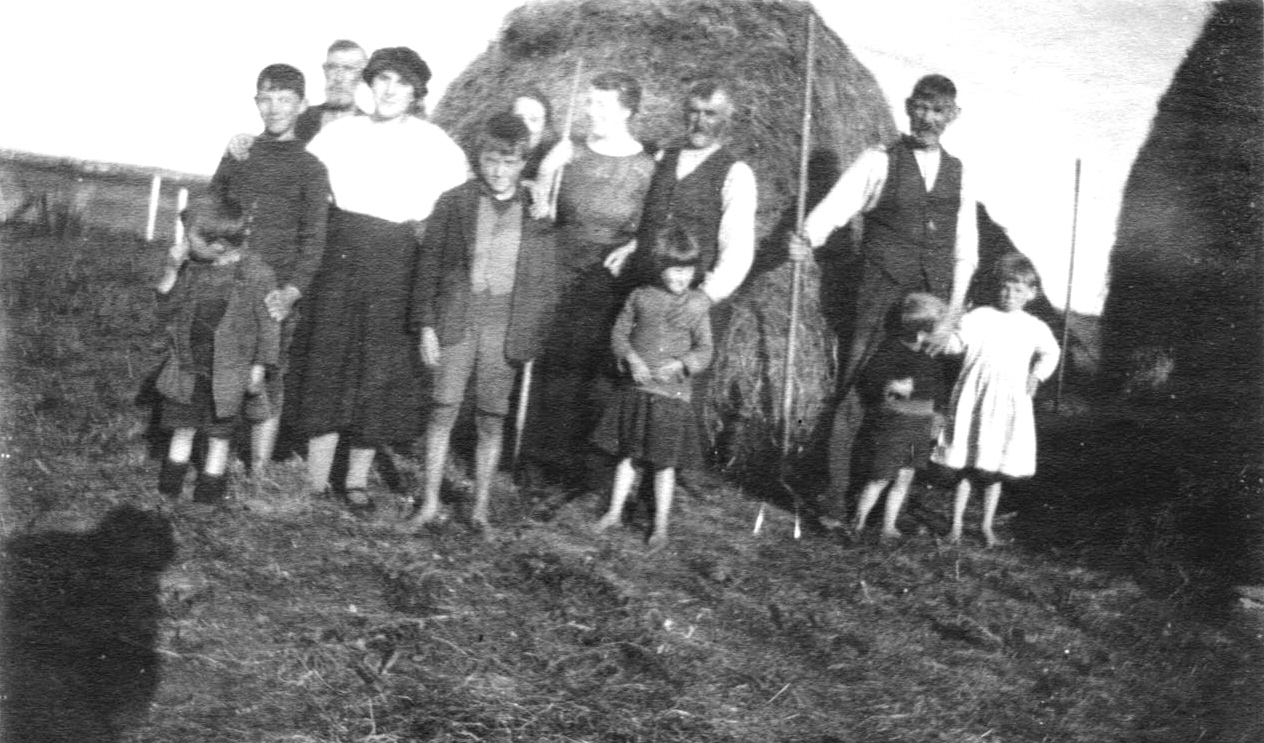
Black and white photograph of a crofting family in their stackyard.
A crofting family in their stackyard in the east end of Tiree in the beginning of the 20th century. Note the pitchforks for tossing the hay up to the top of the stack.