


Walrus bone seam presser.
Walrus bone carving (115 x 40 x 16 mm) with the letters `L B` on one side and `M. L.` on the other, found in a cave in Vaul by Donald Brown and given to Donald MacDonald, Heanish. Probably carved by a sailor.


Walrus bone seam presser.
Walrus bone carving (115 x 40 x 16 mm) with the letters `L B` on one side and `M. L.` on the other, found in a cave in Vaul by Donald Brown and given to Donald MacDonald, Heanish. Probably carved by a sailor.
Carved hardwood seam presser.
Carved hardwood seam presser (150 mm in length) with the letters `J M L`, found in the Neuk, Vaul by Donald Brown and given to Donald MacDonald, Heanish. Probably made by a sailor.

Large roughly-made unglazed grey clay craggan (205 x 220 mm) made on Tiree. Owned by Archie MacLean of Whitehouse, it was given to his neice who gave it to Reg and Meena Knapman for safe keeping until such time a suitable museum was set up in Tiree.
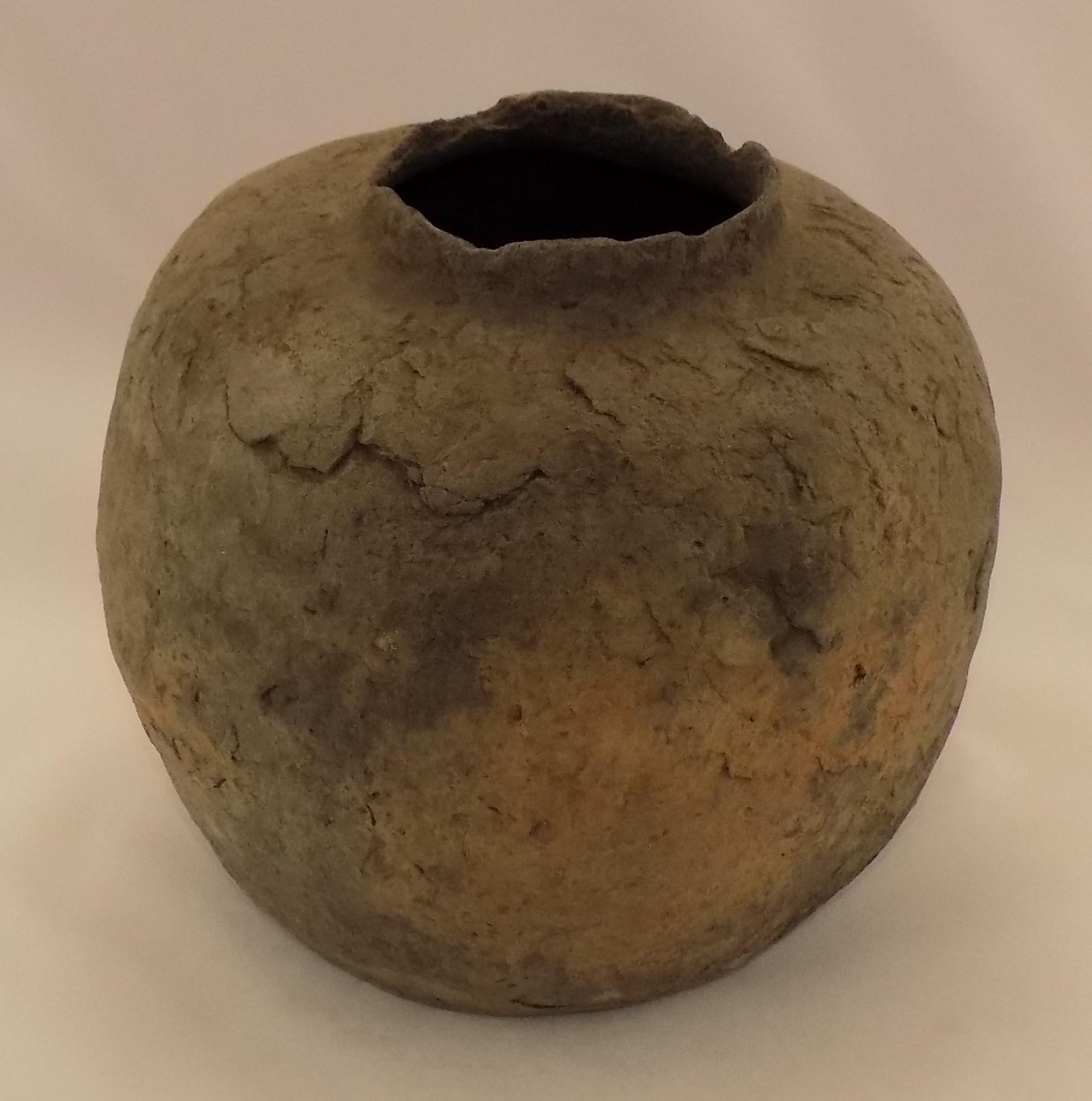
Small pottery roughly-made grey and orange unglazed bowl (70 x 110 mm) made on Tiree. Owned by Archie MacLean of Whitehouse, it was given to his neice who gave it to Reg and Meena Knapman for safe keeping until such time a suitable museum was set up in Tiree.

Small brown roughly-made pottery flagon / craggan (80 x 90 mm) made in Tiree, possibly made to administer milk to invalids. Owned by Archie MacLean of Whitehouse, it was given to his neice who gave it to Reg and Meena Knapman for safe keeping until such time a suitable museum was set up in Tiree.

Bell gun with firing mallet used as a humane killer for slaughtering cattle and sheep. Originally used by Tiree butcher, Donald Archie MacLean, to slaughter cattle and sheep, this humane killer was given to the vetinary on the island, Robert Beck, in the 1960s. Made of cast iron, the maker’s name, W. W. Greener of Birmingham, is embossed around the rim of bell. Once loaded with a single bullet, the bell was positioned on the front of the animal’s head and the gun fired by hitting the trigger (the protruding knob) with the wooden mallet. Although very efficient and humane, it required two hands to operate and another person to steady the animal’s head. Not considered safe enough for use indoors, humane killers with captive bolts are now used instead.

Tiree in 100 Objects – 39 – Bell Gun
The History of Tiree in 100 Objects
Picture of a woman in a crinoline dress made by an Italian POW in Tiree during WWII. Crafted from glass, black paint and coloured metallic paper, which was probably from cigarette packets.

Glass, black paint and coloured silver paper picture of a Dutch boy made an Italian POW on Tiree during WWII. The silver paper is probably from cigarette packets.

Eight Mesolithic flints
Photograph of eight Mesolithic flints.

Courtesy of Mr George Holleyman
These flints are almost certainly of Mesolithic age, that is, made by the hunter-gatherer groups who populated Scotland before the arrival of the first farmers in the 4th millennium BC. Microlithic (small stone) tools like this were used all over northern and western Europe at this time.
Measuring 27-55 millimetres in length, the six scrapers have been given a sharp, curved edge by pressure-flaking and were probably used to dress hides. The slim boring tool also has pressure-flaking along the long edges. The flint core has had several parallel-sided flakes, known as ‘blades’, struck off the flat area.
The flints were found in a sand-hill site at Balephuill in the early 1940s by George Holleyman, later a Fellow of the Society of Antiquaries of London, who was posted to RAF Tiree during World War II.
Wooden butter pat.
Wooden butter pat acquired by George Holleyman from Barrapol between 1941-3.
