


Black and white photograph of Malcolm Kennedy of Moss.
Malcolm Kennedy of Moss in naval uniform in the 1940s. He captained coasters around the Liverpool area.


Black and white photograph of Malcolm Kennedy of Moss.
Malcolm Kennedy of Moss in naval uniform in the 1940s. He captained coasters around the Liverpool area.
Black and white photograph of Donald Kennedy and his daughter-in-law April.
Donald Kennedy (Denny) and his daughter-in-law April on the croft at Heylipol in the early 1940s. April is pouring a shot of whiskey into the tea. The croft was the first one on the left going up the Heylipol road from the church.

Black and white photograph of Malcolm Kennedy of Moss.
Malcolm Kennedy of Moss with a scythe and sheepdog on the Heylipol croft in the late 1930s.

Black and white photograph of Donald Kennedy of Moss.
Donald Kennedy of Moss in the late 1930s. He settled in Australia then moved to New Zealand.

Black and white photograph of Donald Archie and Malcolm Kennedy of Moss.
Donald Archie Kenendy of Moss who was lost at sea in 1939 and his brother Malcolm whose ship was blown up in 1946. Donald Archie and Malcolm were brothers of Morag Kennedy, Evelyn O`Flynn`s mother.

Saddle quern found in Moss.
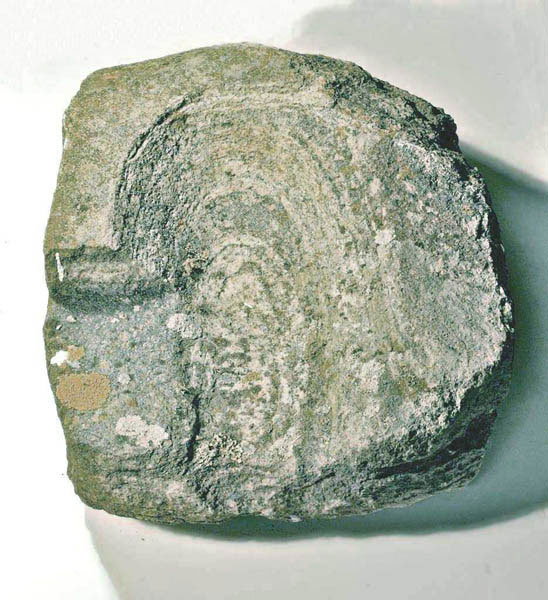
Courtesy of Catriona McLeod
Saddle querns are the most ancient and widely used type of quern-stone. This one was found in Moss in the mid-1980s and may date back to Neolithic times. It was used with a rubbing stone held in the hand, a process that crushed the grain rather than ground it.
Considered women’s work, preparing grain using a saddle quern would have taken many hours and placed great strain on the body, particularly the toes, knees, hips and lower back. They continued in use into the medieval period and were superseded by rotary querns.
Turnbull, in a report on Tiree written in 1768, wrote that meal was made ‘with querns or hand mills which appears to be an expensive and troublesome method. Two women at once, or sometimes three, are commonly employed. By this means there is so much of their time taken up that it greatly retards them from other industry.’
Photocopied extracts from the County of Argyll Fifth Annual Report by the Medical Officer of Health Dr Roger MacNeill, pp 26-27.
Report by Dr Buchanan about an outbreak of scarlet fever spread through the schools.

Photocopied extracts from the County of Argyll Twenty-fifth Annual Report by the Medical Officer of Health Dr Roger MacNeill, pp 50-51.
Report (incomplete) by Dr Dan MacKinnon regarding the lack of shelter, poor soil drainage and the sanitation and water supply.

Black and white postcard of a painting of Moss.
Postcard painting of Moss around 1900 with Heylipol Church in the distance. The figure is possibly the grandmother of Johann MacKinnon nee Brownlie of Barrapol. Houses L-R: Allt Mor, Catriona Rowan`s grandmother`s house; Alex MacPhail`s house; Johann MacKinnon`s grandparents` house.

Newsletter `An Tirisdeach`, No. 49, 28/10/1992.
Local news including the extra turn-around time required by the ferry unload hay lorries, fluoridation of the water supply, the opening of the Sandaig museum and an article about gardening in Moss.