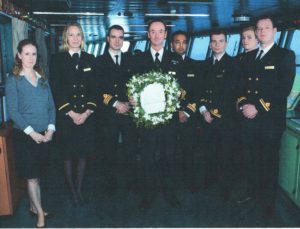
Colour photograph of a wreath commemorating the wrecking of the destroyer HMS Sturdy during WWII. It is being held by the captain of the Queen Mary cruise ship.
Organised by Commander Michael Gibson of Plymouth, the wreath was thrown overboard in the summer of 2015 as the Queen Mary cruised past the Hebrides. HMS Sturdy foundered on rocks at Sandaig during a storm in October 1940. Five lives were lost, but were it not for the actions of Tiree folk, in particular Captain Donald Sinclair, the toll would have been much higher. The dedication on the wreath reads: “Dedicated to the bravery of Captain Donald Sinclair and those who helped in the rescue effort of HMS Sturdy and in remembrance of all those lost on Empire Eland in 1941”. Captain Sinclair was on the Empire Eland when it was torpedoed by a U-boat in the Atlantic.
Colour photograph of the captain and crew of the Queen Mary cruise ship with a wreath commemorating the wrecking of the destroyer HMS Sturdy on rocks at Sandaig during WWII.
Organised by Commander Michael Gibson of Plymouth, the wreath was thrown overboard in the summer of 2015 as the Queen Mary cruised past the Hebrides. HMS Sturdy foundered during a storm in October 1940. Five lives were lost, but were it not for the actions of Tiree folk, in particular Captain Donald Sinclair, the toll would have been much higher. The dedication on the wreath reads: “Dedicated to the bravery of Captain Donald Sinclair and those who helped in the rescue effort of HMS Sturdy and in remembrance of all those lost on Empire Eland in 1941”. Captain Sinclair was on the Empire Eland when it was torpedoed by a U-boat in the Atlantic.
Printed information about the family of Bata Am Marsanta from the censuses of 1851-1901. Bata Am Marsanta was one of the boats belonging to Archibald MacKinnon ‘Am Marsanta Ban’ (1796-1880) caught up in the Balephuil fishing disaster of 1856.
Extract from book The Tiree Bards / Na Baird Tirisdeach about the Balephuil fishing disaster of 1856. One boat belonged to Donald MacLean of Cheann-na-Creige at the south end of Traigh Bhi, Balephuil, where The Studio now stands. Plus some information about Ceit Chalein (Katie Dubh) of Am Bail’ Ur who helped Donald MacLean while his house was being built.
Article from The Times newspaper, 1868, about the wrecking of the coal schooner ‘Maria and Fanny’ off Kenavara during a gale in 1868, the loss of its captain and one member of the crew, and the rescue of the surviving three crew by Captain Archibald Brown, Mannal, in a boat rowed from Balephuil.
Large framed certificate from The Royal Humane Society, London, in 1869, belonging to Captain Archibald Brown, Mannal, for his actions and those of his crew in the rescue of the the surviving crew of a stricken schooner off Kenavara in Balephuil Bay in 1868. The vessel was the ‘Maria and Fanny’ of Milford, Wales, which was on its way between Ayr and Limerick with a load of coal. It was blown off course by a gale north of Ireland. The rescue was carried out at great risk to the captain and his crew. Captain Archibald and his crew were awarded medals of the Society.
Section of brass plumbing from the wreck of the schooner ‘Oceana’, which grounded on Crossapol beach in 1949. Found by Charlie Berlie on Crossapol beach.
Local news: retirement of PC Danny Lapsley; interview with George Campbell; HMS Sturdy memorial; Farmhouse Café opens in Balemartine; Labour spin-doctor Alastair Campbell; cattle sale results; `Danny`s Song`.
Three caulking irons and a sail pricker from the schooner the Mary Stewart: large and small `making` irons, a `hardening` iron (with groove), and a sailmaker`s pricker for making holes in sail canvas. Caulking irons (caladh in Gaelic) came in sets of five and were used to force oakum into spaces between timbers to form a water-tight seal.