Tag Archives: middleton

1999.284.1

Audio cassette recording of Donald MacArthur, Middleton talking to Maggie Campbell in December 1999.

Donald MacArthur of Middleton talks to Maggie Campbell in December 1999 about crofting today compared to how it was when he started, how the wetter weather, subsidies for late cutting and fewer people working the land have contributed to the change from hay-making to silage, about using fertilisers rather than seaweed, keeping cattle outside because of SEPA rules, the changes in cattle transportation and the paperwork involved, changing prices, the effects of BSE, a strong pound and subsidies; he gives his thoughts about the future of crofting in Tiree, diversification, the need for community spirit and religious faith.

1998.276.1

Audio cassette recording of Hector MacPhail talking at the Scarinish Hotel in January 1998.

Hector MacPhail of Ruaig talks at the Scarinish Hotel on 31st January 1998 about emigration to Canada, New Zealand and Patagonia, the Duke of Argyll’s factors, the MacNiven family, cattle droves, smacks and schooners, the shops at Middleton and Hynish, three Tiree men who emigrated to Seattle, ancient graveyards, a school trip to Dundee, Captain Donald MacKinnon of the Taeping, the Downie family, emigration history at Inverary Archives, CalMac boats, the storms in 1953 and 1968, the emigrations of 1855 and 1877. (Continued on AC43)

2000.84.1

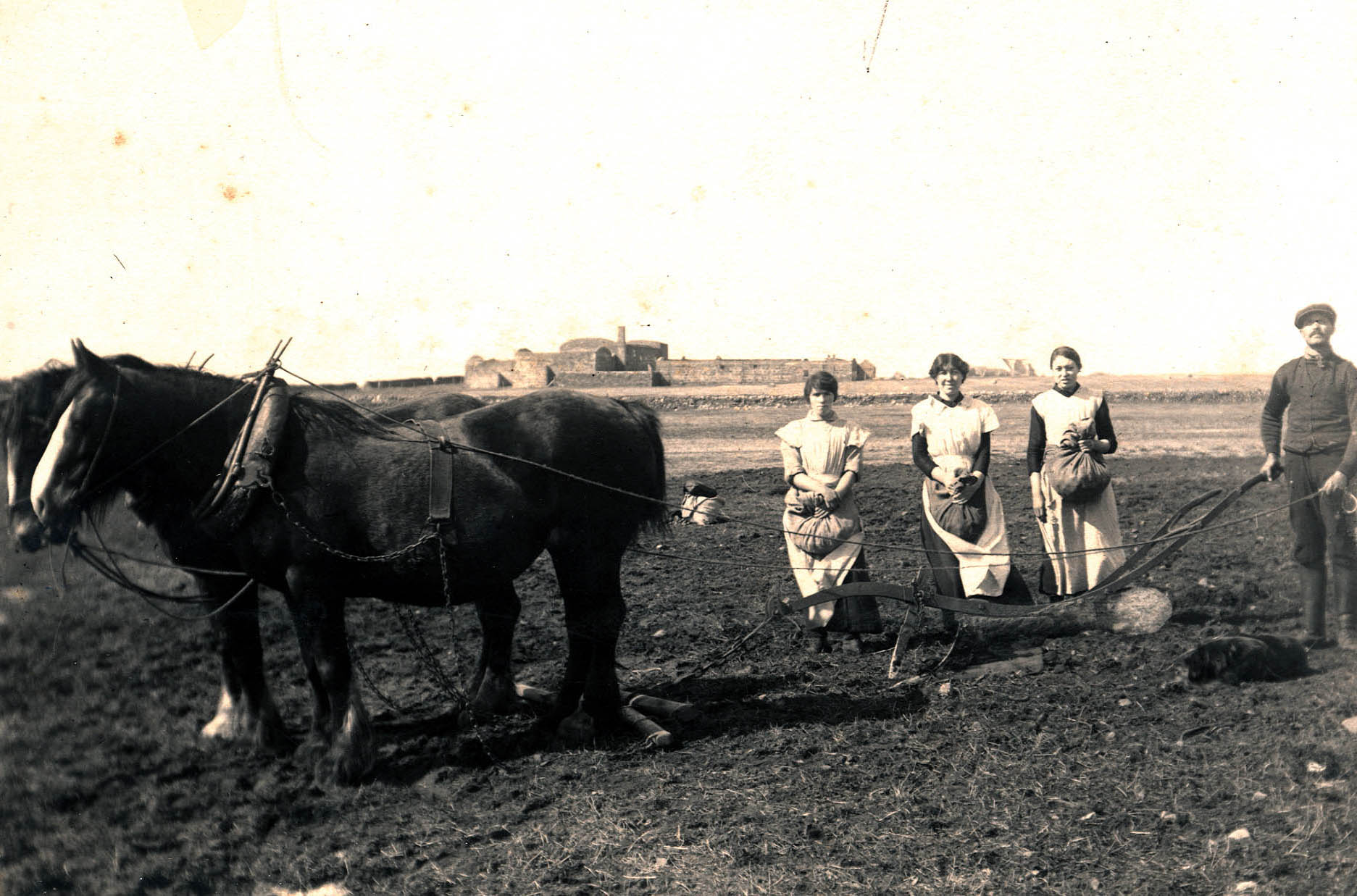
Planting potatoes at Middleton in the 1920s

Photograph of Alasdair MacDonald planting potatoes with Lizzie MacArthur, Effie and Mary Ann MacDonald at Middleton in the 1920s.

k48.jpg

Courtesy of Mr Lachie MacDonald

Taken in the 1920s, the photograph illustrates a standard plough used to prepare the ground for sowing corn. Because of the fine sandy soil in most of Tiree, a ridger was not successful.

The women followed in the furrow planting potatoes from the supplies heaped in their sack aprons and the ploughman made a second furrow to cover them. This process was repeated leaving a 45 cm space between the planted furrows for the grubber.

The Middleton seaweed factory operated by the North British Chemical Company can be seen in the background. Known locally as the Glassary, it ceased operation in 1901 and was demolished during World War II.

Black and white photograph of Alasdair MacDonald planting potatoes at Middleton in the 1920s.

Planting potatoes at Middleton, with the Glessary (as it was known) in the backgound in the 1920s. L-R: Lizzie MacArthur, Middleton and Greenhill – aunt of John MacArthur, Middleton Farm; Effie MacDonald, married to the late Archie Walker, Coll and Kenovaay, Tiree – aunt of Lachie MacDonald , Middleton; Mary Ann MacDonald – aunt of Lachie MacDonald, Middleton; Alasdair MacDonald – father of Lachie MacDonald, Middleton. The photograph illustrates a standard plough used to prepare the ground for sowing corn. Because of the fine sandy soils in most of Tiree, a ridger was not successful. Instead, the standard plough was used and the women followed in the furrow with supplies of potatoes heaped in their sack aprons. The ploughman made a second furrow to cover the potatoes. The same process was repeated thus leaving an 18 inch (45cm) space between planted furrows to allow the grubber to be used.

2000.84.2

Black and white photograph of the crew of the Letitia, Glasgow, 1917.

The crew of the `Letitia` of Glasgow in 1916-17. Back row: (2nd left) Charlie MacDonald, Ruaig – uncle to Mary Flora MacKinnon, Balephetrish and Margaret MacInnis, Ruaig; (3rd left) John MacArthur – father of John MacArthur, Middleton Farm; (2nd right) Alasdair MacDonald – father to Lachie MacDonald, Middleton; (1st right) John MacKinnon, Balephetrish – uncle to John MacKinnon (Iain Aonghais), Kilmoluaig. The ship ran aground at Halifax NS on 1.8.1917 and was abandoned on 4.8.1917.

k49.jpg

2000.84.3

The crew of the ‘Baron Polwarth’

Photograph of the crew of the ‘Baron Polwarth’ in 1916.

k50.jpg

Courtesy of Mr Lachie MacDonald

The ‘Baron Polwarth’ was a tramp steamer that plied its trade around the British coasts and European ports. Owned by the tramp ship company Hugh Hogarth & Sons, which later became the Baron Line, the ships were recognisable by their buff and black funnels.

The owners had a reputation for being overly economical when feeding their crews. As a result, the line was nicknamed the ‘Hungry Hogarths’. The crew of the ‘Baron Polwarth’ included several sailors from Tiree.

One of them, Dougall Lamont, son of Archie Lamont of Cornaigmore, died as a result of an accident on board in January 1916. His remains were brought home to Tiree and interred in Kirkapol cemetery. His fellow crew members clubbed together and bought a marble book which was placed on his grave.

Black and white photograph of the crew of the `Baron Polwarth`, Ardrossan in 1916.

Crew of the Baron Polwarth, Ardrossan, 1916. L-R: (back row) Charlie MacDonald, Ruaig, uncle to Mary Flora MacKinnon, Balephetrish and Margaret MacInnes, Ruaig; John MacKinnon, Balephetrish, uncle to Ian MacKinnon (Iain Aonghais), ‘Lochview’, Kilmoluaig; Charles MacDonald, uncle to Lachie MacDonald, Middleton; John MacArthur, father of John MacArthur, Middleton Farm; (middle row) Hugh Cameron; Walter MacDonald, Moss, uncle to Johann MacKinnon, Barrapol and Neil Brownlie; unknown; (front row) possibly Walter Mackinnon, Greenhill; unknown.