


Three ears of four-row barley.
Three ears of four-row barley grown by Willie MacPhail, Clachan, from seed originally from Uist and harvested in September 2002.

Three ears of four-row barley.
Three ears of four-row barley grown by Willie MacPhail, Clachan, from seed originally from Uist and harvested in September 2002.
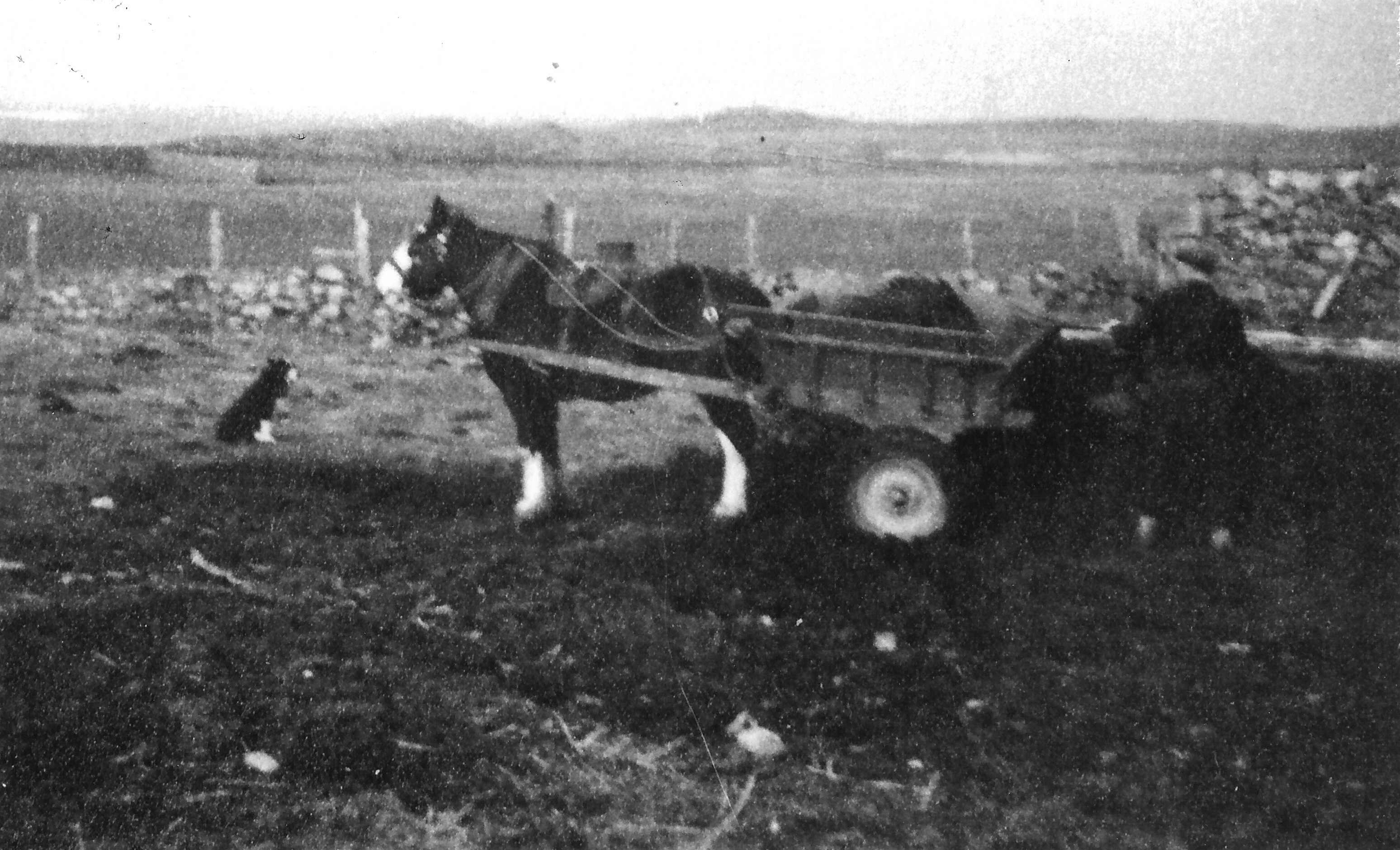
Black and white photograph of a crofter with a horse and cart.
Unknown crofter with a horse and cart in a field, taken during World War II. (Photograph from Mike Hughes in Filing Cabinet 2 drawer 1)
Black and white photograph of Mrs Kennedy, Balevullin.
Mrs Kennedy of Balevullin making a haycock, photographed by George Holleyman.

The Whitehouse MacLeans with a horse-drawn reaper in around 1920.
Photograph of the MacLean family from Whitehouse with a horse-drawn reaper.

Courtesy of Mr Angus MacLean
The MacLean family from Whitehouse, Cornaigbeg are pictured cutting corn with a horse-drawn reaper. This was a tremendous advance on the sickle and scythe. Use of the scythe needed strength and skill and one man could cut only a quarter acre in a day.
Two men sat on the reaper, one to guide the horses which walked beside the standing corn while the other tilted the reaper’s platform when enough corn for a sheaf had gathered. He then pushed it off with an angled rake. The sheaves were tied by people following behind the reaper.
Binders pulled by three horses replaced the reaper. Mechanically operated implements drawn by tractors eventually took over after World War II.
Black and white photograph of cutting corn at Whitehouse.
Cutting corn by reaper at Whitehouse, Cornaig. L-R: Donald MacLean (Big Donald), Charles MacLean (Curly), Tom MacLean, Hector MacLean (Curly’s father), Donald MacLean (father of Tom and Big Donald), unknown, Murdoch MacLean (Curly’s brother).
Cutting corn by a reaper was a tremendous step forward from the sickle and scythe. Sickle work was done mainly by women. Four or five would work together cutting handfuls of corn at a time which were then tied together by the men. The scythe had a blade approx. 2.5 ft long (85 cm) and was handled by the men. A man could cut fully a quarter acre in a day.
The reaper was powered by horses. A cross-member board 4 ins by 2 ins (10 cm x 5 cm) and 4.5 ft long (137 cm) was bolted to the cutting blade of the reaper by hinges, allowing it to operate up and down. Ten strips of wood 4 ins by 1 in (10 cm x 2.5 cm) and 2.5 ft long (75 cm) were placed at 4 inch (10 cm) intervals at right angles to the cross-member. A pedal which was attached to the cross-member was pressed down by the worker’s right foot. This allowed the corn to gather on the platform. He then released the pedal and the platform tilted to the ground. The corn was finally pushed off with the tilting rake. Enough corn to make a whole sheaf then lay on the ground in readiness for the people following behind to tie it. Note the central figure, Hector MacLean, has a tilting rake specially designed to remove corn from the platform.
Binders pulled by 3 horses replaced the reaper. Mechanically operated implements drawn by tractors eventually took over.
Corn stooks at Ruaig
Postcard of corn stooks at Ruaig in the mid-20th century.

This postcard shows a field of corn stooks at Ruaig in the mid-20th century. The corn was cut and bound into a ‘sguab’ (sheaf) using two handfuls pulled from the sheaf to make a ‘bann’ (tie). These were lined up into an ‘adag’, a short double row of eight to ten sheaves.
The old men were very particular to line up the row of ‘adagan’ in the field so that you could see ‘gobhal na h-adaig’ (the gap between the sheaves) from one end of the field to the other. If cut slightly unripe because of the weather, the sheaves were turned every day until they ripened.
Harvesting was hard, thirsty work and a tin of ‘sùgh min-choirce’ (cold well water mixed with oatmeal) was kept in the shade of an ‘adag’ to provide a refreshing drink.
Black and white postcard of Ruaig.
Ruaig with corn sheaves in the foreground and L-R Taigh Eoghainn Iain na Hongs (Ruaig Post Office in the 1930s) and Taigh Dhonnchaidh or Alasdair Dhonnchaidh (Ruaig Post Office in the 1970s).
Lifting potatoes at Ruaig
Postcard of the potato harvest at Ruaig in the mid-1920s.

Courtesy of Mr Angus MacLean
Potatoes were first grown in the Hebrides in 1743 when they were brought back to South Uist from Ireland by MacDonald of Clanranald. His tenants were unwilling to plant them and brought the crop to his house as they refused to eat them.
However, by 1800 potatoes had become the main food crop in the islands, including Tiree. They produce three to five times as many calories as grain from the same area of land. Potatoes are also a much more dependable crop than oats and barley, which can be flattened overnight by a storm.
Dependable, that is, until 1846, when the fungus causing potato blight caused widespread starvation in Europe. It is said that West Hynish was the only area of Tiree to be unaffected. This postcard shows Nancy and Alexander MacInnes in the foreground harvesting potatoes in Ruaig in the mid-1920s.
Black and white photograph of potato lifting at Ruaig.
Lifting potatoes at Ruaig, c. 1925-6, with Nancy and Alexander MacInnes in the foreground (Duncan MacInnes`s aunt and great-uncle).
Newspaper article about Donald MacIntyre, Gott, and his Clydesdale horses, dated 1978.
A Clydesdale mare bred by Donald MacIntyre, Gott, won fourth prize at the Royal Highland Show. Also paragraphs about the school dux, new houses, crofting news, the banker, Tiree Cubs, the new GP and school attendance.
Photocopied extract from the Scottish Geographical Magazine `The Island of Tiree` by James R Coull.
Overview of Tiree covering the physical environment, the development of agriculture, kelp making and fishing, population, crofting as typified by the townships of Ruaig and Salum, communications and services.
Photocopied extract from `Outer Isles` by Ada Goodrich Freer, pp 1-61.
Account of a visit to Tiree in 1894.
Hardback book `The Northern and Western Islands of Scotland` by Frances J Shaw.
An investigation into the economy of the Scottish islands in the 17th century.