


Poster `Obair a` Bhainne`.
Poster about dairying illustrated with black and white drawings of hand implements.

Poster `Obair a` Bhainne`.
Poster about dairying illustrated with black and white drawings of hand implements.
Account by George Holleyman of his life on Tiree 1941-43.
Account by amateur archaeologist George Holleyman of his time in the RAF Service Police on Tiree from September 1941 to June 1943
Account by George Holleyman of his time in the RAF on Tiree 1941-1943.
Account by George Holleymen, an amateur archaeologist, of his time in RAF Tiree as a Service Policeman. Two more copies added in 2011 (E01206).
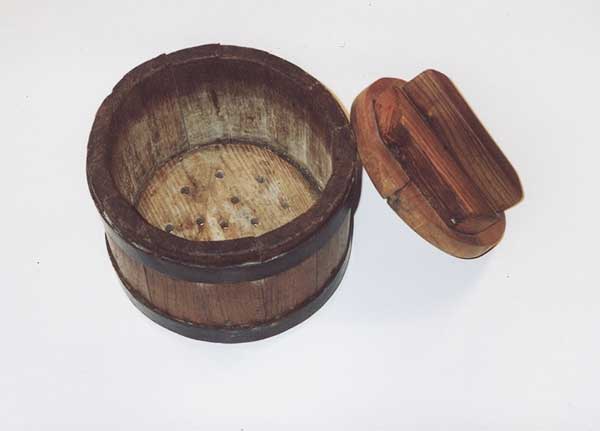
Cheese press or fiodhan.
Courtesy of Mrs Meena Knapman
Probably made at the end of the 19th century by Donald MacLean of Whitehouse, Cornaigbeg, this wooden vat (known in Gaelic as a ‘fiodhan’) would have been used until the 1950s to make cheese.
Standing 165 mm high and with a diameter of 250 mm, the staves are bound with two iron hoops. Holes have been drilled in the sides and base to allow the whey to drain out.
The curds wrapped in muslin would be put in the vat and the lid placed on top. This would be weighted with stones or screwed down in a cheese press for about a week.
Isabella MacLean of Kilmoluaig using a cheese press
Photograph of Isabella MacLean of Kilmoluaig using a cheese press.

Courtesy of Ms Linda Gowans
Isabella MacLean was photographed using a cheese press in Kilmoluaig by George Holleyman, an archaeologist posted to RAF Tiree during World War II. The press was made in the local smiddy. The screw, which turns through an iron hoop set into a large stone, tightens on to the wooden cheese vat, removing excess whey.
Rennet was used to curdle the warmed milk and sometimes salt was added or caraway seeds. The curds were squeezed by hand, wrapped in muslin, put in the cheese vat and pressed. The whey would be fed to calves.
After two to three days, the press would be screwed down another turn. The cheese would be left there for a week then put on a shelf to dry and form a skin. It would be ready for eating in a fortnight.
Black and white photograph of Isabella MacLean, Kilmoluaig.
Isabella MacLean is pictured here using a cheese press made in the local smiddy. The screw, which turns through an iron hoop set into a large stone, tightens on to the wooden cheese vat, removing excess liquid. Rennet was used to curdle the warmed milk and sometimes salt was added, or caraway seeds. The curds were squeezed by hand, wrapped in muslin, put in the cheese vat and pressed. The whey would be fed to calves. After 2-3 days, the press would be screwed down another turn. The cheese would be left there for a week then put on a shelf to dry and form a skin. It would be ready for eating in a fortnight. The cheese press is part of An Iodhlann`s collection.