


Cannonball.
Iron cannonball found on the south end of Traigh Bhi.


Cannonball.
Iron cannonball found on the south end of Traigh Bhi.
Piece of Tiree marble found on Traigh Bhi.
Piece of Tiree marble (80 x 70 x 40) found on Traigh Bhi.
Photocopied extracts from the County of Argyll Third Annual Report by the Medical Officer of Health Dr Roger MacNeill, pp 32-35, 82-83,92-99.
Description of the housing in Tiree, an outbreak of measles,typhoid fever and one case of smallpox as reported by Dr Buchanan.
Photocopied extracts from the County of Argyll Twenty-fifth Annual Report by the Medical Officer of Health Dr Roger MacNeill, pp 50-51.
Report (incomplete) by Dr Dan MacKinnon regarding the lack of shelter, poor soil drainage and the sanitation and water supply.

Eight Mesolithic flints
Photograph of eight Mesolithic flints.

Courtesy of Mr George Holleyman
These flints are almost certainly of Mesolithic age, that is, made by the hunter-gatherer groups who populated Scotland before the arrival of the first farmers in the 4th millennium BC. Microlithic (small stone) tools like this were used all over northern and western Europe at this time.
Measuring 27-55 millimetres in length, the six scrapers have been given a sharp, curved edge by pressure-flaking and were probably used to dress hides. The slim boring tool also has pressure-flaking along the long edges. The flint core has had several parallel-sided flakes, known as ‘blades’, struck off the flat area.
The flints were found in a sand-hill site at Balephuill in the early 1940s by George Holleyman, later a Fellow of the Society of Antiquaries of London, who was posted to RAF Tiree during World War II.
Colour photograph of sheep-dippers at Balephuil in 1988.
Taking a break from sheep-dipping at Balephuil in 1988. L-R: Hector Kennedy, Neil MacDonald, Hector Brown, Hannah Williams and David MacClounnan.

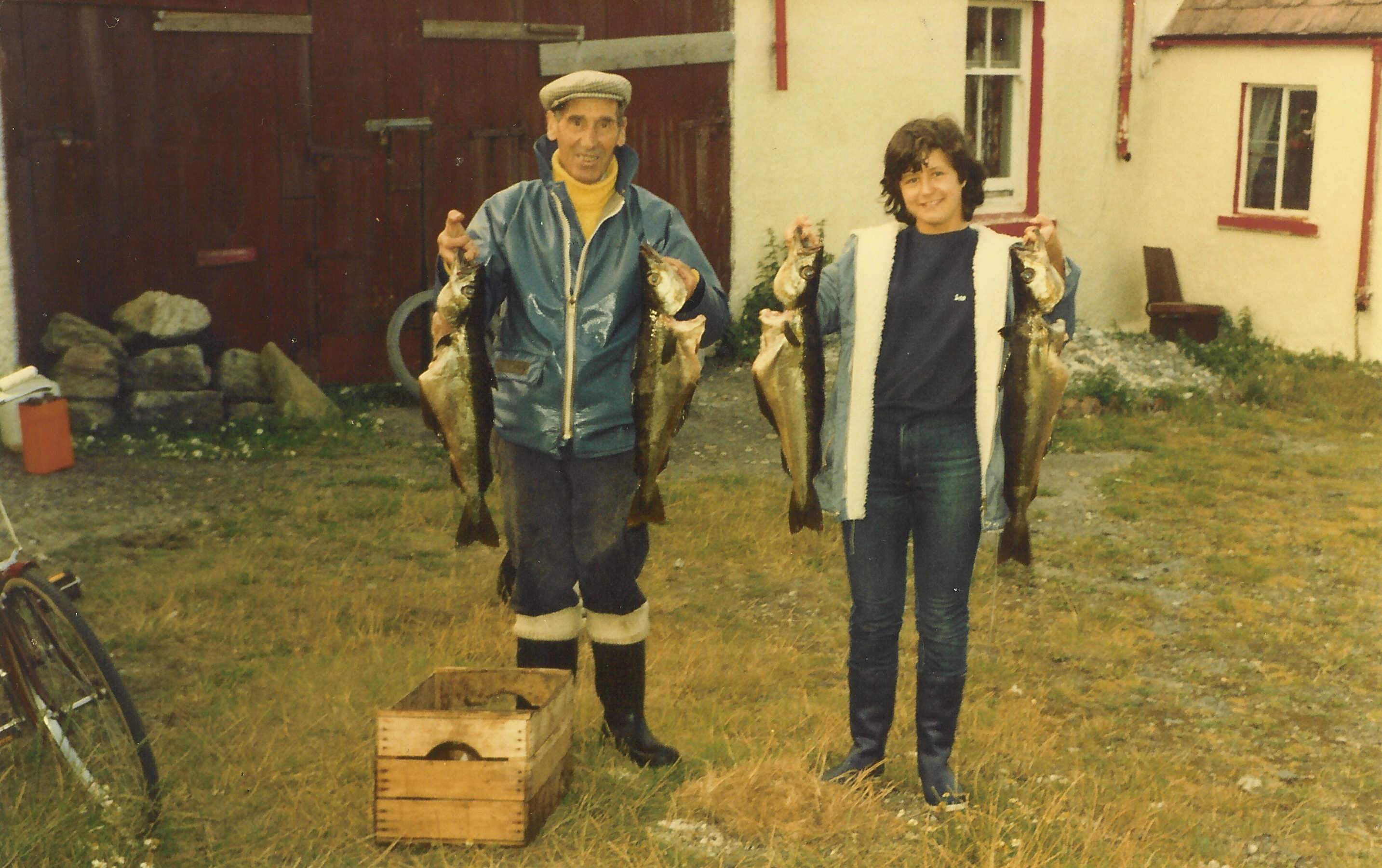
David MacClounnan and Alison MacKay with a catch of lythe
Photograph of David MacClounnan and Alison MacKay in Balephuil with a catch of lythe in 1983.
Courtesy of Mrs Nan MacClounnan
David MacClounnan and Alison MacKay are pictured here with a catch of lythe (pollack) in Bail’ Ur, Balephuil in August 1983. As lythe feed on sand eels, Tiree fishermen would bait their hooks with rubber eels bought from the local shop or sometimes made from the covering of electrical wires.
Lythe were fished from rocks or from a boat, often very successfully. Fish were preserved for the winter by steeping them in brine then packing them in barrels or pails with coarse salt. Larger fish like cod, lythe and ling were split in two.
Once salted, the fish were hung by the tails on a line outside or in the byre to dry. Others were hung in the chimney and were smoked as well.
Colour photograph of David MacClounnan and Alison MacKay in 1983.
David MacClounnan and Alison MacKay in Bail` Ur with a catch of lythe (pollack) in August 1983.
Colour photograph of Duncan and Neil MacKinnon and David MacClounnan in 1991.
Twins Duncan and Neil MacKinnon and David MacClounnan, all from Balephuil, collecting tangles in West Hynish in February 1991.

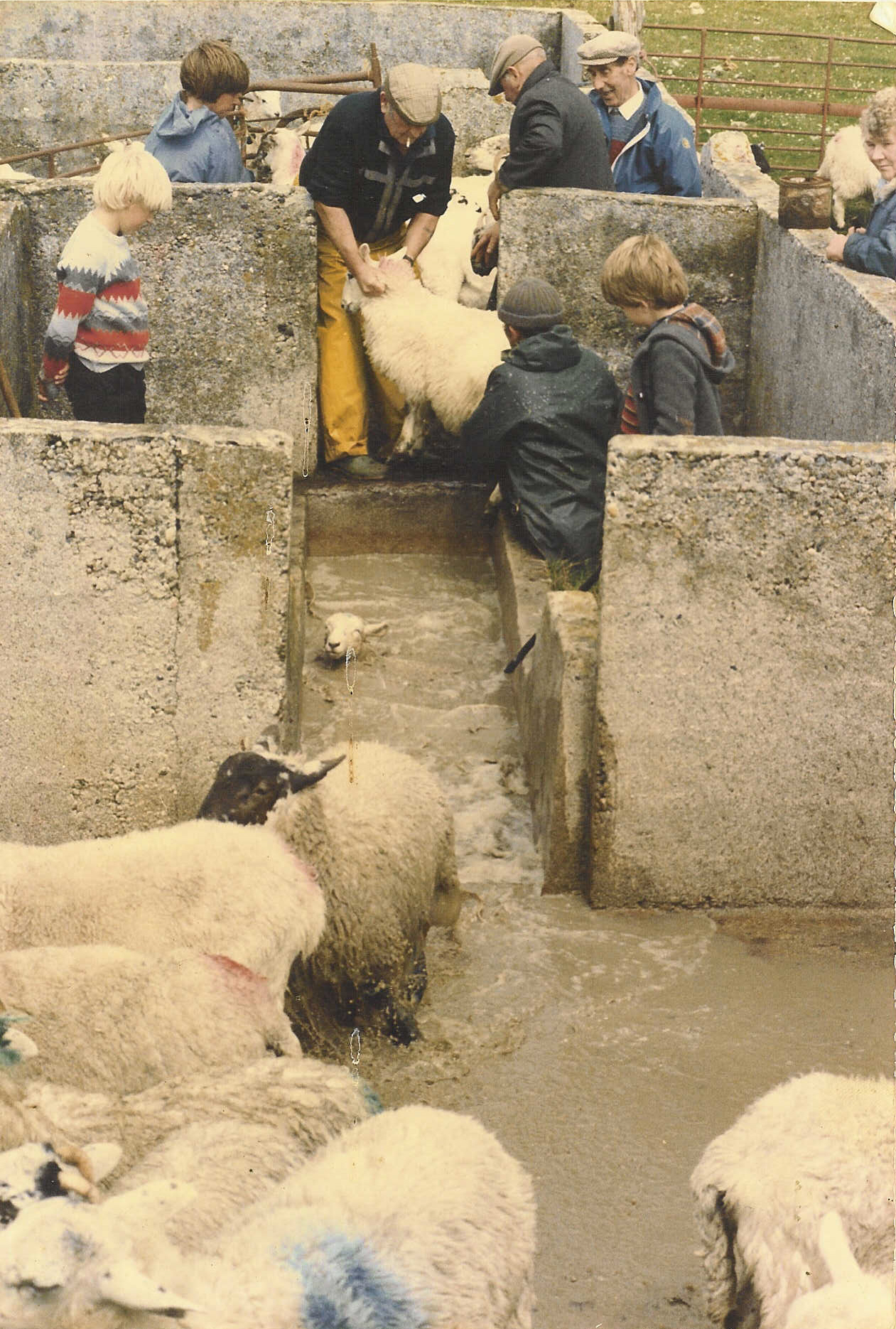
Dipping sheep at Balephuil in 1987
Photograph of sheep-dipping at Balephuil in 1987.
Courtesy of Mrs Nan MacClounnan
This photograph shows sheep being put through a dip-bath at Balephuil in 1987. Twice-yearly dipping was compulsory up to 1989 in an effort to eradicate scab, a disease caused by a parasitic mite that can result in severe loss of condition and death, especially of lambs. Dipping also treated other parasites such as blowfly maggots and ticks.
The majority of dips contain organophosphates (OP) which were originally developed as chemical warfare agents. The effects of exposure can include headache, exhaustion, blurred vision, muscle twitching and confusion. People subsequently handling sheep can also be at risk.
As well as being hazardous to health, sheep dips are harmful to wildlife and the environment, and their disposal is problematical. Nowadays most crofters on Tiree use non-OP pour-on treatments to control parasites on their sheep.
Colour photograph of sheep-dipping in Balephuil in 1987.
Sheep-dipping in Balephuil in August 1987. L-R: (front) Etty MacDonald, unknown, unknown, (back) unknown, John MacPhail, John Brown, David MacClounnan.
The baptism of Christine MacDonald at Balephuil in the 1960s
Photograph of the baptism of Christine MacDonald at Balephuil in the 1960s

Courtesy of Mr Donald MacKinnon
The Reverend Cowie is pictured here around 1963 baptising Christine MacDonald in Abhainn Bhì, attended by lay preacher, Lachlan MacKinnon. The stream, named after a Columban saint Mo Bhì, has long been associated with Christianity.
For over a hundred years until the 1940s, the Baptist Church was very influential in Tiree and its buildings frequently filled to capacity. In 1874 its membership peaked at a hundred and sixty. By the late 1980s it had fallen to under ten; today there are around a dozen.
There are two small Baptist churches on the island at Balemartine and Baugh. Only the Balemartine one is still in use and Sunday services attract over thirty worshippers.
Black and white photograph of a baptism at Balephuil.
Baptist minister Rev Cowie baptising Teen MacDonald in the burn at Balephuill, with Lachie MacKinnon, Parkhouse in attendance, around 1963-4.