


Black and white photograph of the new road to Silversands, Vaul.
Photograph from a small album from Silversands, Vaul, titled `The new road to Silversands`, probably taken in the late 1920s to early 1930s.


Black and white photograph of the new road to Silversands, Vaul.
Photograph from a small album from Silversands, Vaul, titled `The new road to Silversands`, probably taken in the late 1920s to early 1930s.
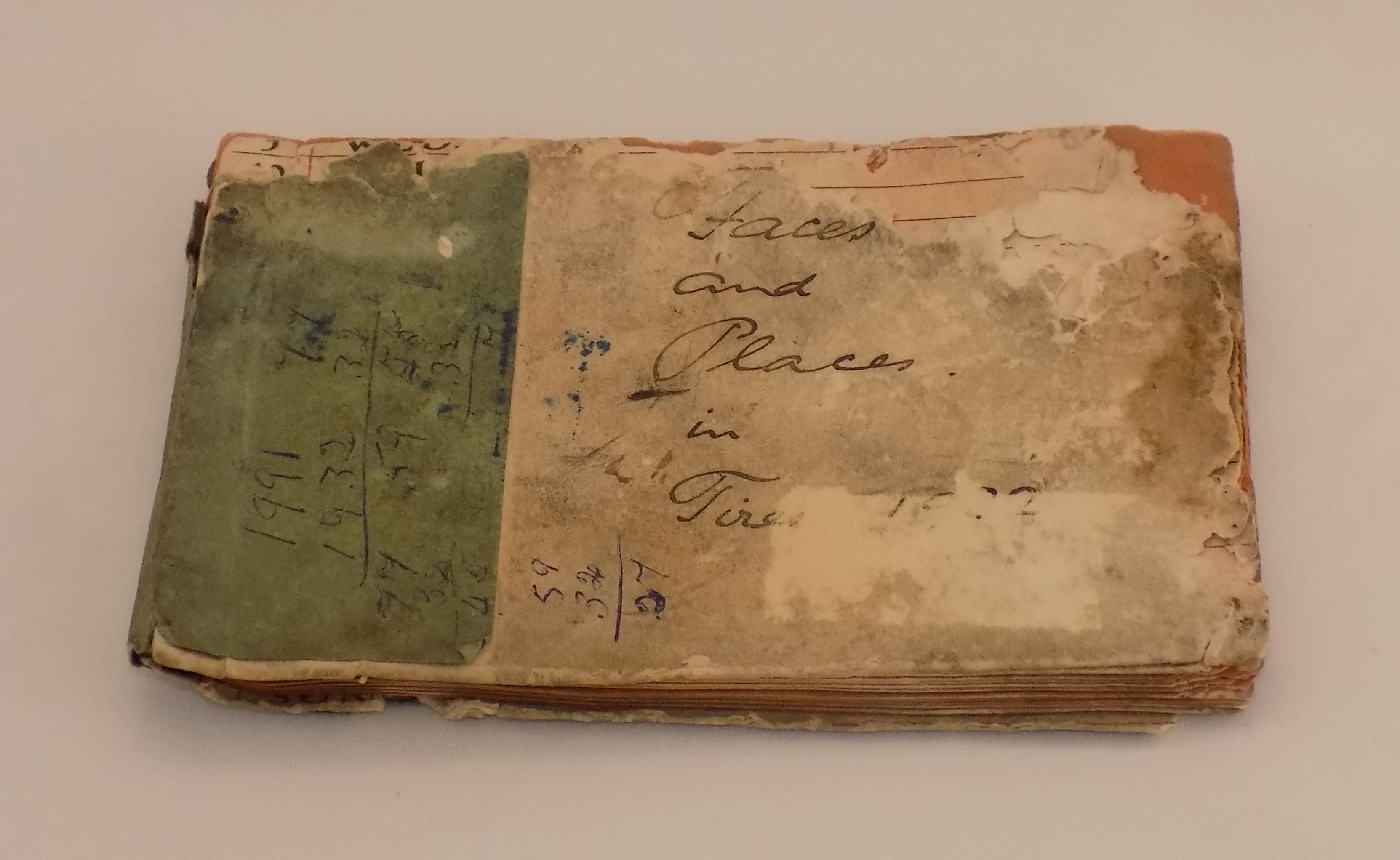
Small photo album titled `Places and Faces in Tiree 1932`.
Small photograph album titled `Places and Faces in Tiree 1932` said to come from Silversands and containing 17 black and white photographs with captions.
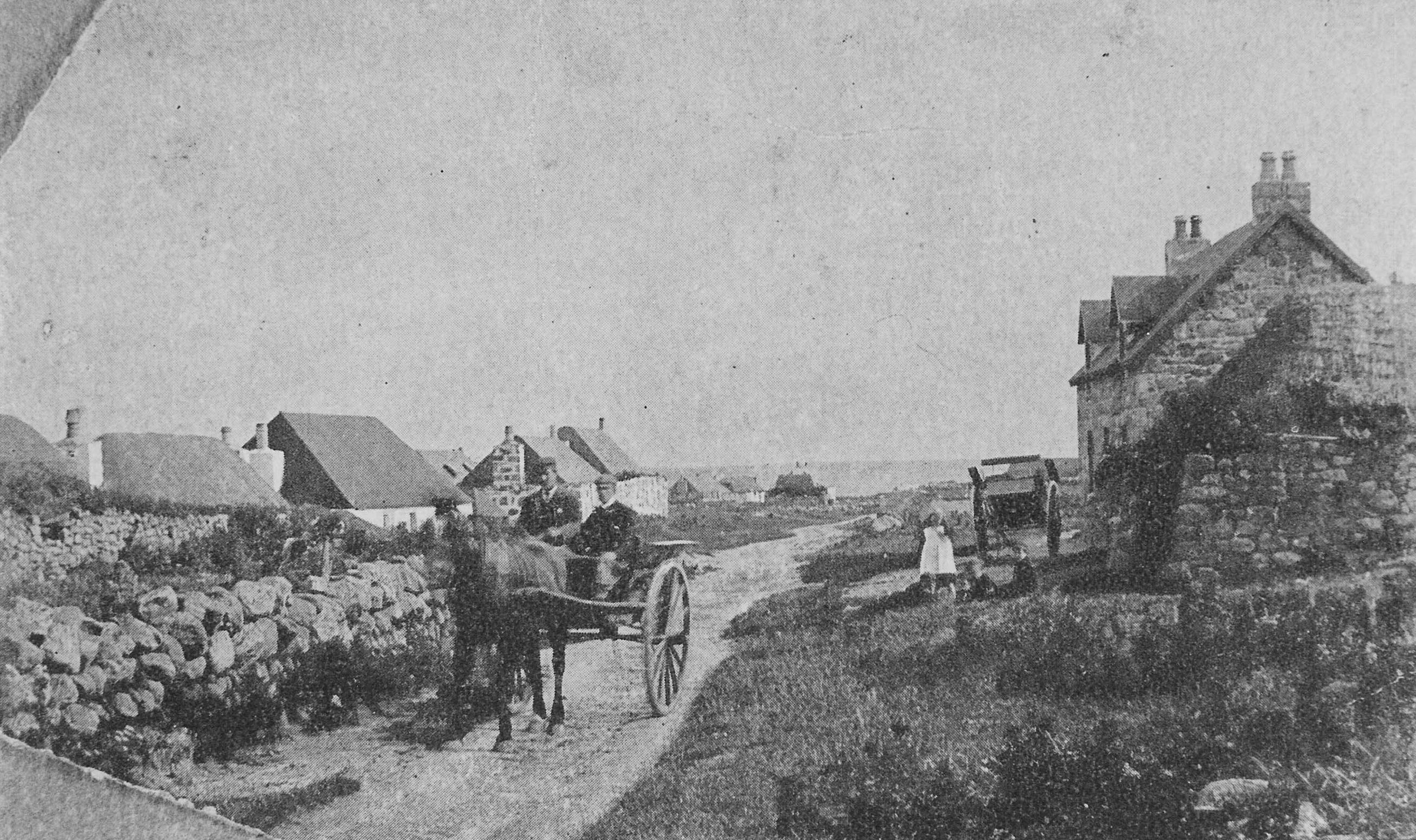
Black and white photograph of Mannal.
View of Mannal looking south with two men in a horse-drawn cart and children playing at the side of the road. (Original photograph 1997.178.1)
Outside the general store in Scarinish in 1910
Photograph of Calum MacLean, Hugh MacArthur and Peter Anderson outside the general store in Scarinish in 1910.

Courtesy of Mr Angus MacLean
Calum MacLean, Hugh MacArthur and Peter Anderson are pictured in 1910 outside the shop in Scarinish owned and run by Hugh and his brother Dan. As well as a general store, the building contained a Post Office and a hardware department upstairs
Calum MacLean (Calum Bùidsear) from Moss opened a butcher’s shop in Scarinish in 1930s on a site previously housing a baker and cobbler. The business was taken over by Donald and Nan MacLean in 1953.
Peter Anderson came to Tiree in 1886 as the island’s first gamekeeper. A keen ornithologist, he published ‘The Birds of the Island of Tiree’ in ‘The Scottish Naturalist’ in 1913
Black and white photograph of Scarinish shop in 1910.
Scarinish shop, 1910. L-R: Calum MacLean (butcher in Scarinish), Hugh MacArthur (partner in shop), Peter Anderson (gamekeeper). (Original photograph 1997.178.1)
Black and white photograph of Neil MacLean of Salum and Balephuil.
Neil MacLean (Niall Mac Eachainn `ic Ailein), crofter at Balephuil, born in 1837, the son of Hector MacLean and Mary MacDonald (see photograph E12).

Black and white photograph of John Brown, Scarinish Hotel, 1946.
John Brown, Scarinish Hotel, 1946.

Black and white photograph of Donald MacLean and family in 1904.
Donald MacLean, his wife Annie MacMillan and family in Saskatchewan, c. 1904. L-R: (back row) Agnes, 11; Hugh,15; Laughlin, 19; Alena, 13; Archibald, 21; (front row) Victoria, 9; Annie MacMillan, married Donald on 24/2/1883 – Donald`s second marriage; Donald MacLean (Domhnaill Mac Eachainn `ic Ailein); Annie, 6. Another daughter, May, died in infancy. Donald was a son of Hector MacLean of Balephuil and Mary MacDonald of Caoles.

The Whitehouse MacLeans with a horse-drawn reaper in around 1920.
Photograph of the MacLean family from Whitehouse with a horse-drawn reaper.

Courtesy of Mr Angus MacLean
The MacLean family from Whitehouse, Cornaigbeg are pictured cutting corn with a horse-drawn reaper. This was a tremendous advance on the sickle and scythe. Use of the scythe needed strength and skill and one man could cut only a quarter acre in a day.
Two men sat on the reaper, one to guide the horses which walked beside the standing corn while the other tilted the reaper’s platform when enough corn for a sheaf had gathered. He then pushed it off with an angled rake. The sheaves were tied by people following behind the reaper.
Binders pulled by three horses replaced the reaper. Mechanically operated implements drawn by tractors eventually took over after World War II.
Black and white photograph of cutting corn at Whitehouse.
Cutting corn by reaper at Whitehouse, Cornaig. L-R: Donald MacLean (Big Donald), Charles MacLean (Curly), Tom MacLean, Hector MacLean (Curly’s father), Donald MacLean (father of Tom and Big Donald), unknown, Murdoch MacLean (Curly’s brother).
Cutting corn by a reaper was a tremendous step forward from the sickle and scythe. Sickle work was done mainly by women. Four or five would work together cutting handfuls of corn at a time which were then tied together by the men. The scythe had a blade approx. 2.5 ft long (85 cm) and was handled by the men. A man could cut fully a quarter acre in a day.
The reaper was powered by horses. A cross-member board 4 ins by 2 ins (10 cm x 5 cm) and 4.5 ft long (137 cm) was bolted to the cutting blade of the reaper by hinges, allowing it to operate up and down. Ten strips of wood 4 ins by 1 in (10 cm x 2.5 cm) and 2.5 ft long (75 cm) were placed at 4 inch (10 cm) intervals at right angles to the cross-member. A pedal which was attached to the cross-member was pressed down by the worker’s right foot. This allowed the corn to gather on the platform. He then released the pedal and the platform tilted to the ground. The corn was finally pushed off with the tilting rake. Enough corn to make a whole sheaf then lay on the ground in readiness for the people following behind to tie it. Note the central figure, Hector MacLean, has a tilting rake specially designed to remove corn from the platform.
Binders pulled by 3 horses replaced the reaper. Mechanically operated implements drawn by tractors eventually took over.
Black and white photograph of Mary MacLean nee MacDonald.
Mary MacLean nee MacDonald of Caoles, married Hector MacLean, Balephuil, on 27/2/1828 and had Marion (b. 1831), Neil (b. 1837), John (b. 1841), Hugh (b. 1843), Donald (b. 1846), Ann (b. 1848), and Allan (b. 1855). She emigrated to Shoal Lake, Manitoba in 1877.

Black and white photograph of Iain, the herd boy.
Photograph from a small album from Silversands, Vaul, titled `Maighstir Iain`, as either (1) Iain MacFarlane, (brother of Lachie MacFarlane of Hynish) identified by Chrissie, Lachie`s widow. Iain died at sea at the beginning of WWII. Or (2) Jimmy Purdon, the first child `boarded out` with Elsie MacKinnon, Kirkapol. Identified by his brother via Fiona MacKinnon, Lodge Farm in 2010. Probably taken in the late 1920s to early 1930s.
