


Black and white photograph of John Hume, Heylipol Farm.
John Hume shearing sheep at Heylipol Farm in the 1940s.


Black and white photograph of John Hume, Heylipol Farm.
John Hume shearing sheep at Heylipol Farm in the 1940s.
WAAFs on the steamer ‘Lochearn’ in 1945
Photograph of WAAFs on the steamer ‘Lochearn’ in 1945.

Courtesy of Mrs Jean Inglis
The Women’s Auxiliary Air Force (WAAF) was created in 1939. Although WAAFs did not serve as aircrew, they played a vital role in transport, communications, meteorology, aircraft control and intelligence.
The group of WAAFs in this photo were leaving Tiree on the steamer ‘Lochearn’. Jean Inglis née Davies from Edinburgh (back row, extreme right) spent two years underground at 18 Group HQ, Coastal Command at Rosyth before being posted to Tiree in May 1945.
Jean was a wireless operator and, with her team, made contact with aircraft in the area, on one occasion helping to guide a damaged plane to a safe landing on the island.
Black and white photograph of WAAFs on `Lochearn` during WWII.
WAAFs on the `Lochearn` during WWII. L-R: (back) Joy Pearce, London; Nan Hogarth, Whitby; unknown; Jean Inglis nee Davies, Edinburgh; (front) Flora Semple, Aberdeen; Marjorie Pollard, Burnley; Jean Hind, England. Jean Inglis spent two years underground at 18 Group HQ, Coastal Command at Rosyth before being posted to Tiree on 27/5/1945. LACW (leading aircraft woman) Jean Hind was a Wireless Operator who met Wing Commander Bryn Lewis while both serving on Tiree on 8 July 1944). They married on 9 July 1950. Nan Hogarth was also a LACW Wireless Operator.
Black and white photograph of the stackyard at Cnoc Gorm, Kenovay.
The stackyard at Cnoc Gorm, Kenovay, in the 1940s.

Black and white photograph of a coal puffer on the beach at Balephetrish in 1945.
Coal puffer on the beach at Balephetrish in September 1945.

Whalebone post sockets from the broch at Vaul
Photograph of whalebone post sockets from the broch at Vaul.

Courtesy of Mr Nicholas Redman
These whale vertebrae, photographed by Nicholas Redman in 2003, are two of the four excavated from Dùn Mòr at Vaul by Dr. Euan Mackie in the early 1960s and now stored at the Hunterian Museum in Glasgow.
The vertebrae were positioned two on each side of the rectangular hearth set in the centre of the floor of the broch. They had been perforated in the middle and doubtless used as post sockets. The best preserved vertebrae would have held an 8 cm thick post.
Situated too close to the hearth to be roof supports, the posts were probably used to support some sort of roasting spit or a frame for a cooking cauldron.
Three black and white photographs of whale vertebrae from Dun Mor, Vaul.
Whalebone post sockets excavated from Dun Mor, Vaul, by Dr Euan MacKie in the 1960s and now stored at the Hunterian Museum in Glasgow. (2 photographs not displayed in Filing Cabinet 8 drawer 2)
Shearing sheep at Heylipol Farm in the 1940s
Photograph of sheep-shearing at Heylipol Farm in the 1940s.
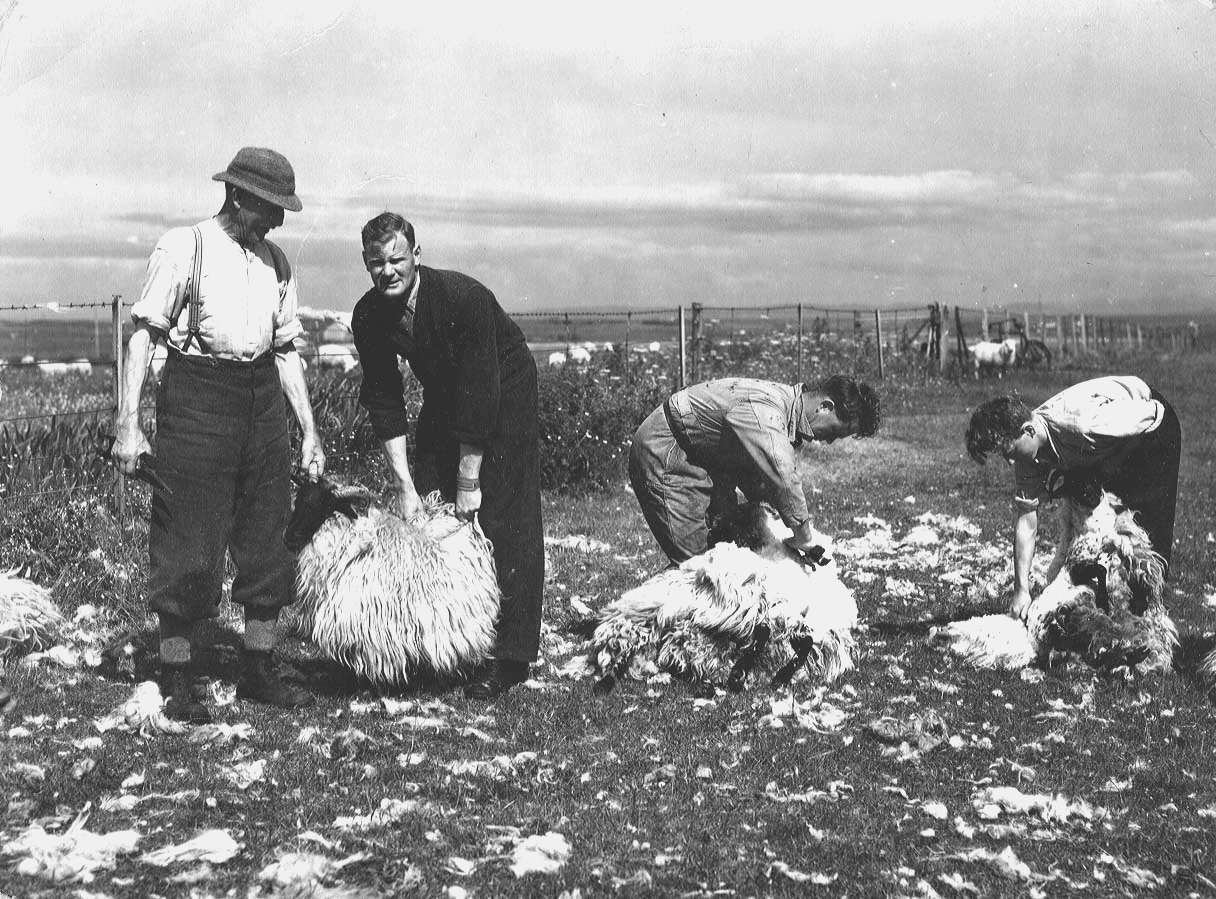
Courtesy of Mrs Cathie Omand
From left to right, farm manager John Hume, factor Iain MacLaren, Lachie MacFarlane of Hynish and Neil MacLean of Heylipol are clipping black-faced sheep at Heylipol Farm using hand shears in the 1940s. Hogs are sheared at the end of May or the beginning of June. Sheep with lambs are sheared in July when the weather is warmer.
Crofters would send their best Cheviot fleeces to the Scottish Wool Growers mill in Brora on the Moray Firth to be made into blankets or spun into hanks known as ‘snath Gaidhealach’ (Highland wool). Wool prices plummeted in the 1980s coinciding with increasing use of feather duvets.
In Tiree nowadays, Suffolk tups (rams) are commonly put to ‘mule’ ewes, a black-face/Blue Leicester cross. The Blue Leicester input maintains the quality of the fleece and produces a larger lamb.
Black and white photograph of sheep-shearing at Heylipol Farm in the 1940s.
Sheep-shearing at Heylipol Farm in the 1940s. L-R: shepherd John Hume; factor Iain MacLaren; Lachie MacFarlane, Hynish; Neil MacLean, Heylipol Farm.
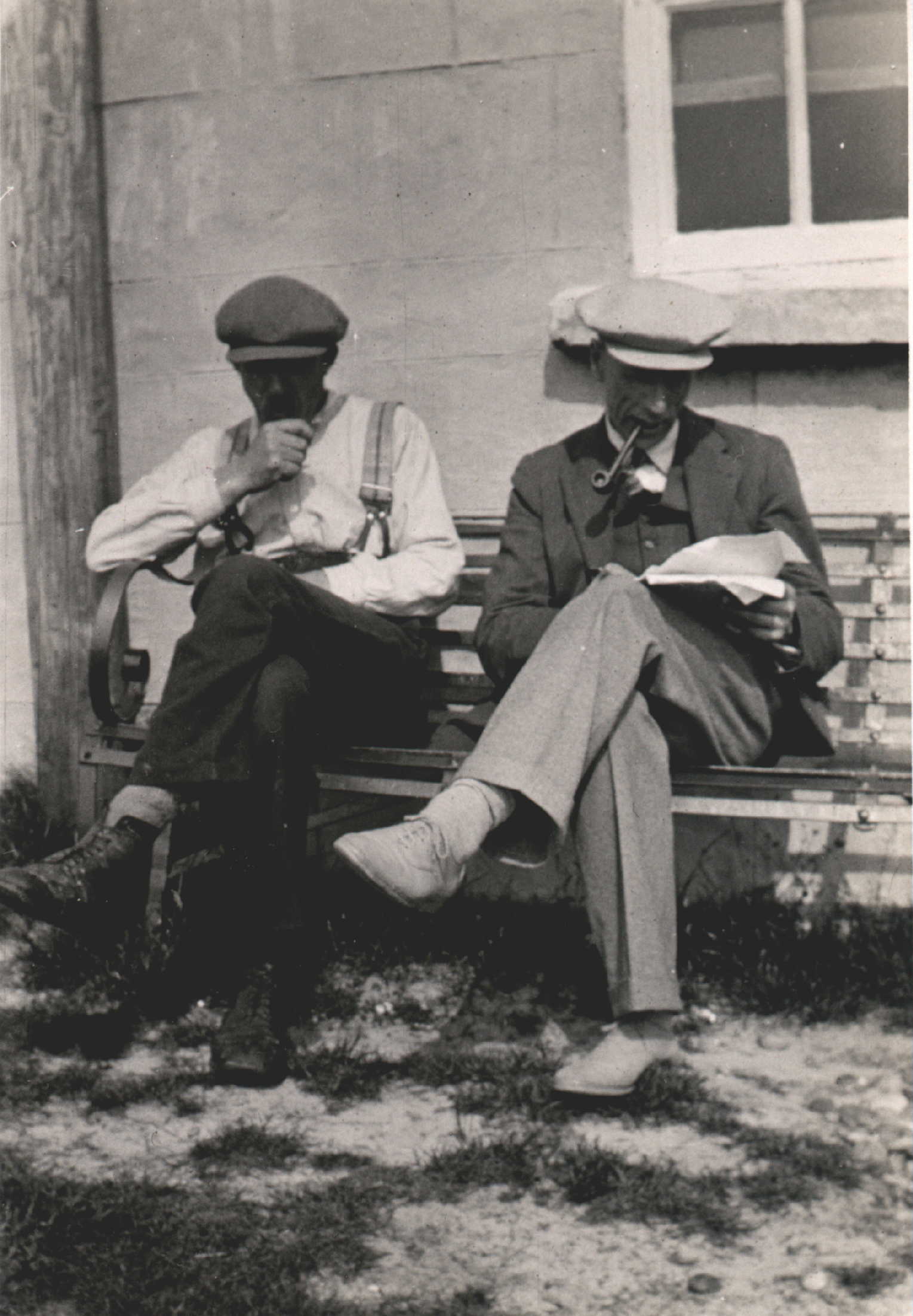
Black and white photograph of Hugh Lamont of Ruaig Post Office.
L-R: Hugh Lamont of Ruaig Post Office with an unknown man, probably taken between WWI and WWII.
Colour photograph of Alasdair MacDonald, Kilmoluaig.
Alasdair MacDonald, Kilmoluaig milking a cow into a `tanger`, used to milk cows that kicked and to measure feed for calves.

Black and white photograph of WAAF Jean Hynd and `Mrs Mac` in Hynish.
`Mrs Mac` and WAAF Jean Hynd in Hynish during WWII.

Black and white photograph of Donald and Sarah Black in 1895.
Donald Black(1854-1937) and his wife Sarah Brown both from Balephuil, photographed in 1895 when Donald was appointed Justice of the Peace for Assinboia Territory in the Canadian North West Territories.
