Black and white photograph of `The Peace and Plenty` at Caoles in the late 1920s or early 1930s.
The skiff `The Peace and Plenty` at Caoles in the late 1920s or early 1930s. L-R: Donald MacDonald (Domhnall Eachainn Bhain) of Coll View, Caoles (Professor Donald Meek`s grand-uncle) and Alexander MacLean of Carnan, Caoles.
Black and white postcard of Port a` Mhuilinn, Baugh.
Port a` Mhuilinn, Baugh.
Black and white photograph of a Tiree regatta in 1938.
Lugboats leaving Scarinish harbour for a Tiree regatta in 1938.
Transporting lobster creels at Caoles in 1936
Photograph of Calum MacDonald and Alex MacIntosh transporting lobster creels at Caoles in 1936.
Courtesy of Mrs Janet MacIntosh
Calum MacDonald and Alex MacIntosh are shown in this photograph of 1936 transporting lobster creels by horse and cart at Caoles. In the 1930s the men would go out lobster fishing every day rowing or sailing their skiffs around the island to their preferred fishing sites.
The creels were baited with salted fish. A line, around 9 fathoms long, was tied to the bottom frame of the creel and at the other end a number of small herring net corks attached every six feet to keep the rope on the surface at low tide. The top cork was marked to identify the owner.
The lobsters were packed with seaweed in wooden boxes and sent by ferry and rail to Billingsgate market in London. If they survived the journey, the fisherman would eventually receive a postal order, paying one shilling and sixpence per lobster.
Black and white photograph of Calum MacDonald and Alex MacIntosh in 1936.
Collecting creels by horse and cart at Caoles in August 1936. L-R: Calum MacDonald and Alex MacIntosh.
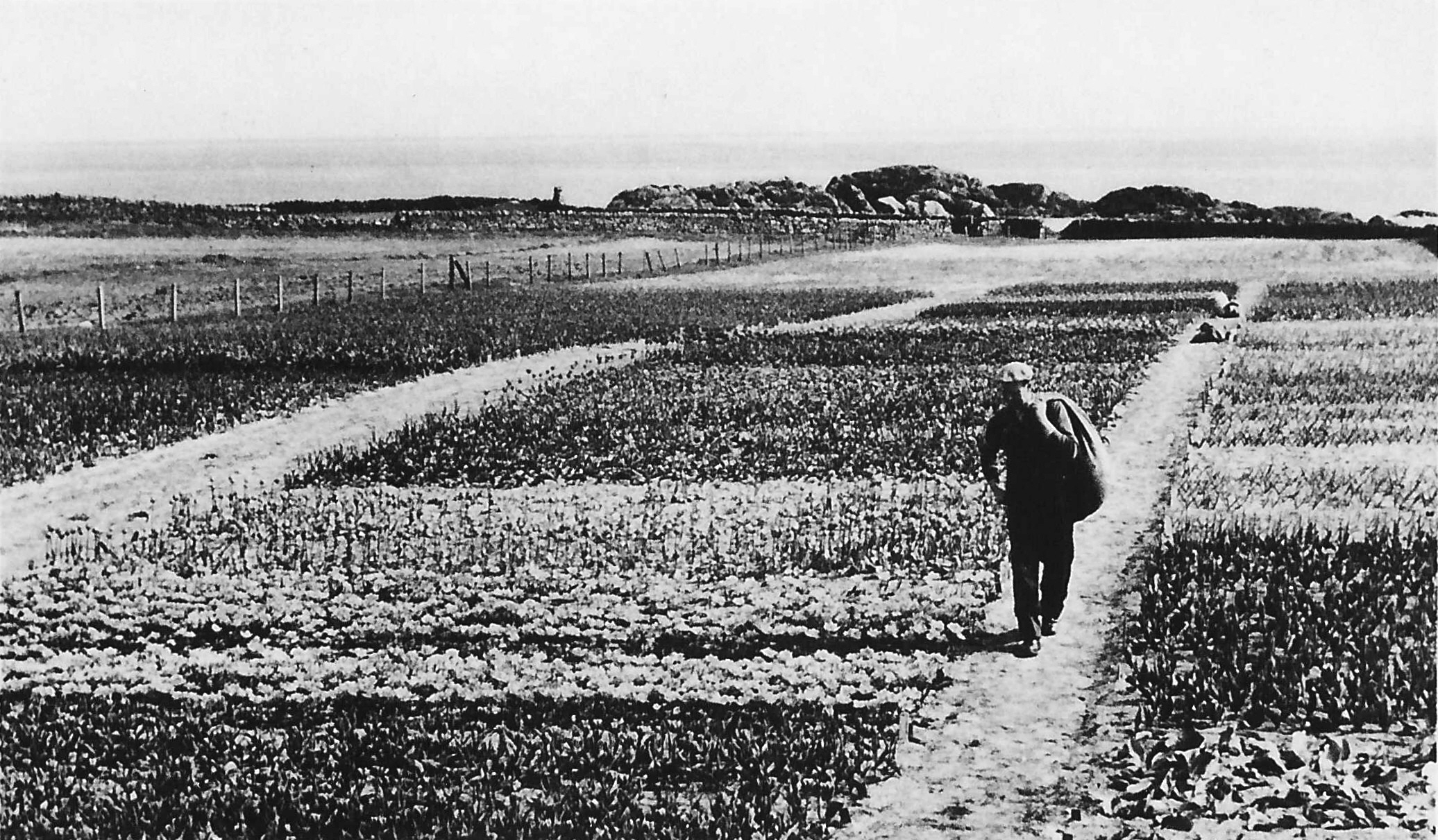
Mr R. M. Percy at the Hynish bulb farm in the 1950s
Postcard of the Hynish bulb farm in the 1950s.
Courtesy of Mrs Mary MacKinnon
In the early 1950s the West of Scotland Agricultural College’s horticultural adviser R. M. Percy suggested an experiment in bulb-growing to Walter Hume of Hynish. The experiment showed that the light sandy soils of Tiree were well suited to growing daffodil, tulip, narcissus and hyacinth bulbs.
Encouraged by this success, a number of crofters formed a Hebridean bulb-growers association and launched into bulb-growing as a commercial enterprise, supplying mainland hot-house growers with bulbs for forcing. Initially the economic prospects looked good as the yield per acre was high.
However, the bulbs were decimated by diseases and ravaged by pheasants, mice and slugs. Reinvigorating spent bulbs took longer than expected and markets became more difficult to find. Nowadays the only reminders of the bulb experiment are patches of daffodils growing wild in the fields.
Black and white postcard of the bulb fields at Hynish.
Postcard of the bulb fields at Hynish.
Black and white postcard of a boat at Gott Bay pier.
Tying up at Gott Bay pier. Eairdsidh na pacaid is standing in the stern.
Black and white postcard of Scarinish harbour in 1938.
Postcard of the `Mary Stewart` beached in Scarinish harbour in 1938 with lobster pots in the foreground, the Scarinish Hotel at the extreme left and communication masts in the background to the right. (Duplicate of A7)
Black and white photograph of Ruaig School in 1952-3.
Ruaig School in 1952-3. L-R: (back row) Mary Gardiner; Annie MacLelland; May Meechan; Jane Meechan; Irene MacDonald, Machair House; Jean MacFarlane, teacher; (2nd back row) John MacLelland; Agne MacCulloch; Jean Cunningham; Sandra Band; Tommy MacKinnon, Vaul; Agnes Law; Gavin Clark; (3rd back row) Mary Ann MacLean; John Shanks; Robert MacDonald; David Conn; Lachie MacDonald; Alfie Tarbert; (front row) Mary MacInnes; Ann MacKinnon (Langley); Sylvia MacKinnon; Betty Cunningham; Ellen Macinnes. (Duplicate of W3 – 1999.24.25. Not indexed)
Laser print of a black and white photograph of an unknown family taken by the shore at Scarinish in 1922.
Unknown family at the shore at Scarinish in 1922. (From Myra Lamont’s photograph album of the 1920s.)
Laser print of a black and white photograph of an unknown group taken at the Tiree Show in Scarinish in 1922.
Unknown group taken at the Tiree Show in Scarinish in 1922. (From Myra Lamont’s photograph album of the 1920s.)