


Black and white photograph of the Mary Stewart in Scarinish harbour in 1927.
The Mary Stewart in Scarinish harbour with the lighthouse in the background, from a small photograph album from Silversands in Vaul titled 1927.
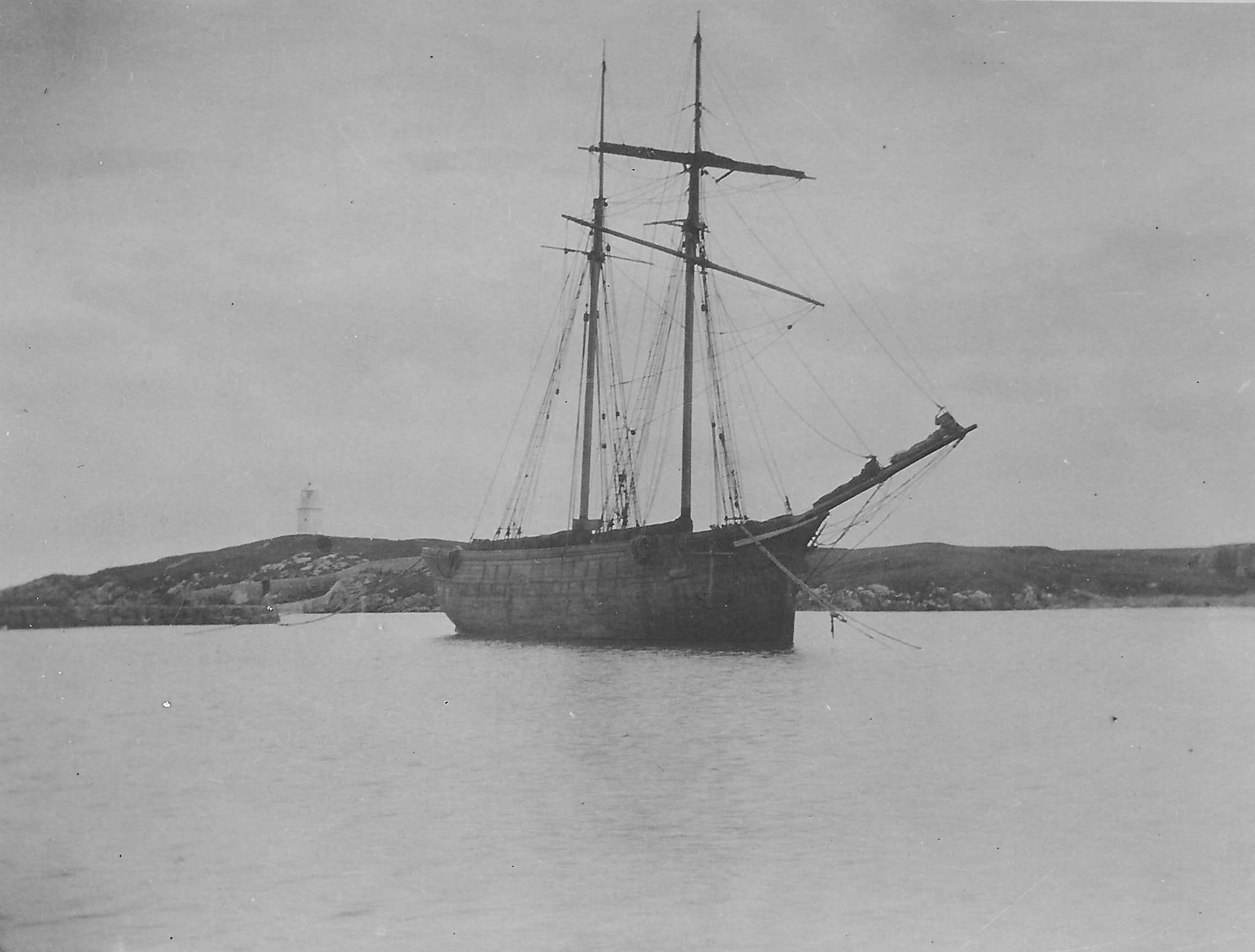

Black and white photograph of the Mary Stewart in Scarinish harbour in 1927.
The Mary Stewart in Scarinish harbour with the lighthouse in the background, from a small photograph album from Silversands in Vaul titled 1927.
Black and white photograph of a group of people relaxing outside Silversands in 1924.
Relaxing outside Silversands, from a small photograph album from Silversands in Vaul titled `1924`.

Black and white photograph of an unknown woman sitting on the Ringing Stone in 1930.
The Ringing Stone from a small photograph album from Silversands in Vaul titled `September 1930`.

The crew of the ‘Baron Polwarth’
Photograph of the crew of the ‘Baron Polwarth’ in 1916.

Courtesy of Mr Lachie MacDonald
The ‘Baron Polwarth’ was a tramp steamer that plied its trade around the British coasts and European ports. Owned by the tramp ship company Hugh Hogarth & Sons, which later became the Baron Line, the ships were recognisable by their buff and black funnels.
The owners had a reputation for being overly economical when feeding their crews. As a result, the line was nicknamed the ‘Hungry Hogarths’. The crew of the ‘Baron Polwarth’ included several sailors from Tiree.
One of them, Dougall Lamont, son of Archie Lamont of Cornaigmore, died as a result of an accident on board in January 1916. His remains were brought home to Tiree and interred in Kirkapol cemetery. His fellow crew members clubbed together and bought a marble book which was placed on his grave.
Black and white photograph of the crew of the `Baron Polwarth`, Ardrossan in 1916.
Crew of the Baron Polwarth, Ardrossan, 1916. L-R: (back row) Charlie MacDonald, Ruaig, uncle to Mary Flora MacKinnon, Balephetrish and Margaret MacInnes, Ruaig; John MacKinnon, Balephetrish, uncle to Ian MacKinnon (Iain Aonghais), ‘Lochview’, Kilmoluaig; Charles MacDonald, uncle to Lachie MacDonald, Middleton; John MacArthur, father of John MacArthur, Middleton Farm; (middle row) Hugh Cameron; Walter MacDonald, Moss, uncle to Johann MacKinnon, Barrapol and Neil Brownlie; unknown; (front row) possibly Walter Mackinnon, Greenhill; unknown.
Black and white photograph of an air crew at RAF Tiree during WWII.
Air crew from 281 Squadron at RAF Tiree during WWII.
L-R: (back) Ron Dryden, Leicester; Johnny (surname unknown); Billy MacAulay, Liverpool; (front) Ray Warwick; Bill Robby.

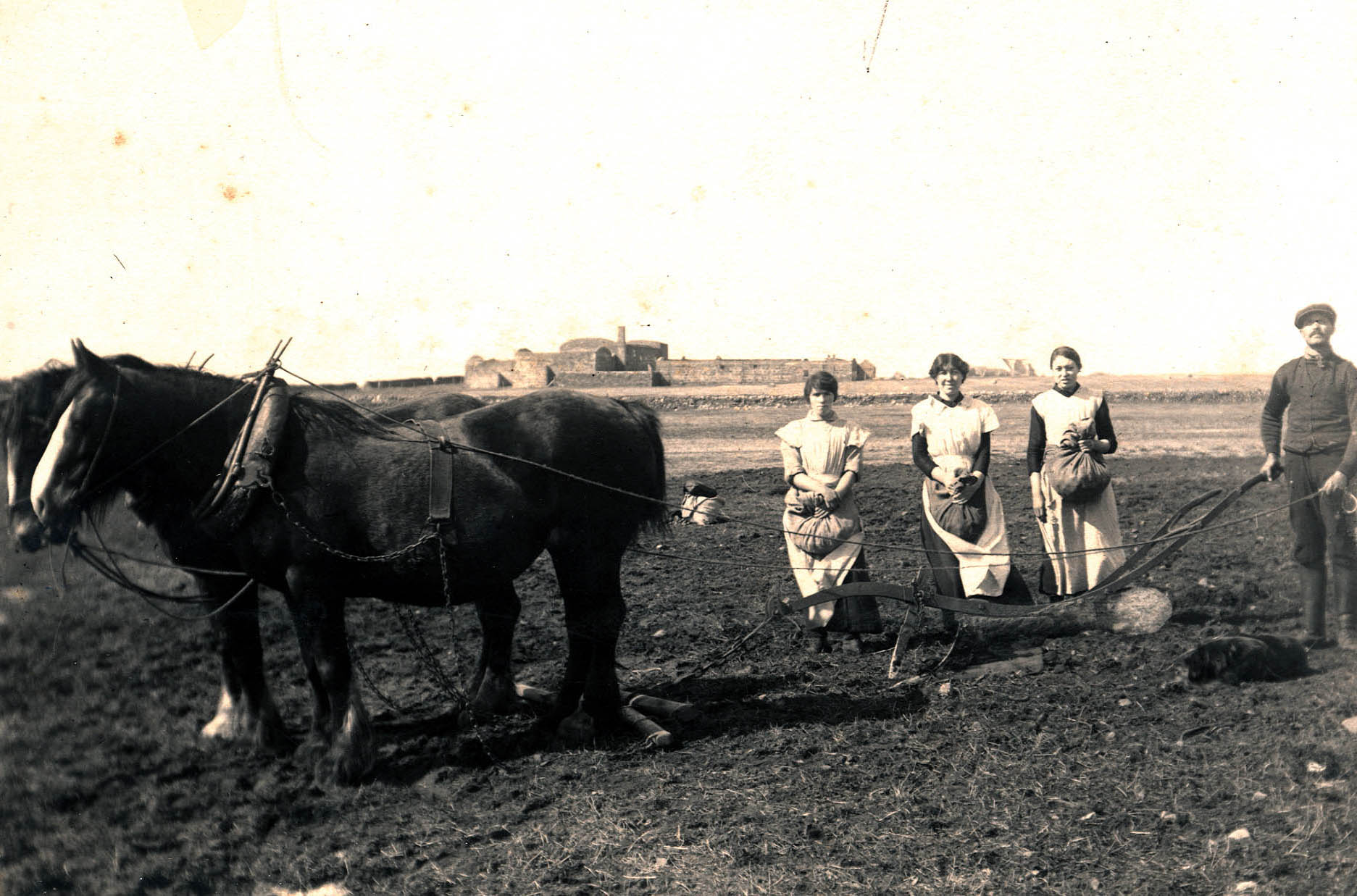
Planting potatoes at Middleton in the 1920s
Photograph of Alasdair MacDonald planting potatoes with Lizzie MacArthur, Effie and Mary Ann MacDonald at Middleton in the 1920s.
Courtesy of Mr Lachie MacDonald
Taken in the 1920s, the photograph illustrates a standard plough used to prepare the ground for sowing corn. Because of the fine sandy soil in most of Tiree, a ridger was not successful.
The women followed in the furrow planting potatoes from the supplies heaped in their sack aprons and the ploughman made a second furrow to cover them. This process was repeated leaving a 45 cm space between the planted furrows for the grubber.
The Middleton seaweed factory operated by the North British Chemical Company can be seen in the background. Known locally as the Glassary, it ceased operation in 1901 and was demolished during World War II.
Black and white photograph of Alasdair MacDonald planting potatoes at Middleton in the 1920s.
Planting potatoes at Middleton, with the Glessary (as it was known) in the backgound in the 1920s. L-R: Lizzie MacArthur, Middleton and Greenhill – aunt of John MacArthur, Middleton Farm; Effie MacDonald, married to the late Archie Walker, Coll and Kenovaay, Tiree – aunt of Lachie MacDonald , Middleton; Mary Ann MacDonald – aunt of Lachie MacDonald, Middleton; Alasdair MacDonald – father of Lachie MacDonald, Middleton. The photograph illustrates a standard plough used to prepare the ground for sowing corn. Because of the fine sandy soils in most of Tiree, a ridger was not successful. Instead, the standard plough was used and the women followed in the furrow with supplies of potatoes heaped in their sack aprons. The ploughman made a second furrow to cover the potatoes. The same process was repeated thus leaving an 18 inch (45cm) space between planted furrows to allow the grubber to be used.
Black and white photograph of the crew of the `Baron Polwarth`, Ardrossan in the late 1920s.
The crew of the `Baron Polwarth` of Ardrossan in the late 1920s. Front row: (1st left) John MacKinnon, Balephetrish, uncle to John MacKinnon (Iain Aonghais), Kilmoluaig; (2nd right) Hugh Cameron.

Black and white photograph of airman Ray Warwick at RAF Tiree during WWII.
Airman Ray Warwick with his crossbow at RAF Tiree during WWII. Ray had two hobbies on Tiree – his home-made crossbow for pursuing hares across the airfield and carving wooden chairs from a single piece of wood.

Black and white photograph of an unknown crew in the 1920s.
Unknown crew in the 1920s.

Black and white photograph of ground staff at RAF Tiree during WWII.
` “Better than the makers.” Some of the ground crew detached at Tiree.`
