


Tom Barr`s bell.
Tom Barr`s bell which hung outside Balephetrish farm and was rung to notify the farm hands of working times.


Tom Barr`s bell.
Tom Barr`s bell which hung outside Balephetrish farm and was rung to notify the farm hands of working times.
Ship`s wheel from the schooner `Mary Stewart`, the remains of which are still visible in Scarinish Harbour.

Souvenir baseball cap for Tiree Wave Classic 2003.

Piece of rubble from the old hall at Crossapol.
Piece of concrete rubble from the old hall at Crossapol.
Saddle quern found in Moss.
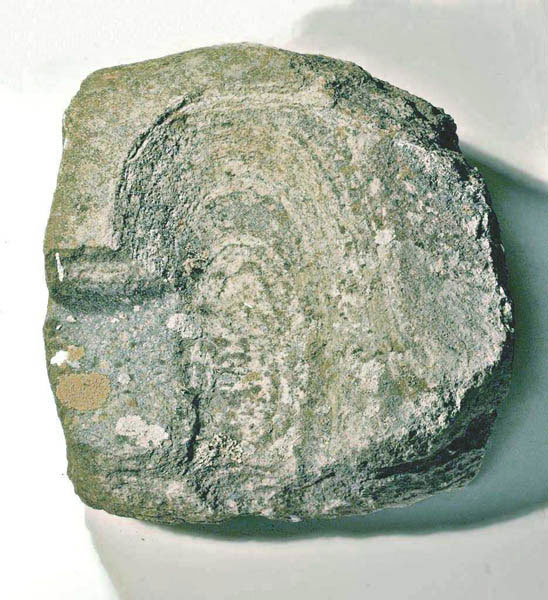
Courtesy of Catriona McLeod
Saddle querns are the most ancient and widely used type of quern-stone. This one was found in Moss in the mid-1980s and may date back to Neolithic times. It was used with a rubbing stone held in the hand, a process that crushed the grain rather than ground it.
Considered women’s work, preparing grain using a saddle quern would have taken many hours and placed great strain on the body, particularly the toes, knees, hips and lower back. They continued in use into the medieval period and were superseded by rotary querns.
Turnbull, in a report on Tiree written in 1768, wrote that meal was made ‘with querns or hand mills which appears to be an expensive and troublesome method. Two women at once, or sometimes three, are commonly employed. By this means there is so much of their time taken up that it greatly retards them from other industry.’
An corran / sickle.
Sickle made in Gott smiddy around 1840.

Tiree in 100 Objects – 43 – Sickle
Bottom section of hand quern.
Bottom section of hand quern from Gott.
Pitchfork head.
Pitchfork head made in Gott smiddy around 1840. Painted black 2013.

Glazed pottery lid from a jar of Fortnum & Mason potted game.
Glazed pottery lid from a jar of Fortnum & Mason potted game dug up from Scarinish machair in 2003.

Two smiddy-made nails from the Reading Room (now An Iodhlann), each approx. 135 mm long.

