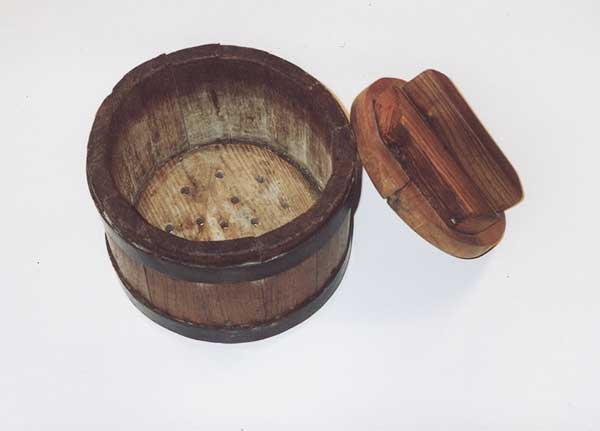
Probably made at the end of the 19th century by Donald MacLean of Whitehouse, Cornaigbeg, this wooden vat (known in Gaelic as a ‘fiodhan’) would have been used until the 1950s to make cheese.
Standing 165 mm high and with a diameter of 250 mm, the staves are bound with two iron hoops. Holes have been drilled in the sides and base to allow the whey to drain out.
The curds wrapped in muslin would be put in the vat and the lid placed on top. This would be weighted with stones or screwed down in a cheese press for about a week.
Extract from ‘The Island of Tiree’ by William Reeves, D.D.
Transcription of an extract from ‘The Island of Tiree’ by William Reeves, D.D. about the ancient chapels and graveyards on the island.
Dr Reeves’ monograph on the ecclesiastical antiquities of Tiree was published in the Ulster Journal of Archaeology in 1854. In it he lists thirteen sites at Balinoe, Cornaigmore, Balephetrish, Kirkapol, Kilkenneth, Kennavara, Kilmoluaig, Barrapol, Hynish, Heylipol and Caoles.
In the Statistical Account of the 1790s, Rev. Archibald MacColl recorded that on Tiree there were ‘15 remains of old chapels or churches, at some of which are burying grounds and crosses still to be seen.’ Esrkine Beveridge in his ‘Coll and Tiree’ proposed sites for the two chapels not identified by Dr Reeves.
The first is Caibeal Thomais (St Thomas’s Chapel) which was situated with its burial ground on the outskirts of Scarinish. The second is on Cnoc Grianal, a knoll on the north-west of Ben Hynish near to Balephuil, where there may be the remains of a building measuring some 12 by 24 feet lying on an east-west axis.
Cardboard egg box. Brown cardboard lidded eggbox, 242 x 190 x 73 mm, printed with `eggs with care` and lines for sender and addressee, containing corrugated cardboard insert for one dozen eggs.
Every Tiree croft had its chickens in the old days and eggs were a useful way to buy things from the shops if you had no money. In the Second World War, the airmen on Tiree were nicknamed the Royal Egg Force because of their fondness for them.
Extract from John Knox’s Tour through the Highlands and the Hebrides in 1786
Transcription of an extract from ‘A Tour through the Highlands of Scotland and the Hebride Isles, in 1786’ by John Knox.
In 1786 the British Society for Extending the Fisheries sent John Knox to the north and west coasts of Scotland to prospect for new harbours and fishing grounds. During his visit to Tiree, he surveyed the coastline and concluded that Gott Bay was the most practicable place for a pier.
This was in line with the thinking of the Society’s Governor, the 5th Duke of Argyll, who over the previous fifteen years had encouraged settlement in a new fishing village at Scarinish by offering ‘a few years’ free possession of a house-room, two acres of arable and a cow’s grass.’
In 1793 the Duke again instructed the island’s Chamberlain to encourage his tenants to attend to the fishing. However, in a list of exports from Tiree in the following year there is still no mention of any fish being sent from the island.
The full publication is available to borrow from An Iodhlann: 2017.50.3
As a result of the potato famine of 1846, the 8th Duke of Argyll devised a strategy to deal with the endemic poverty and overcrowding on Tiree: assisted emigration of cottars and the smallest tenants, prohibition of the subdivision of crofts, consolidation of small tenancies and the creation of small farms.
This led to a reduction in the numbers of small tenants, increased numbers of larger tenants and an increase in rental income. However, these policies also contributed to the continuing fall in the island’s population. An estimated 3670 people left Tiree between 1841 and 1881.
A second wave of emigration in 1880s confirmed the decline which was sustained throughout the 20th century with many islanders leaving to find work elsewhere.