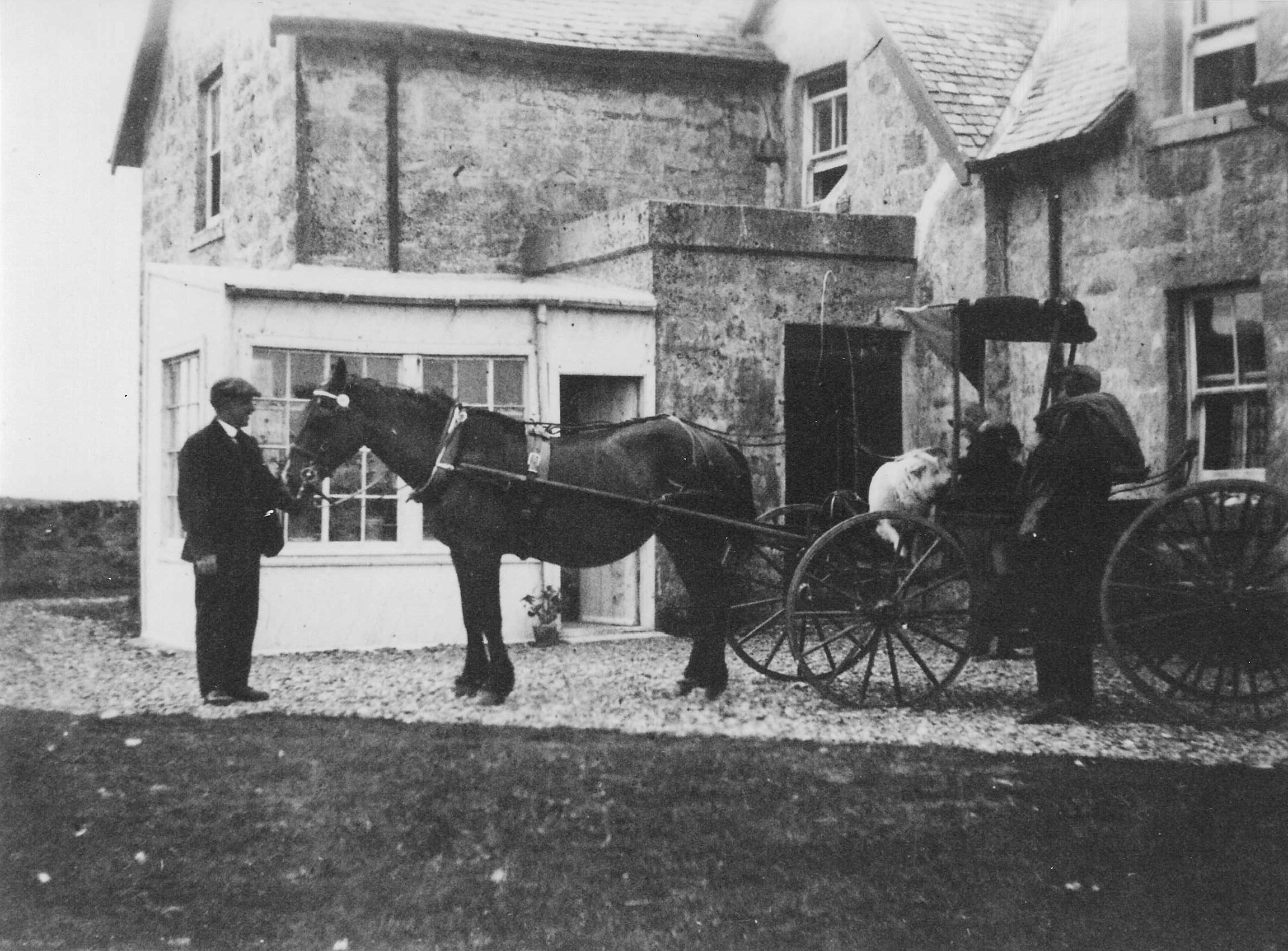
Black and white photograph of John MacKinnon, Lodge Farm.
John MacKinnon of Lodge Farm, Kirkapol is pictured here outside the Lodge with Lady Victoria Campbell’s buckboard. The daughter of the 8th Duke of Argyll, Lady Victoria contracted polio in 1859 when 5 years old and was lame for the rest of her life. When rough seas or low tides made it impossible for passengers to board the lighter for the mail-boat at either of the small piers at Scarinish harbour, the boat was run in as far as possible on the beach at Gott Bay. ‘Faithful John’ would drive the horse and buckboard through the water to the stranded lighter to transfer Lady Victoria, fortunately always without accident.
Outside the general store in Scarinish in 1910
Photograph of Calum MacLean, Hugh MacArthur and Peter Anderson outside the general store in Scarinish in 1910.
Courtesy of Mr Angus MacLean
Calum MacLean, Hugh MacArthur and Peter Anderson are pictured in 1910 outside the shop in Scarinish owned and run by Hugh and his brother Dan. As well as a general store, the building contained a Post Office and a hardware department upstairs
Calum MacLean (Calum Bùidsear) from Moss opened a butcher’s shop in Scarinish in 1930s on a site previously housing a baker and cobbler. The business was taken over by Donald and Nan MacLean in 1953.
Peter Anderson came to Tiree in 1886 as the island’s first gamekeeper. A keen ornithologist, he published ‘The Birds of the Island of Tiree’ in ‘The Scottish Naturalist’ in 1913
Black and white photograph of Scarinish shop in 1910.
Scarinish shop, 1910. L-R: Calum MacLean (butcher in Scarinish), Hugh MacArthur (partner in shop), Peter Anderson (gamekeeper). (Original photograph 1997.178.1)
The Whitehouse MacLeans with a horse-drawn reaper in around 1920.
Photograph of the MacLean family from Whitehouse with a horse-drawn reaper.
Courtesy of Mr Angus MacLean
The MacLean family from Whitehouse, Cornaigbeg are pictured cutting corn with a horse-drawn reaper. This was a tremendous advance on the sickle and scythe. Use of the scythe needed strength and skill and one man could cut only a quarter acre in a day.
Two men sat on the reaper, one to guide the horses which walked beside the standing corn while the other tilted the reaper’s platform when enough corn for a sheaf had gathered. He then pushed it off with an angled rake. The sheaves were tied by people following behind the reaper.
Binders pulled by three horses replaced the reaper. Mechanically operated implements drawn by tractors eventually took over after World War II.
Black and white photograph of cutting corn at Whitehouse.
Cutting corn by reaper at Whitehouse, Cornaig. L-R: Donald MacLean (Big Donald), Charles MacLean (Curly), Tom MacLean, Hector MacLean (Curly’s father), Donald MacLean (father of Tom and Big Donald), unknown, Murdoch MacLean (Curly’s brother).
Cutting corn by a reaper was a tremendous step forward from the sickle and scythe. Sickle work was done mainly by women. Four or five would work together cutting handfuls of corn at a time which were then tied together by the men. The scythe had a blade approx. 2.5 ft long (85 cm) and was handled by the men. A man could cut fully a quarter acre in a day.
The reaper was powered by horses. A cross-member board 4 ins by 2 ins (10 cm x 5 cm) and 4.5 ft long (137 cm) was bolted to the cutting blade of the reaper by hinges, allowing it to operate up and down. Ten strips of wood 4 ins by 1 in (10 cm x 2.5 cm) and 2.5 ft long (75 cm) were placed at 4 inch (10 cm) intervals at right angles to the cross-member. A pedal which was attached to the cross-member was pressed down by the worker’s right foot. This allowed the corn to gather on the platform. He then released the pedal and the platform tilted to the ground. The corn was finally pushed off with the tilting rake. Enough corn to make a whole sheaf then lay on the ground in readiness for the people following behind to tie it. Note the central figure, Hector MacLean, has a tilting rake specially designed to remove corn from the platform.
Binders pulled by 3 horses replaced the reaper. Mechanically operated implements drawn by tractors eventually took over.
Board-mounted photographs of visits to the Lodge 1911-1921.
Originals photographs taken during visits to the Lodge 1911-1921, copied as C27-C37, D1-D30, H37 and J1.
Booklet `Birds of Tiree` by Peter Anderson.
Information on bird sightings on Tiree in 1913 based mainly on the notes and observations of Peter Anderson who was the first gamekeeper on the island in 1886.
Black and white photograph of Willie, Alick and Nancy MacLean of Cornaigbeg.
L-R: Willie, Alick and Nancy MacLean who built Corraire, Cornaigbeg in 1915.
Black and white photograph of the Mary Stewart in Gott Bay, 1912.
The `Mary Stewart` in Gott Bay with two horse-drawn carts on the shore, taken in 1912.
Black and white photograph of Oliver Balfour taken on Gott Bay in 1912.
Oliver Balfour (Lady Frances Balfour`s son) lying on the sand on Gott Bay with Lady Frances` samoyed, Vaul, taken in 1912.
Black and white photograph of Oliver Balfour taken in the Lodge gardens in 1912.
Oliver Balfour, Lady Frances Balfour`s son, with the family dogs in the Lodge gardens, taken in 1912.
Black and white photograph of Annie Balfour taken at the Lodge in 1912.
Annie Balfour, Lady Frances` daughter, with a pony called Blackie taken at the Lodge in 1912.