


Copy of New Zealand Soldier`s Pay Book.
New Zealand Soldier`s Pay Book for Private Archibald John MacLean of Cornaigmore, Donald Archie MacLean`s father, who served in WWI.

Copy of New Zealand Soldier`s Pay Book.
New Zealand Soldier`s Pay Book for Private Archibald John MacLean of Cornaigmore, Donald Archie MacLean`s father, who served in WWI.
Photocopied newspaper article about brothers A. and R. MacCallum from Cornaigbeg.
Obituaries for two brothers from Cornaigbeg, Private A. MacCallum who was killed by gunshot in France on 12/3/1916 at the age of 30 and Seargeant Robert MacCallum who died in action as Beaumont Hamel on 13/11/1915 at the age of 32.
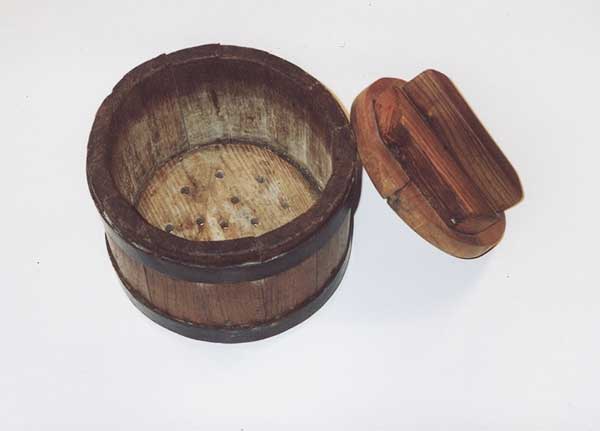
Cheese press or fiodhan.
Courtesy of Mrs Meena Knapman
Probably made at the end of the 19th century by Donald MacLean of Whitehouse, Cornaigbeg, this wooden vat (known in Gaelic as a ‘fiodhan’) would have been used until the 1950s to make cheese.
Standing 165 mm high and with a diameter of 250 mm, the staves are bound with two iron hoops. Holes have been drilled in the sides and base to allow the whey to drain out.
The curds wrapped in muslin would be put in the vat and the lid placed on top. This would be weighted with stones or screwed down in a cheese press for about a week.
Block forming part of pulley found in Hynish.
Block forming part of pulley found in a shed opposite Milton House in Hynish by Patrick Lorimer.
Knickers made from a flour sack
Photograph of a pair of knickers made from a flour sack.

These women’s knickers were made in Tiree from a flour sack in the first quarter of the 20th century. The isolation of the crofting community on Tiree made it necessary to make do with the materials to hand.
The knickers were sewn by machine with flat seams and decorated with hand-made tatting round the legs. The waist may have been elasticated or tightened with a drawstring.
Flour was purchased in 140 lb (65 kg) sacks made from closely woven cotton. The seams would have been unpicked and the material plastered with black soap (‘siaban dubh’) to remove the printing before putting it outside to bleach in the sun. The flour producer’s name, Harter, is still visible.
Black and white postcard of Port an Tobair, Balemartine.
Port an Tobair, Balemartine, with three fishing dinghies in the foreground, probably photographed in the early 20th century.

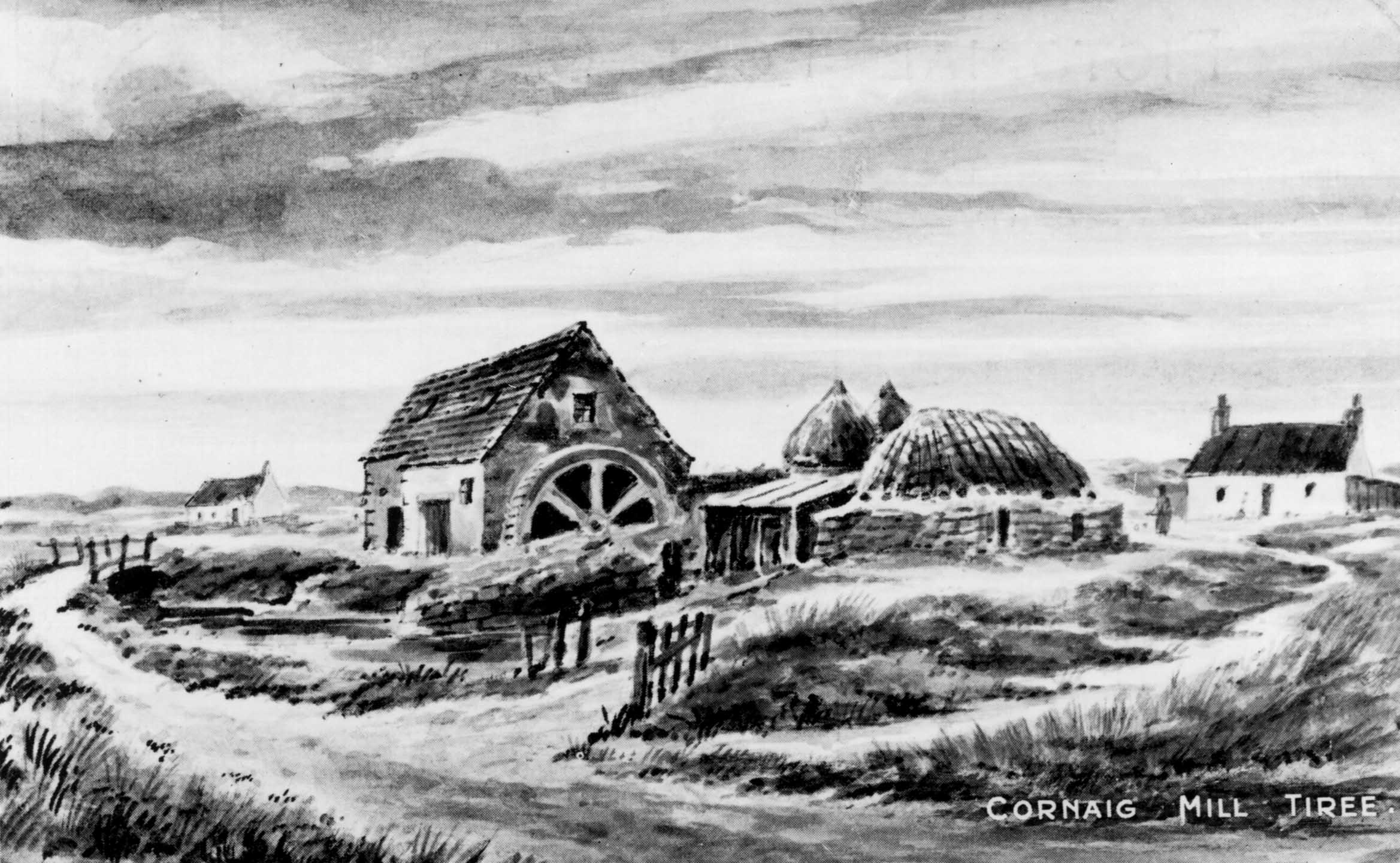
Black and white postcard of Cornaig mill.
Postcard of a painting of Cornaig mill, probably produced in the early 20th century.
Lachlan MacPhail carting seaweed
Photograph of Lachlan MacPhail carting seaweed

Courtesy of Mr Ailig MacArthur
Lachlan MacPhail, originally from Luing, is pictured with a cartload of seaweed outside the shepherd’s cottage where he lived in Crossapol. A fork has been stuck in the back of the cart to stop the seaweed slipping off.
Gathered from March to May, the seaweed is spread on grass or on ground to be planted with corn or potatoes. Red seaweed known as ‘bàrr-dearg’ was considered the best for this purpose but only came ashore on certain tides usually in the month of May.
The soils of Tiree are predominantly light and sandy and need feeding with organic matter every year to keep their fertility. Although not considered as good a fertiliser as manure, seaweed improves the condition of the soil and aids water retention.
Black and white photograph of Lachlann MacPhail, Crossapol.
Lachlan MacPhail from Luing with a cartload of seaweed outside the shepherd’s cottage where he lived in Crossapol, Tiree, probably taken in the early 20th century.
Black and white photograph of Gott Bay pier.
Gott Bay pier, probably taken in the early 20th century.

Black and white photograph of Donald MacKechnie, Kilmoluaig.
Donald MacKechnie, Kilmoluaig, (Maggie Campbell`s father) in his naval uniform.