


Laser print of photograph of a stone cross from Kilkenneth Chapel.
photograph of a stone cross from Kilkenneth Chapel, now missing..
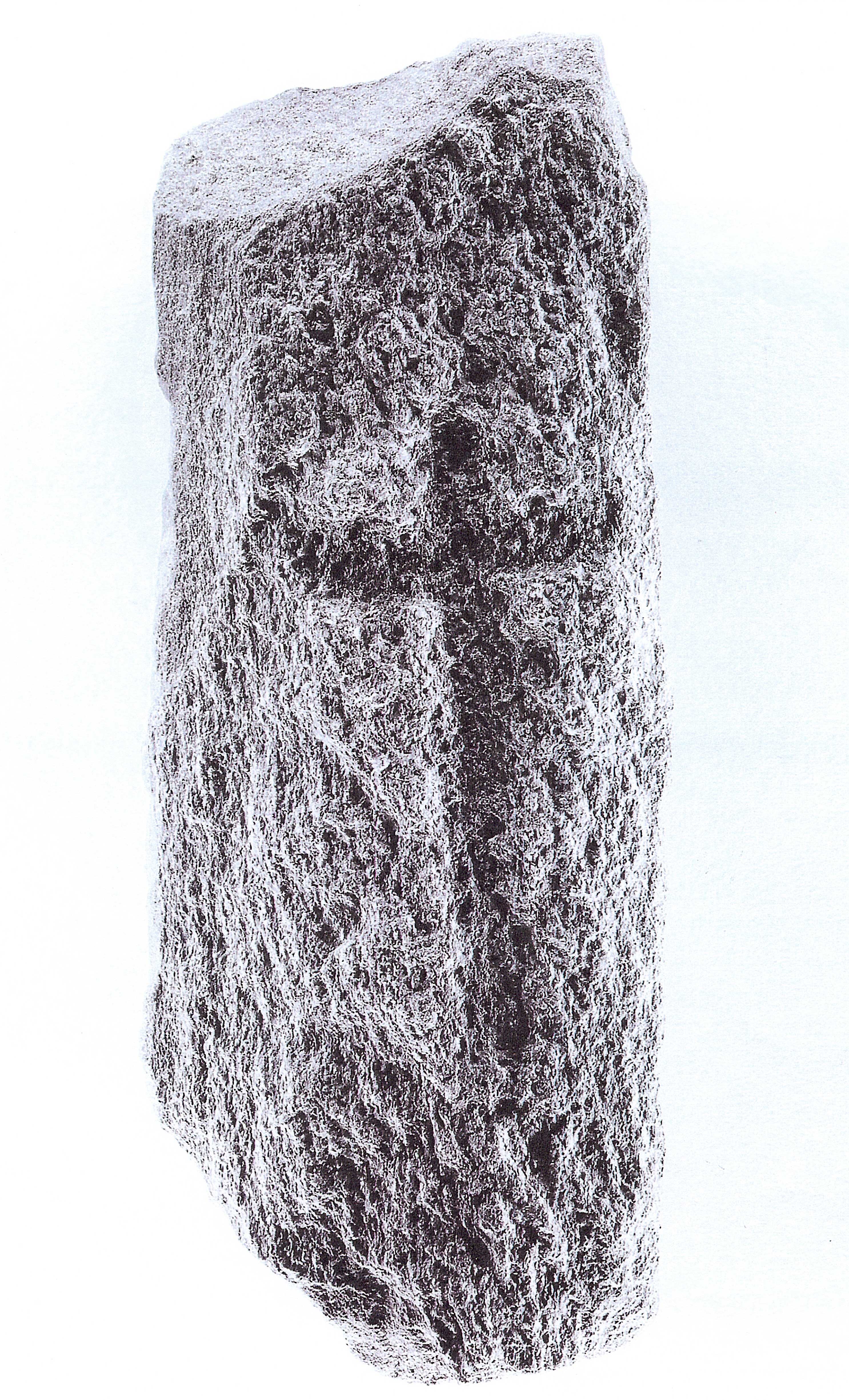

Laser print of photograph of a stone cross from Kilkenneth Chapel.
photograph of a stone cross from Kilkenneth Chapel, now missing..
Colour photograph of the construction of the roll-on roll-off ferry terminus at Gott Bay pier in 1992.
The construction of the roll-on roll-off ferry terminus at Gott Bay pier in 1992.

The seaweed factory at Middleton
Photograph of the remains of the seaweed factory at Middleton.

Courtesy of Mr Donald MacKinnon
The kelp forests around Tiree are the fourth largest in Scottish waters. This abundance fuelled the seaweed industry on the island which, for a hundred years, produced alkali for soap and glass manufacture, and for bleaching linen.
Undercut by cheap foreign imports, the industry slumped from the 1830s until the 1860s when the North British Chemical Company appointed as manager a brilliant young chemist, Edward Curtis-Stanford. He arrived in Tiree in 1864 to supervise the building of the factory at Middleton, known locally as the Glassary.
Until 1901 the factory extracted iodine and alginates from the tangles, selling the residual charcoal as fertilizer and deodorants for earth closets, and using the gas produced by the process to light the buildings. Most of the factory was demolished in 1941 to provide the foundations of the runways built at the Reef for the RAF station.
Black and white photograph of the old seaweed factory at Middleton.
The old seaweed factory at Middleton in the early 20th century.
An corran / sickle.
Sickle made in Gott smiddy around 1840.

Tiree in 100 Objects – 43 – Sickle
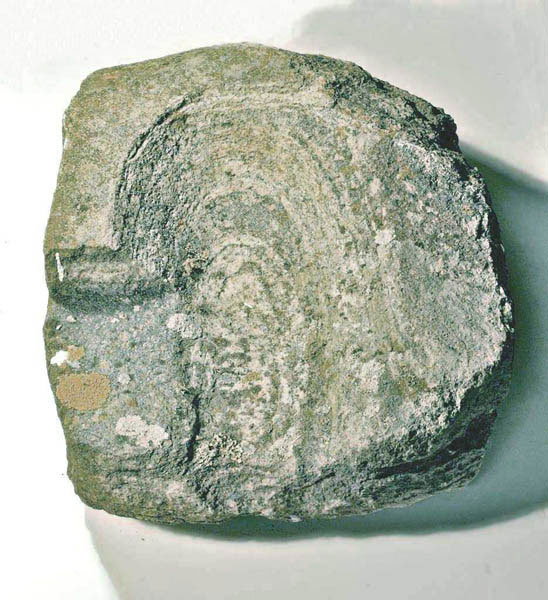
Saddle quern found in Moss.
Courtesy of Catriona McLeod
Saddle querns are the most ancient and widely used type of quern-stone. This one was found in Moss in the mid-1980s and may date back to Neolithic times. It was used with a rubbing stone held in the hand, a process that crushed the grain rather than ground it.
Considered women’s work, preparing grain using a saddle quern would have taken many hours and placed great strain on the body, particularly the toes, knees, hips and lower back. They continued in use into the medieval period and were superseded by rotary querns.
Turnbull, in a report on Tiree written in 1768, wrote that meal was made ‘with querns or hand mills which appears to be an expensive and troublesome method. Two women at once, or sometimes three, are commonly employed. By this means there is so much of their time taken up that it greatly retards them from other industry.’
Pitchfork head.
Pitchfork head made in Gott smiddy around 1840. Painted black 2013.

Black and white photograph of a `swee` made by the blacksmith in Cornaigbeg.
Swee used to hang pots over the fire, made by Archie MacEachern, the blacksmith in Cornaigbeg.

Photograph of Flora MacEachern of Cornaigbeg in a swimming costume in the 1930s.

Courtesy of Mrs Mairi Brady
Flora MacEachern, known as Fileag, was the daughter of the blacksmith at Creag Mhòr in Cornaigbeg. She was photographed in the 1930s in a swimming costume that was typical of the Victorian era, covering the arms and legs and accessorised with a fancy cap.
In the 19th century bathing in the sea was considered to be therapeutic. Although costumes were quite modest, it was common for men to swim naked when away from women. This practice was banned in Britain in 1860; bathing was segregated until 1901.
In the early 20th century, bathing wear started to shrink, first exposing the arms then the thighs; collars gradually receded and necklines plunged. New fabrics allowed for more comfortable and practical swimwear and swimming became the leisure pursuit it is today.
Flora MacLean discarding flower heads from the Hynish bulb farm
Photograph of Flora MacLean discarding flower heads from the Hynish bulb farm, photographed by the Sunday Express in May 1957.

Courtesy of Sunday Express
Flora MacLean of Kenovay was photographed by the Sunday Express in 1957 discarding flower heads from the Hynish bulb farm. In the 1950s daffodil, tulip, narcissus and hyacinth bulbs were grown by a number of Tiree crofters to supply mainland hot-house growers with bulbs for forcing.
The busiest time was in the spring and summer. The flowers were removed to strengthen the bulbs which were dug up in June and graded according to size and condition. Large bulbs were exported to the mainland with the smaller ones replanted in the autumn for another year’s growth.
The initial outlay for ‘mother’ bulbs was high although spent bulbs could be purchased for a fraction of the cost. Unfortunately, the crop was decimated by diseases and pests, profit margins fell and the scheme petered out.
Black and white photograph of Flora MacLean of Druimfhraoich, Kenovay.
Flora MacLean of Druimfhraoich, Kenovay, discarding bulbs from the Hynish bulb farm, photographed by the Sunday Express in May 1957.
Black and white photograph of the 1986/7 Tiree `baby boom` families at the Lodge Hotel in 1987.

The L-R: (front row) Alain, Fiona Campbell’s son; Ross MacLennan, Scarinish; David, June Hunter’s son; Jamie, Sandra MacLeod’s son; Laura and Helen Boyd, Cornaig, the vets’ daughters; Alison, Jennifer Skene’s daughter; Christine, Ailidh Cameron’s daughter; Iain, Fiona MacInnes’ son; Iain, Josie Brown’s son; (middle row) Ann MacKinnon Hillcrest and Kenneth; Fiona Campbell, Kilmoluaig and Ailidh; Marion Findlater, Scarinish and Andrew; Ailidh Cameron, Balevullin and Sèonaid; Tish MacKinnon, Kilmoluaig and Lynn; Margaret MacKinnon and Jennifer; Josie Brown, Cornaigbeg and Colin; Lena Munn, Crossapol and Amanda; Catriona MacLean, Kilmoluaig and Johann; (back) Jean MacGowan, Heylipol and Daniel; June Hunter, Cornaig; Sandra McLeod, Hynish; Jennifer Skene, Balemartine and Gordon; Jill Latham, Baugh and Abigail; Judith Boyd (vet) and Matthew; Clare Jones, Baugh and Michael; Monica Smith, Hynish and Graham; Fiona MacInnes, Ruaig and Frazer; Jean MacKay, Balemartine and Donald Roddy; Ann Gillespie, Crossapol, Christopher and nephew John Campbell; Joyce Gillespie, Balinoe and Martin.
