Category Archives: frasan

2000.84.1

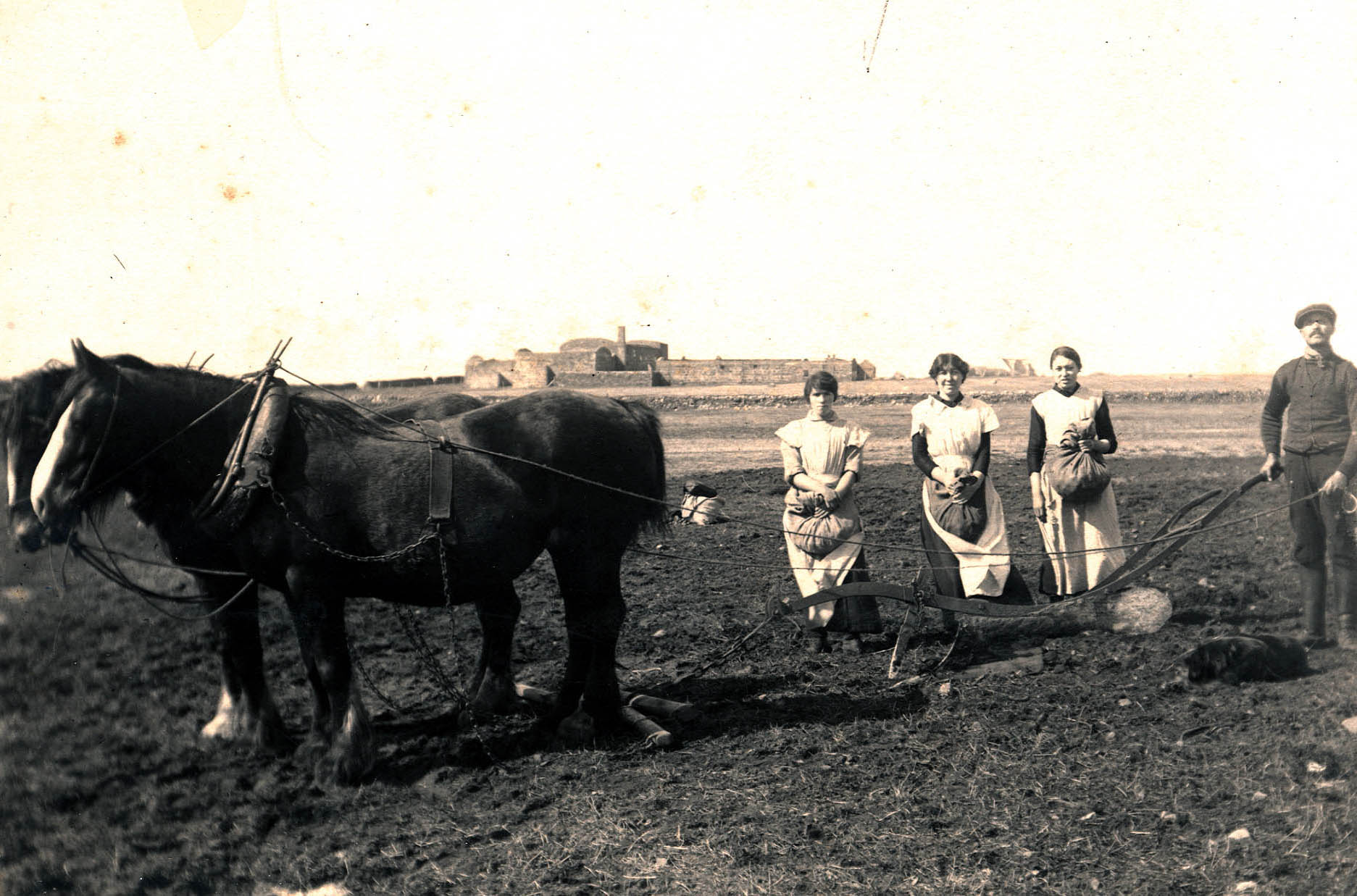
Planting potatoes at Middleton in the 1920s

Photograph of Alasdair MacDonald planting potatoes with Lizzie MacArthur, Effie and Mary Ann MacDonald at Middleton in the 1920s.
k48.jpg

Courtesy of Mr Lachie MacDonald

Taken in the 1920s, the photograph illustrates a standard plough used to prepare the ground for sowing corn. Because of the fine sandy soil in most of Tiree, a ridger was not successful.

The women followed in the furrow planting potatoes from the supplies heaped in their sack aprons and the ploughman made a second furrow to cover them. This process was repeated leaving a 45 cm space between the planted furrows for the grubber.

The Middleton seaweed factory operated by the North British Chemical Company can be seen in the background. Known locally as the Glassary, it ceased operation in 1901 and was demolished during World War II.

Black and white photograph of Alasdair MacDonald planting potatoes at Middleton in the 1920s.

Planting potatoes at Middleton, with the Glessary (as it was known) in the backgound in the 1920s. L-R: Lizzie MacArthur, Middleton and Greenhill – aunt of John MacArthur, Middleton Farm; Effie MacDonald, married to the late Archie Walker, Coll and Kenovaay, Tiree – aunt of Lachie MacDonald , Middleton; Mary Ann MacDonald – aunt of Lachie MacDonald, Middleton; Alasdair MacDonald – father of Lachie MacDonald, Middleton. The photograph illustrates a standard plough used to prepare the ground for sowing corn. Because of the fine sandy soils in most of Tiree, a ridger was not successful. Instead, the standard plough was used and the women followed in the furrow with supplies of potatoes heaped in their sack aprons. The ploughman made a second furrow to cover the potatoes. The same process was repeated thus leaving an 18 inch (45cm) space between planted furrows to allow the grubber to be used.

1998.184.4

The seaweed factory at Middleton

Photograph of the remains of the seaweed factory at Middleton.

p29.jpg

Courtesy of Mr Donald MacKinnon

The kelp forests around Tiree are the fourth largest in Scottish waters. This abundance fuelled the seaweed industry on the island which, for a hundred years, produced alkali for soap and glass manufacture, and for bleaching linen.

Undercut by cheap foreign imports, the industry slumped from the 1830s until the 1860s when the North British Chemical Company appointed as manager a brilliant young chemist, Edward Curtis-Stanford. He arrived in Tiree in 1864 to supervise the building of the factory at Middleton, known locally as the Glassary.

Until 1901 the factory extracted iodine and alginates from the tangles, selling the residual charcoal as fertilizer and deodorants for earth closets, and using the gas produced by the process to light the buildings. Most of the factory was demolished in 1941 to provide the foundations of the runways built at the Reef for the RAF station.

Black and white photograph of the old seaweed factory at Middleton.

The old seaweed factory at Middleton in the early 20th century.

2003.175.1

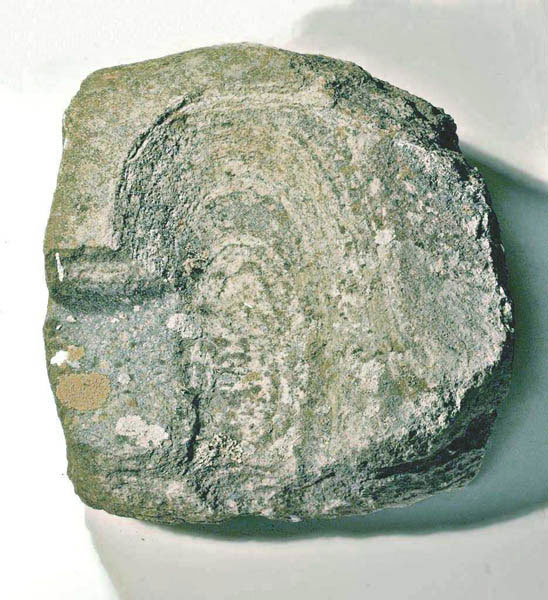
Saddle quern found in Moss.

Saddle quern

Courtesy of Catriona McLeod

Saddle querns are the most ancient and widely used type of quern-stone. This one was found in Moss in the mid-1980s and may date back to Neolithic times. It was used with a rubbing stone held in the hand, a process that crushed the grain rather than ground it.

Considered women’s work, preparing grain using a saddle quern would have taken many hours and placed great strain on the body, particularly the toes, knees, hips and lower back. They continued in use into the medieval period and were superseded by rotary querns.

Turnbull, in a report on Tiree written in 1768, wrote that meal was made ‘with querns or hand mills which appears to be an expensive and troublesome method. Two women at once, or sometimes three, are commonly employed. By this means there is so much of their time taken up that it greatly retards them from other industry.’

Tiree in 100 Objects – 2 – Saddle Quern

The History of Tiree in 100 Objects

1998.174.1

Black and white postcard of Am Bail`Ur / The New Village, Balephuil, around 1900.

r2.jpg

Postcard of Bail`Ur, Balephuil around 1900. Houses L-R: Taigh Iain Bhlac (his first thatched house at present-day cattle-grid); Taigh Iain ’ic Dhòmhnaill Mhòir (MacDonald); Taigh Mòr an Tuathanaich / Dhomhnaill Mhic Nèill (MacNeill); Taigh Nèill Òig / Chaluim Nèill Òig (Sinclair); Taigh Dhonnchaidh Mhurchaidh (Campbell); Bùth Iain ‘ic Dhòmhnaill Mhòir (MacDonald); Taigh Sheumais Bhàin (MacDonald); Taigh Fhearchair/Taigh Chailein Fhearchair (MacDonald); Taigh MhacÀidh (Mackay) / Ealasdair Iain Mhòir / a’ Ghreusaiche  (MacArthur); Taigh Màiri Bheag; Taigh Ealasdair Bhrùin (Brown); Bùth/Taigh Ealasdair Lachainn (Mackinnon); Taigh Dhòmhnaill ‘ic Lachainn (Mackinnon); Taigh Chlèabhair (John Kennedy); Taigh na Coinneimh /  Balephuil Mission House; Taigh Chaluim Nèill (Brown); Taigh Ghilleasbaig Chaimbeil (Campbell)

Amendments to house names provided by Ailean Boyd, Balephuil.