


O/S map sheet LXXVIII.7.
Map of the Balinoe/Balemartine/Mannal area at a scale of 25 inches to mile (1:2,500).

O/S map sheet LXXVIII.7.
Map of the Balinoe/Balemartine/Mannal area at a scale of 25 inches to mile (1:2,500).
John Fletcher talking about writing at school
Sound clip in English of John Fletcher of Balemartine talking about the writing materials he used at school in the late 1940s.
Courtesy of Mr John Fletcher
John Fletcher talks to Maggie Campbell in September 2005 about learning to count and write at Balemartine School in the late 1940s. There were around eighty children attending the school, which was one of five on the island.
At break-time the children were given hot reconstituted National Dried Milk in tin mugs. John drank it quite happily but some of the children hated the taste, comparing it with the fresh milk they got at home.
Toilet facilities at the school were basic: buckets with blue disinfectant, two for the boys and two for the girls. These were taken down to the shore by the cleaner at night and thrown into the sea.
Sepia postcard of Balemartine postmarked 1911.
Postcard of `Taobh na Mara`, Balemartine, postmarked 1911.

Sepia photograph of Margaret MacDonald and Malcolm MacKinnon of Balemartine.
Margaret MacDonald (Magaidh Dhòmhnaill ’ic Eòghainn) and butcher Malcolm MacKinnon (Calum bùidsear) with a collie dog at Balemartine in the 1930s.

Sepia photograph of Margaret MacDonald, Flora Campbell and members of Margaret`s family at Balemartine sliabh.
Balemartine sliabh in the 1930s. L-R: Maggie MacDonald (Magaidh Dhòmhnaill ’ic Eòghainn); Maggie`s nephew and his mother, Maggie`s sister (married surname MacPhee); Maggie`s brother Donald MacDonald.

Sepia photograph of Margaret MacDonald and members of her family.
Balemartine sliabh in the 1930s. L-R: Maggie MacDonald (Magaidh Dhòmhnaill ’ic Eòghainn), her sister Mrs MacPhee and her sister`s son, Neil Campbell astride the Clydesdale horse and Maggie`s brother, Donald MacDonald.

Packed lunches and school dinners in the 1940s
Sound clip in English of Janet MacIntosh talking about packed lunches and school dinners in the 1940s.
Courtesy of Mrs Janet MacIntosh
Janet MacIntosh was recorded in August 2005 talking to Maggie Campbell of Kilmoluaig about her schooldays in Balemartine in the 1940s. She remembers how ‘wonderful’ hot school dinners were compared to packed lunches.
When she was a child, the diet on Tiree was plain and simple. White and brown flour and oatmeal came in hundredweight bags and were stored in the ‘girnel’, a wooden chest with a lid and internal partitions, that kept the mice out. Housewives baked every day.
More fish was eaten than meat; there were few vegetables other than potatoes and no fruit. Food from the shore was also eaten: soup made with whelks (winkles) and oatmeal, or with dulse, and milk puddings made with carrageen.
Port an Tobair at Balemartine
Photograph of Port an Tobair at Balemartine in 2004.
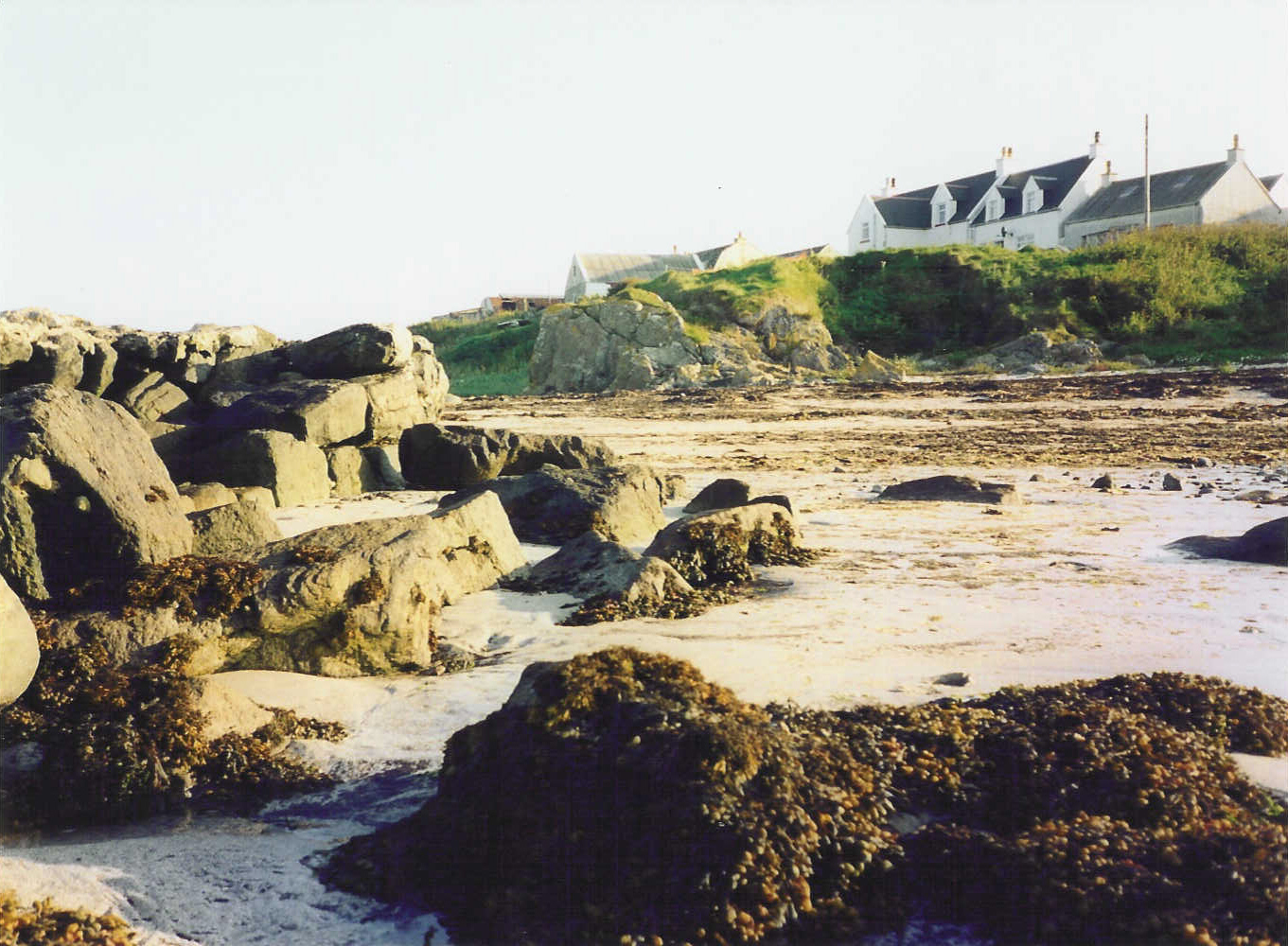
Envious of the success of the Dutch fishing fleet in the North Sea, the British Government established the Fishery Board in 1809 to promote fishing around Britain. In 1824, the Board commenced a programme of pier building funded with contributions from landlords.
In 1847 at the height of the potato famine, the 8th Duke of Argyll paid £690 as his share of the cost to build four piers in Tiree at the Green, West Hynish, Balemartine and Milton. The Balemartine pier was built at Port an Tobair (harbour of the well) and at its busiest twelve boats used it.
Exposed to winter storms, the pier was repeatedly damaged. In 1902 thirty fishermen wrote to the County Clerk asking for it to be repaired. In 1912 the 9th Duke of Argyll and Lord Archibald Campbell contributed to its repair but it was finally destroyed by a storm in 1936.
Colour photograph of Port an Tobair at Balemartine in 2004.
Port an Tobair at Balemartine photographed by Dr John Holliday in 2004.
The shed at Balemartine with the roof made from an old boat, photographed by Dr John Holliday in 2004.

The unpredictability of the sea quite naturally bred a strong sense of the magical and superstitious amongst Tiree’s fishermen. Everything had to be done sun- or clock-wise. Boats were always pushed into the sea stern first and then turned ‘deiseal’, clock-wise.
Women were thought to be unlucky in or near a boat. It was widely thought that it brought misfortune to have a minister on a boat. Even meeting a minister on the way to fishing was a bad sign. If anyone called after a fisherman going to sea it was unlucky and they turned back.
It was bad luck to burn a boat and the old fishermen would pull boats that were no longer seaworthy up on the shore and leave them to rot. Sometimes old boats were made into roofs for outhouses as in this photograph taken in Balemartine.
Mini-disk recording of Alasdair MacArthur, Balemartine talking to Maggie Campbell in May 2005.
Alasdair MacArthur (Alasdair Sheumais Alasdair) of Balemartine talks to Maggie Campbell in May 2005 about his life both at sea and on land, his time on the ferry ‘The Heb’ and how he progressed to achieve honorary seaman status.
