Gott Bay pier in the 1920s
Photograph of a pig being hoisted aboard a steamer at Gott Bay pier in the 1920s.
Courtesy of Mrs Grace Campbell
In this photograph taken in the 1920s, a pig is being hoisted by a rope sling aboard a small steamer at Gott Bay pier. Canvas slings were more commonly used, but even so the pigs used to scream most horribly while in the air.
The Statistical Account of 1845 records that ‘a great number of pigs have been reared in this parish… They are generally exported alive chiefly to Glasgow and Greenock… Last spring upwards of 500 were shipped off from this island.’
The Agricultural Statistics for Tiree show that in 1867 there were only 260 pigs on the island. In 1910, the numbers had increased to 360, half of which were breeding sows. However, after 1910 the numbers declined steadily and by the mid-1960s there were none on the island
Black and white photograph of a pig being hoisted off a boat.
A pig being hoisted on or off a boat, probably taken in the 1930s.
Black and white photograph of crofters carting marram grass for thatching.
Two crofters carting marram grass for thatching behind Ben Hough in the 1930s or 1940s.
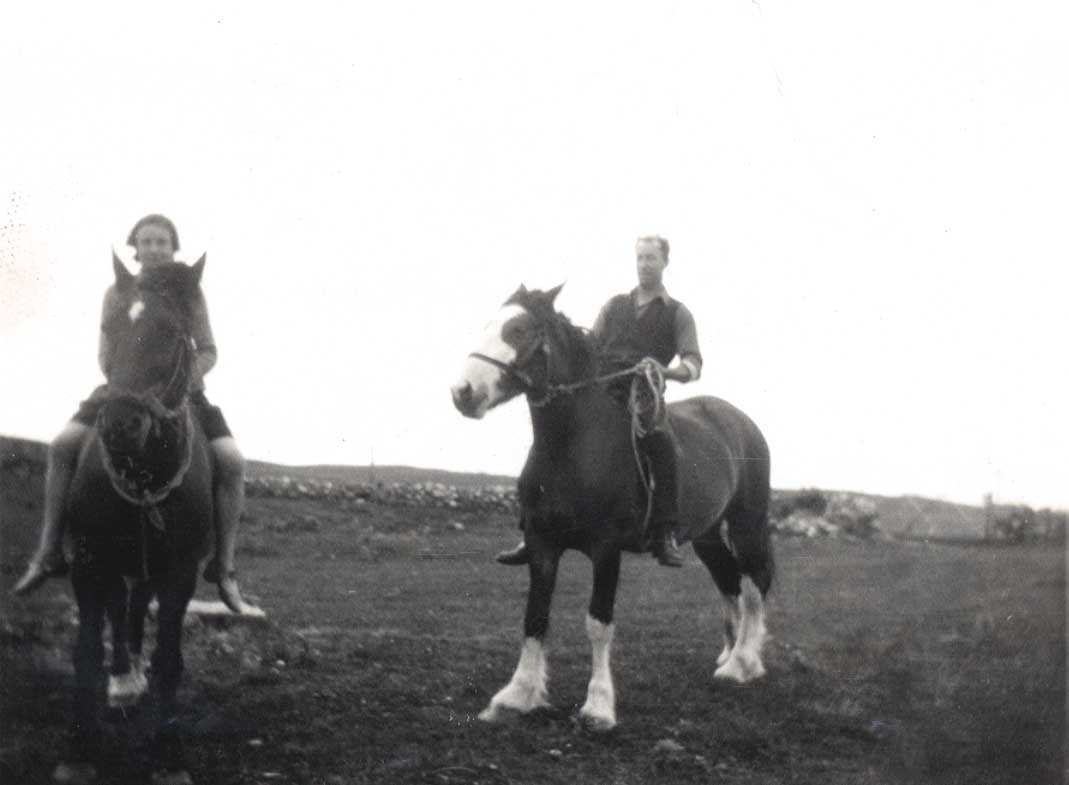
Black and white photograph of Grace Campbell and Duncan MacPhee.
L-R: Grace Campbell of Tullymet and Duncan MacPhee of Scarinish astride Russell and Gypsy in the late 1930s.
Colour photograph of Alasdair MacDonald, Kilmoluaig.
Alasdair MacDonald, Kilmoluaig milking a cow into a `tanger`, used to milk cows that kicked and to measure feed for calves.
Black and white photograph of Elizabeth MacMaster, Kenovay.
Elizabeth MacMaster, Kenovay at milking time at Cnoc Gorm, probably taken in the 1940s.
Black and white photograph of John Hume, Heylipol Farm.
John Hume shearing sheep at Heylipol Farm in the 1940s.
Shearing sheep at Heylipol Farm in the 1940s
Photograph of sheep-shearing at Heylipol Farm in the 1940s.
Courtesy of Mrs Cathie Omand
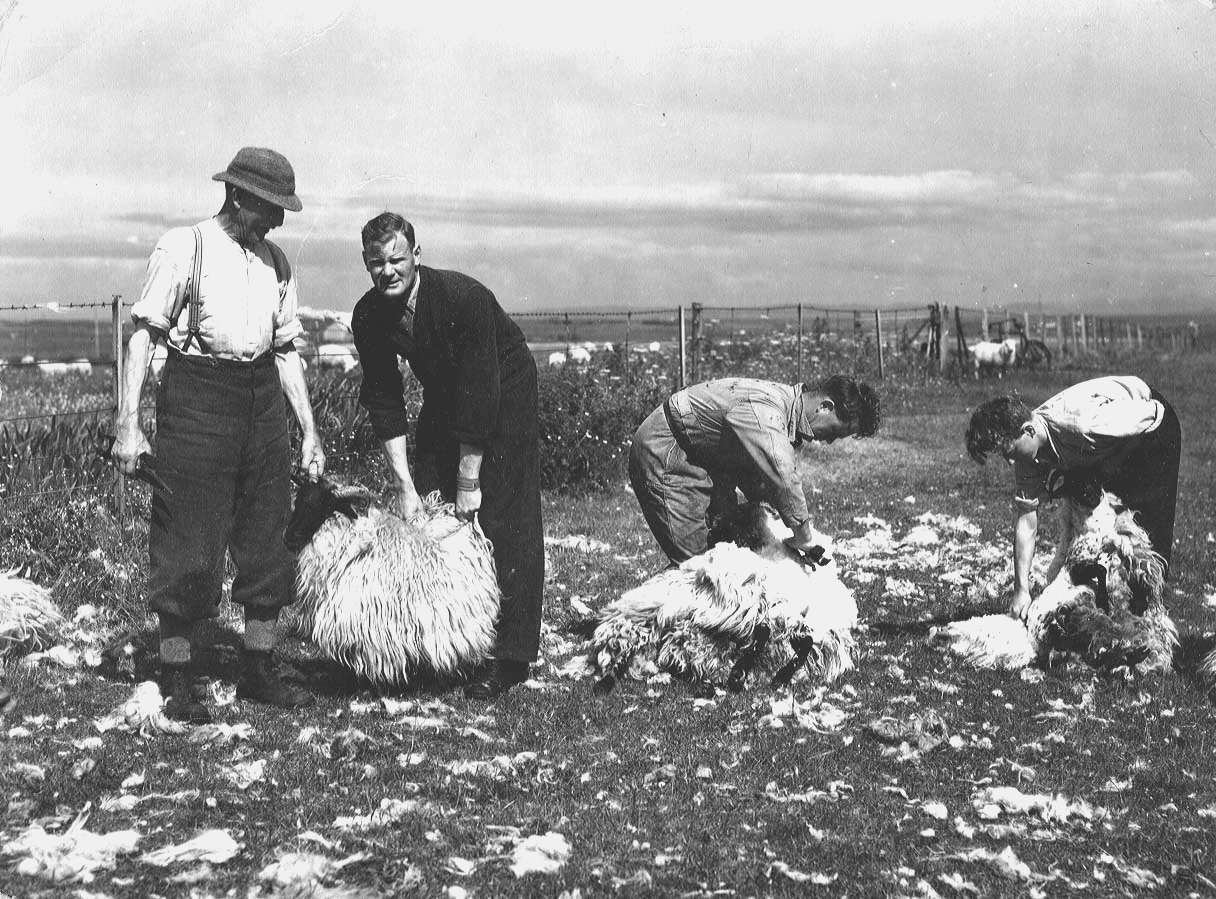
From left to right, farm manager John Hume, factor Iain MacLaren, Lachie MacFarlane of Hynish and Neil MacLean of Heylipol are clipping black-faced sheep at Heylipol Farm using hand shears in the 1940s. Hogs are sheared at the end of May or the beginning of June. Sheep with lambs are sheared in July when the weather is warmer.
Crofters would send their best Cheviot fleeces to the Scottish Wool Growers mill in Brora on the Moray Firth to be made into blankets or spun into hanks known as ‘snath Gaidhealach’ (Highland wool). Wool prices plummeted in the 1980s coinciding with increasing use of feather duvets.
In Tiree nowadays, Suffolk tups (rams) are commonly put to ‘mule’ ewes, a black-face/Blue Leicester cross. The Blue Leicester input maintains the quality of the fleece and produces a larger lamb.
Black and white photograph of sheep-shearing at Heylipol Farm in the 1940s.
Sheep-shearing at Heylipol Farm in the 1940s. L-R: shepherd John Hume; factor Iain MacLaren; Lachie MacFarlane, Hynish; Neil MacLean, Heylipol Farm.
Report `Farm Study` by Julie MacInnes of Shawlands Academy.
Report by Julie MacInnes (part of the coursework for unknown qualification taken at Shawlands Academy) which examines the characteristics of crofting and how it is affected by the physical environment and distance from markets. Looks in details at two crofts – Donald Kennedy`s croft in Balevullin and Corrairigh in Cornaigbeg.
Catalogue for United Auction sale on 15/2/2003.
Catalogue for United Auction sale on 15/2/2003 of suckled calves, store and breeding cattle, giving vendor`s name and township and a decsription of stock for sale.
Photocopied newspaper cutting about Tiree lamb sales in August 2002.
Page of photographs about the August 2002 lamb sales at Crossapol. One photograph of Euan MacKinnon, Huillcrest.