Photograph of a pair of knickers made from a flour sack.
These women’s knickers were made in Tiree from a flour sack in the first quarter of the 20th century. The isolation of the crofting community on Tiree made it necessary to make do with the materials to hand.
The knickers were sewn by machine with flat seams and decorated with hand-made tatting round the legs. The waist may have been elasticated or tightened with a drawstring.
Flour was purchased in 140 lb (65 kg) sacks made from closely woven cotton. The seams would have been unpicked and the material plastered with black soap (‘siaban dubh’) to remove the printing before putting it outside to bleach in the sun. The flour producer’s name, Harter, is still visible.
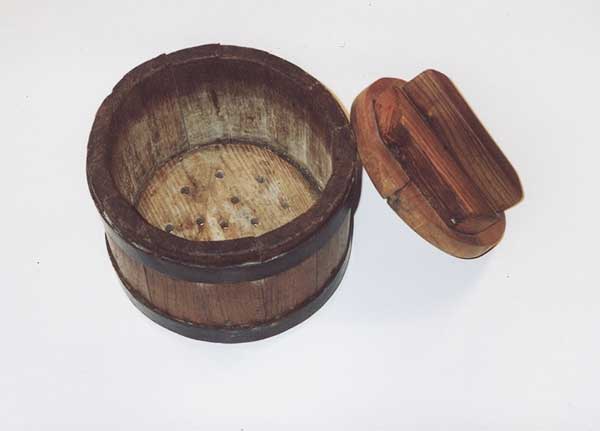
Probably made at the end of the 19th century by Donald MacLean of Whitehouse, Cornaigbeg, this wooden vat (known in Gaelic as a ‘fiodhan’) would have been used until the 1950s to make cheese.
Standing 165 mm high and with a diameter of 250 mm, the staves are bound with two iron hoops. Holes have been drilled in the sides and base to allow the whey to drain out.
The curds wrapped in muslin would be put in the vat and the lid placed on top. This would be weighted with stones or screwed down in a cheese press for about a week.
Black and white photograph of a horn spoon, a serving mallet and a butter pat.
Horn spoon from Balevullin (left); serving mallet made of whalebone found in a ruined cottage in Caoles (middle); wooden butter pat (right), all photographed by George Holleyman.
Isabella MacLean of Kilmoluaig using a cheese press
Photograph of Isabella MacLean of Kilmoluaig using a cheese press.
Courtesy of Ms Linda Gowans
Isabella MacLean was photographed using a cheese press in Kilmoluaig by George Holleyman, an archaeologist posted to RAF Tiree during World War II. The press was made in the local smiddy. The screw, which turns through an iron hoop set into a large stone, tightens on to the wooden cheese vat, removing excess whey.
Rennet was used to curdle the warmed milk and sometimes salt was added or caraway seeds. The curds were squeezed by hand, wrapped in muslin, put in the cheese vat and pressed. The whey would be fed to calves.
After two to three days, the press would be screwed down another turn. The cheese would be left there for a week then put on a shelf to dry and form a skin. It would be ready for eating in a fortnight.
Black and white photograph of Isabella MacLean, Kilmoluaig.
Isabella MacLean is pictured here using a cheese press made in the local smiddy. The screw, which turns through an iron hoop set into a large stone, tightens on to the wooden cheese vat, removing excess liquid. Rennet was used to curdle the warmed milk and sometimes salt was added, or caraway seeds. The curds were squeezed by hand, wrapped in muslin, put in the cheese vat and pressed. The whey would be fed to calves. After 2-3 days, the press would be screwed down another turn. The cheese would be left there for a week then put on a shelf to dry and form a skin. It would be ready for eating in a fortnight. The cheese press is part of An Iodhlann`s collection.
Photograph of Marion MacDonald churning butter at Sandaig in the 1940s.
Courtesy of Ms Linda Gowans
Marion MacDonald was photographed by George Holleyman churning butter outside her thatched house in Sandaig during World War II. The churn consists of a narrow wooden barrel (about 300 mm wide and 650 mm tall) and a plunger. At the end of the plunger is a wooden disc with holes drilled in it.
Milk would be left to stand in a metal basin and the cream skimmed off using a saucer or clam shell into an earthenware butter crock. The cream would be strained through muslin into the scalded churn and agitated using the plunger.
Once the butter had formed, it was put into cold water then slapped between the hands to remove excess liquid. The remaining buttermilk would be drunk or used for baking.
Black and white photograph of Marion MacDonald, Sandaig.
Marion MacDonald is pictured churning butter outside her thatched house in Sandaig, Tiree. The churn consists of a narrow wooden barrel (about 300 mm wide and 650 mm tall) and a plunger. At the end of the plunger is a wooden disc with holes drilled in it. Milk would be left to stand in a metal basin and the cream skimmed off using a saucer or clam shell into an earthenware butter crock. The cream would be strained through muslin into the scalded churn and agitated using the plunger. Once the butter had formed, it was put into cold water then slapped between the hands to remove excess liquid. The remaining buttermilk would be drunk or used for baking.
Newspaper article and photo about Tiree woman appearing on TV programme `Good Morning with Ann and Nick`.
The appearance on TV programme `Good Morning with Ann and Nick` of Mary Davies, Flora MacDonald, Bella MacKinnon, Peggy Cameron, Nonnie MacFadyen, Elspeth Gillies and Monica Smith in 1993.
Audio cassette recording of Hector MacPhail interviewed by his daughter Winnifred Dowl in Ontario in July 1979 and again in June 1982.
Hector MacPhail talks to his daughter Winnifred Dell in July 1979 and June 1983 about his early childhood memories of Tiree, emigrating with his family to Ontario, Canada in 1903, his life and work in Canada and buying his own farm in 1920, and his family.