John MacFadyen of Scarinish
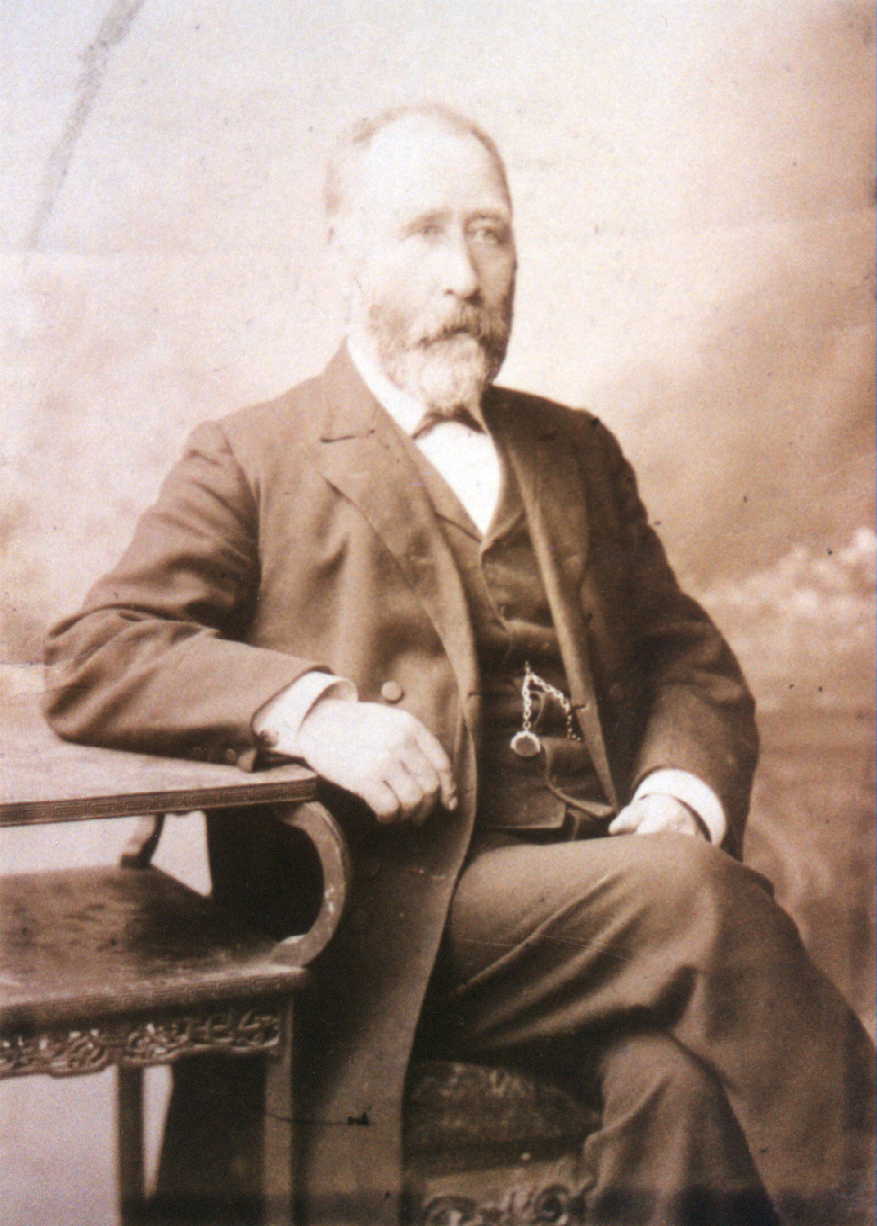
Photograph of John MacFadyen of Scarinish in the 1950s.
Courtesy of Dr Hugh Kennedy
John MacFadyen (Iain Sheumais) of Scarinish went round the island with his pony and trap in the 1950s selling fish. He was also the piermaster at Gott Bay pier for many years.
Black and white photograph of John MacFadyen, Scarinish.
John MacFadyen (Iain Sheumais) of Scarinish who went round selling fish in the 1950s. (Original in Filing Cabinet 8 drawer1)
The first plane to land on Tiree
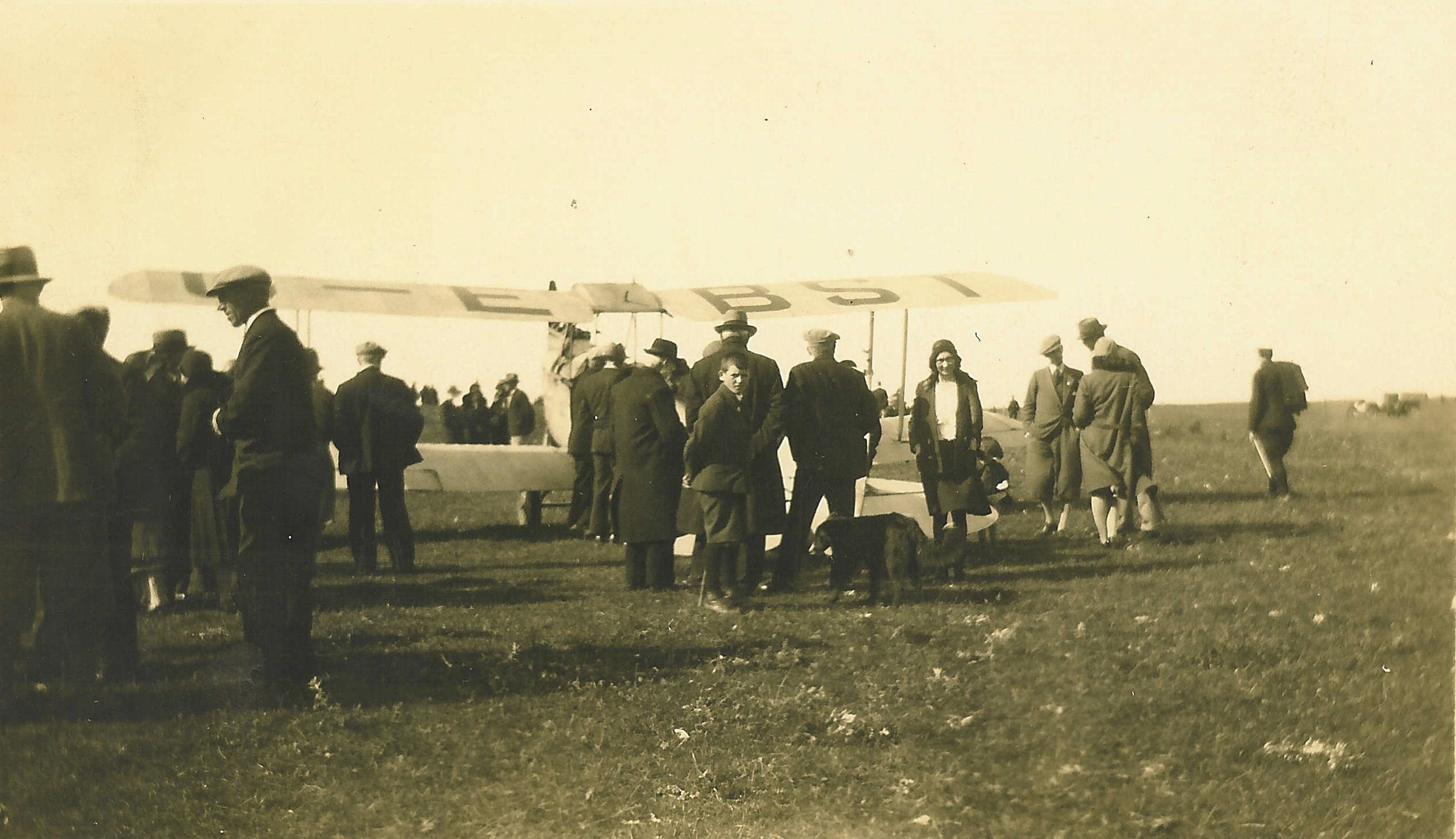
Photograph of the first plane to land on Tiree in 1929.
Courtesy of Dr Hugh Kennedy
The first plane to land on Tiree was brought out by the Glasgow Tiree Association for their Sports Day held on the Reef on the18th July 1929. Piloted by Captain A. N. Kingwill, the two-seater Moth had the logo of Manchester Airlines painted on its side.
Islanders gathered on the top of Cnoc nan Deilgeanan in Crossapol to witness the landing. The plane carried on board a supply of the day’s newspapers including the Glasgow Evening Times which contained a message to the islanders in Gaelic from the editor.
Short flights on the plane were on offer at 2/6d (12p) a time and Captain Kingwill gave a display of aerial manoeuvres. Over the next few years, the Tiree Association brought out a number of small planes for the sports.
Black and white photograph of Tiree Association Sports Day in the late 1920s.
Tiree Association Sports Day in 1927 or 1928. Captain A. N. Kingwill was hired to fly the first plane to the island, bringing with him the day’s newspapers. Short flights on the plane were on offer at 2/6d (12p) a time and Captain Kingwill gave a display of stunt-flying. (Original in Filing Cabinet 8 drawer1)
Black and white photograph of Dolly MacCallum with a visitor outside her café in Crossapol around 1960.
Dolly MacCallum outside her café at Viewfield, Crossapol with a visitor around 1960.
Rev. Allan MacDougall
Photograph of Rev. Allan MacDougall.
Courtesy of Mrs Catriona Finnegan
Born in Caoles in 1846, Allan MacDougall first worked as a fisherman. He was converted by Rev. Archibald Farquharson whom he accompanied on preaching tours of Perthshire. While there he met the Baptist pastor Rev. Alexander MacDougall and was baptised by him.
Allan assisted John and Duncan MacFarlane during the Baptist revival on Tiree in 1874. He then moved to Broadford in Skye where he was twice pastor (1875-1878 and 1885-1920). In the intervening years he was pastor at Bunessan in the Ross of Mull.
He married a woman from Skye, Catherine MacDonald, with whom he had seven children. His son, Neil, became headmaster of Ruaig School. In 1920 Allan retired to Milton where he lived until his death in 1938.
Black and white photograph of Rev. Allan MacDougall.
Baptist minister Rev. Allan MacDougall of Caoles, 1846-1938.
Black and white photograph of a coal puffer at Hynish pier.
The coal puffer `Starlight` at Hynish pier, c. 1920 – 1940.
John and Christina MacPhail of Balinoe
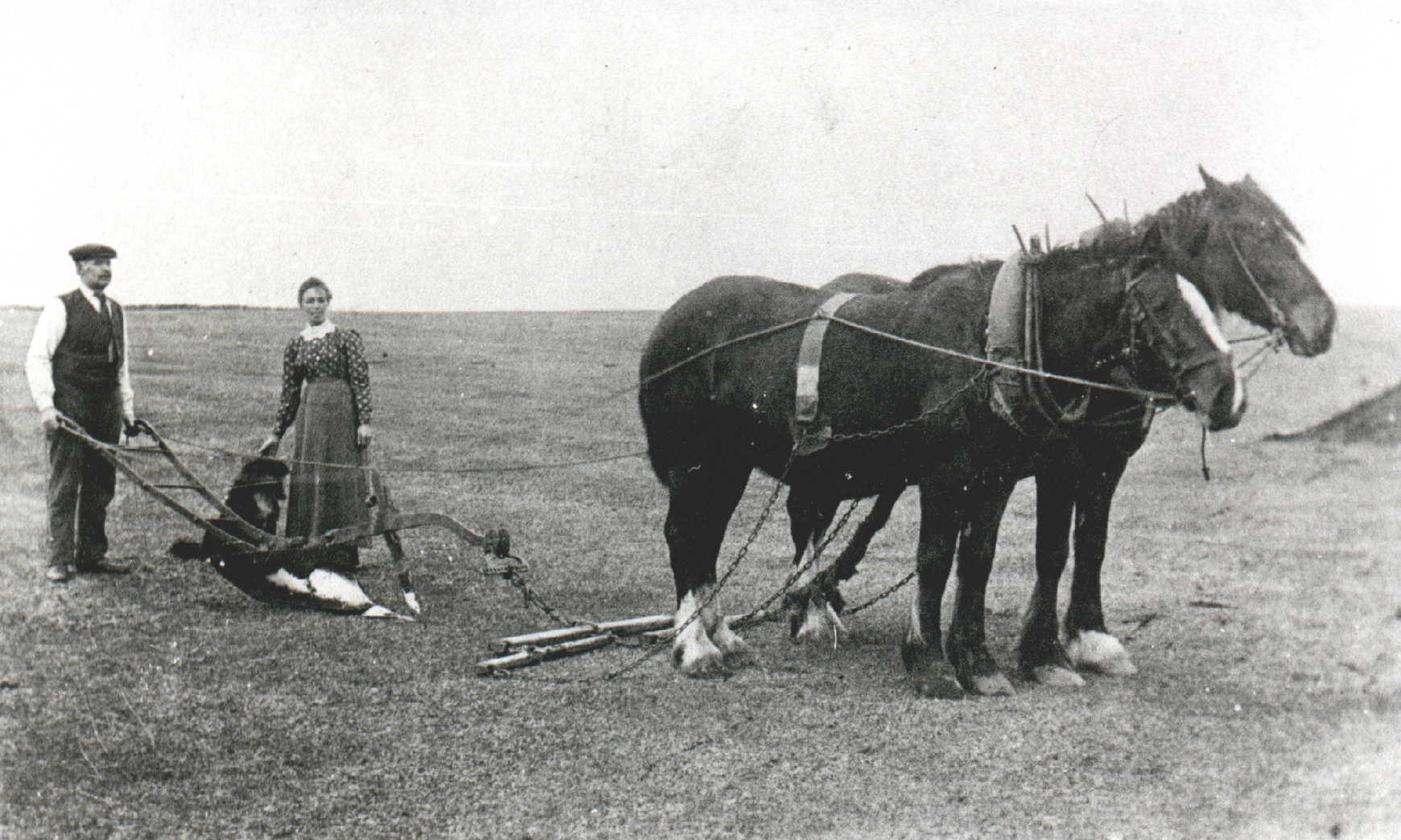
Photograph of John and Christina MacPhail of Balinoe.
Courtesy of Mrs Mairi Campbell
John MacPhail (Iain Eacha’ Ruaidh) and his wife, Christina (Hutty Nèill an Tuathanaich), of Balinoe are pictured with a standard plough used for preparing the ground for sowing corn and potatoes.
Out of his working clothes, the crofter is celebrating the end of his spring ploughing. The polished ploughshare is oiled and ready to be returned to the implement shed until the autumn when it will be used for opening potato drills.
The plough is hitched to two exceptionally well-bred Clydesdales of the Tiree type. Introduced in the 1870s, Clydesdales were crossed with local ponies to produce lighter and faster draught animals for which Tiree was famous in the early 20th century.
Black and white photograph of John and Christina MacPhail of Balinoe.
L-R: John MacPhail (Iain Eacha` Ruaidh) of Balinoe and his wife Christina (Hutty Neill an Tuathanaich) with a plough drawn by two exceptionally well-bred Clydesdales of the Tiree type. Out of his working clothes, the crofter celebrates the end of his spring work. Note the polished ploughshare is oiled and ready to be returned to the implement shed till next spring. (Crofting details supplied by Donald MacIntyre, Gott)
Two men building a corn stack
Photograph of two men building a corn stack.
Courtesy of Mrs Mairi Campbell
The two men are building a corn stack or ‘mulan’ which will provide winter feeding for horses, cattle and hens and seed for spring sowing. In the background is a row of haystacks. Corn stacks were built with the heads of the sheaves to the centre so the finished stack contained a column of seed.
Four sheaves were placed upright in the centre with further sheaves added around the centre, working clockwise. The sheaves were always kept with the seed uppermost so any moisture would run away from it down the straw.
The diameter of the stack was carefully measured using a special rope, either six or seven fathoms long, marked with a knot at one end and a block at the other. The stack was re-measured every two rows to keep it straight. These traditional methods are still in use today by a few crofters on the island.
Black and white photograph of building a cornstack at Whitehouse.
The two men are building a corn stack which will provide winter feeding for horses, cattle and hens and seed for spring sowing. In the background is a row of haystacks. At harvest time, the cut corn would be bundled by hand into sheaves, six of which would be stood together to form stooks. When sufficiently dry, the stooks would be transported by horse and cart to the stackyard. Corn stacks were built with the heads of the sheaves to the centre so the finished stack contained a column of seed. These traditional methods are still in use today by a few crofters on the island.
Tobar Eachainn
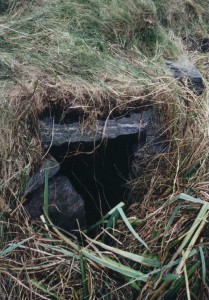
Photograph of Tobar Eachainn at Kirkapol.
Tobar Eachainn (Hector’s Well) is situated on the west bank of Kirkapol stream a hundred metres to the east of Kirkapol graveyard. Formerly known as Tobar Odhrain (Oran’s Well), its waters were said to have healing properties.
St Oran was a relative and a disciple of St Columba. He possibly spent time in Tiree as the larger of the two graveyards at Kirkapol is also dedicated to him. Evidence of the foundations of a chapel was uncovered there by a grave-digger in the late 19th century.
The well is a natural spring which is enclosed within dry-stone walls and roofed with turf-covered slabs. It was closed as a source of drinking water in the 1940s because of its close proximity to the graveyard.
Colour photograph of Tobair Eachainn.
Tobair Eachainn, once known as Tobair Odhrain, on Lodge Farm.
Black and white photograph of excavated human remains in one of the Kirkapol chapels.
Excavated human bones in the larger of the Kirkapol chapels, St Columba`s, taken in 2001.
Colour photograph of a cross carved on a rock.
Cross carved on a rock near the Kirkapol chapels photographed in 2001.