The Remembrance Service in 1921
Photograph of the Remembrance Service at the War Memorial in Scarinish in 1921.
Courtesy of Mrs Jean Lindsay
Picture of Hugh Cameron watching the Remembrance service held on Tiree at the Scarinish War Memorial.
Black and white photograph of Hugh Cameron at the 1921 Remembrance Day service.
Hugh Cameron (right) with two pipers, Hugh MacArthur of Tullymet and Hugh Campbell of Port Glasgow, at the 1921 Remembrance Day service at the War Memorial in Scarinish.
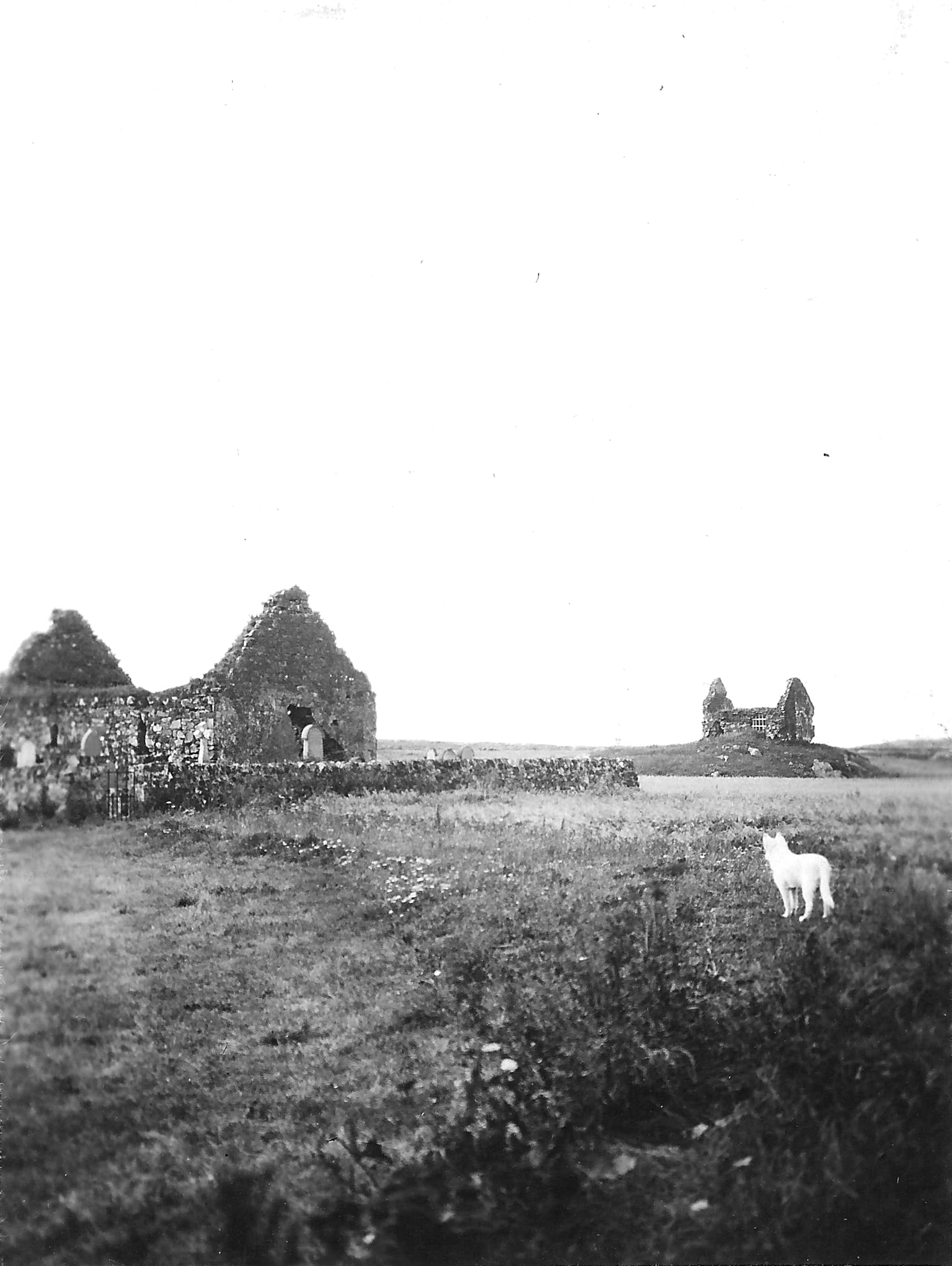
Black and white photograph of the Kirkapol Chapels in 1912.
The Kirkapol chapels with Lady Frances Balfour`s samoyed, Vaul, in the foreground, taken in 1912.
Minesweepers off Tiree during World War I
Photograph of minesweepers off the coast of Tiree during World War I.
Courtesy of Mrs Jean Lindsay
World War I had a devastating impact on Tiree. The Roll of Honour lists two hundred and ninety men who served in the conflict and the Scarinish War Memorial records the names of sixty-six who died.
Apart from the occasional fighting ship seen on the skyline, and the attack by a U-boat on the ‘Plover’ north of Coll, the Great War was predominantly a distant conflict, fought in the trenches of Europe and the oceans of the world.
The war was foretold by Tiree’s most famous seer, John MacLean (Iain MacEachainn Bhàin), who said, ‘There is a great war coming soon… On sea and land the losses will be heavy and in a land which is unknown to me, the ground will be soaked in blood. Millions will go to their eternal rest in the soil of this land and beautiful red flowers will grow over them.’
Black and white photograph of minesweepers off the coast of Tiree during WW1.
Five minesweepers off the coast of Tiree during WW1.
Scarinish Post Office in 1919
Photograph of the postmistress and postmen at Scarinish Post Office in 1919.
Courtesy of Mr Angus MacLean
The postmistress, Margaret Robertson (centre right), is pictured seated beside veterinary surgeon, John MacDougall, outside the old Post Office in Scarinish which was originally established in 1802
The postal service was extremely irregular and uncertain until 1863 when mail packets were conveyed to and from Tiree at public expense. Telegraphy arrived in Tiree two years too late for reporters covering the Crofters’ War in 1886. They had to resort to carrier pigeon to send urgent despatches.
The first telephones were installed in Tiree in the mid-1920s but were restricted to official use for the transmission of telegrams. In 1941 the first public call box was installed at Crossapol for the benefit of the airfield construction workers.
Black and white photograph of the postmistress and postmen at Scarinish Post Office in 1919.
The postmistress and postmen at Scarinish Post Office in 1919. L-R: (standing) Archibald MacLean, `Bayview`, Scarinish; Donald MacDougall, Kilmoluaig; (in carriages) Hugh Lamont, Ruaig; Mary MacNeill; Jack Munn, Heanish; John MacDougall, vet; Margaret Robertson, Scarinish (postmistres); unknown; unknown. (Original photograph – 1997.178.1)
Lifting potatoes at Ruaig
Postcard of the potato harvest at Ruaig in the mid-1920s.
Courtesy of Mr Angus MacLean
Potatoes were first grown in the Hebrides in 1743 when they were brought back to South Uist from Ireland by MacDonald of Clanranald. His tenants were unwilling to plant them and brought the crop to his house as they refused to eat them.
However, by 1800 potatoes had become the main food crop in the islands, including Tiree. They produce three to five times as many calories as grain from the same area of land. Potatoes are also a much more dependable crop than oats and barley, which can be flattened overnight by a storm.
Dependable, that is, until 1846, when the fungus causing potato blight caused widespread starvation in Europe. It is said that West Hynish was the only area of Tiree to be unaffected. This postcard shows Nancy and Alexander MacInnes in the foreground harvesting potatoes in Ruaig in the mid-1920s.
Black and white photograph of potato lifting at Ruaig.
Lifting potatoes at Ruaig, c. 1925-6, with Nancy and Alexander MacInnes in the foreground (Duncan MacInnes`s aunt and great-uncle).
Black and white postcard of drawing of Caoles.
Drawing of Caoles with cultivated fields, crofthouses, stackyards and a view of Coll in the background.
Corn stooks at Ruaig
Postcard of corn stooks at Ruaig in the mid-20th century.
This postcard shows a field of corn stooks at Ruaig in the mid-20th century. The corn was cut and bound into a ‘sguab’ (sheaf) using two handfuls pulled from the sheaf to make a ‘bann’ (tie). These were lined up into an ‘adag’, a short double row of eight to ten sheaves.
The old men were very particular to line up the row of ‘adagan’ in the field so that you could see ‘gobhal na h-adaig’ (the gap between the sheaves) from one end of the field to the other. If cut slightly unripe because of the weather, the sheaves were turned every day until they ripened.
Harvesting was hard, thirsty work and a tin of ‘sùgh min-choirce’ (cold well water mixed with oatmeal) was kept in the shade of an ‘adag’ to provide a refreshing drink.
Black and white postcard of Ruaig.
Ruaig with corn sheaves in the foreground and L-R Taigh Eoghainn Iain na Hongs (Ruaig Post Office in the 1930s) and Taigh Dhonnchaidh or Alasdair Dhonnchaidh (Ruaig Post Office in the 1970s).
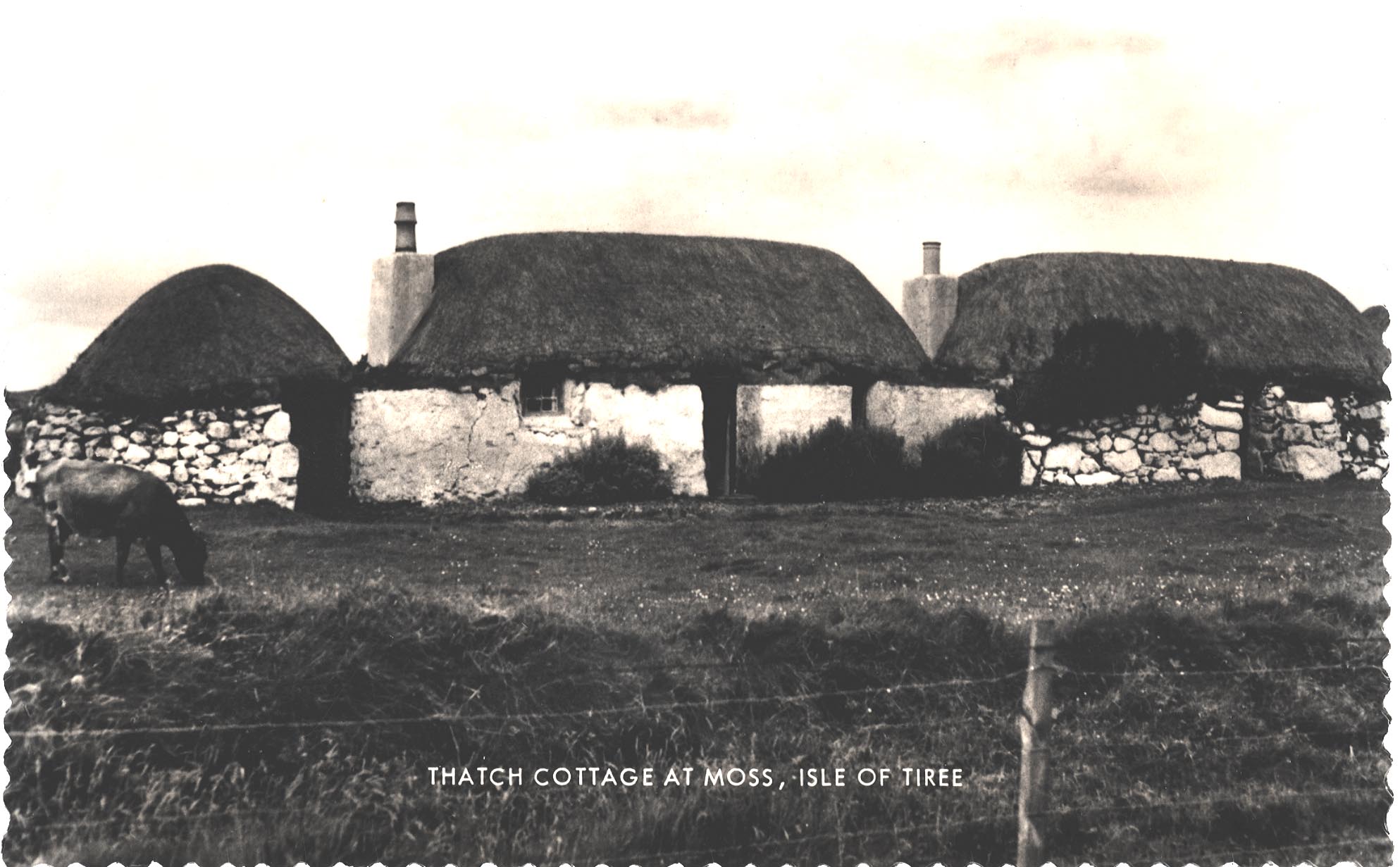
Black and white postcard of the thatched house at Moss.
The thatched house and outbuildings in Moss.
Shooting party at the Scarinish Hotel around 1912
Photograph of a shooting party at the Scarinish Hotel around 1912.
Courtesy of Mr Angus MacLean
During the Victorian era and up to World War I, game shooting was a popular field sport. This photograph taken outside the Scarinish Hotel around 1912 shows a shooting party, probably attracted to Tiree by the huge numbers of common snipe.
Sir Hugh Gladstone wrote in his ‘Record Bags & Shooting Records’ of 1922 that Lord Elphinstone and a Mr J. Cobbold, who visited Tiree in the autumn of 1908 and 1909, on both occasions bagged over 1,000 snipe in ten days’ shooting.
Although shooting parties still come to Tiree in October through to January to shoot mainly geese and some snipe, their numbers are exceeded by bird-watchers keen to sight corncrakes, of which one third of the UK population can be found on the island.
Black and white photograph of a shooting party at the Scarinish Hotel.
Shooting party at the Scarinish Hotel around 1912. (Original in Filing Cabinet 2 drawer 1: 1997.178)
1943 ENSA concert party
Photograph of an ENSA concert party in 1943.
Courtesy of Mr Angus MacLean
ENSA, the Entertainments National Service Association, was set up in 1939 to provide entertainment for the British armed forces during World War II. Operating as a part of the Navy, Army and Air Force Institute (NAAFI), it was affectionately known as ‘Every Night Something Awful’.
This photograph is of a travelling concert party which performed in front of the RAF base personnel in October 1943. Concerts consisted of a couple of hours of singing, comedy and sketches, some good and some not so good.
Their spirit and dedication was admired and appreciated, even on return visits of the same concert party when the show had been seen before.
Black and white photograph of a wartime revue.
Wartime revue at RAF Tiree on 15/10/1943. (Original in Filing Cabinet 2 drawer 1: 1997.178)