Record Type: review

1997.189.22

The interior of an officer’s Nissen hut

Photograph of the interior of an officer’s Nissen hut at the RAF station on Tiree in World War II.

c156.jpg

Courtesy of Mr Mike Hughes

This photograph shows the inside of an officer’s Nissen hut on Tiree during World War II. The Reef, the central area of the island, was requisitioned by the Ministry of War in 1940 to build the RAF Station which became operational in 1941.

Some four thousand RAF personnel were housed in hundreds of Nissen huts around Crossapol and Hough. The Nissen hut was designed in 1916 by Peter Nissen, a Canadian mining engineer, and was used extensively by the Allies in World War II in the construction of new facilities.

The hut consisted of sheets of corrugated steel bent into half a cylinder and closed at the ends with semi-circular masonry or wooden walls. Because the curved sheets stacked easily together, one hut could be packed on to a three ton truck. Six men could assemble one in four hours, although the record time was 1 hour 27 minutes.

Black and white photograph of the inside of Nissen hut during World War II.

The inside of an officer`s Nissen hut on Tiree during World War II. (Photograph from Mike Hughes in Filing Cabinet 2 drawer 1)

1997.185.3

‘An Sulaire’

Photograph of ‘An Sulaire’ in Scarinish harbour in 1997.

a187.jpg

Courtesy of Mr James Christie

The lug sail boat ‘An Sulaire’ coming into Scarinish old harbour in the summer of 1997.

Colour photograph of `An Sulaire` in the summer of 1997.

The lugboat, `An Sulaire`, in Scarinish harbour in the summer of 1997.

1997.184.3

Lachlan MacPhail carting seaweed

Photograph of Lachlan MacPhail carting seaweed

x29.jpg

Courtesy of Mr Ailig MacArthur

Lachlan MacPhail, originally from Luing, is pictured with a cartload of seaweed outside the shepherd’s cottage where he lived in Crossapol. A fork has been stuck in the back of the cart to stop the seaweed slipping off.

Gathered from March to May, the seaweed is spread on grass or on ground to be planted with corn or potatoes. Red seaweed known as ‘bàrr-dearg’ was considered the best for this purpose but only came ashore on certain tides usually in the month of May.

The soils of Tiree are predominantly light and sandy and need feeding with organic matter every year to keep their fertility. Although not considered as good a fertiliser as manure, seaweed improves the condition of the soil and aids water retention.

Black and white photograph of Lachlann MacPhail, Crossapol.

Lachlan MacPhail from Luing with a cartload of seaweed outside the shepherd’s cottage where he lived in Crossapol, Tiree, probably taken in the early 20th century.

1997.179.6

Archibald MacLeod of Balevullin

Photograph of Archibald MacLeod thatching an outhouse in Balevullin in the 1940s

x38.jpg

Courtesy of Ms Linda M. Gowans

George Holleyman, an archaeologist posted to Tiree during World War II, photographed Archibald MacLeod thatching an outhouse in Balevullin in the early 1940s. Thatching is started down at the tobhta, the ledge at the top of the wall, with the first row of sheaves being put on tips upwards.

After the first row, the sheaves are placed tips downwards until the ridge is reached when they are laid across the top with the tips on alternate sides. The thatch is put on thicker at the back, the windward side, and slightly halfway up the roof to give a more rounded shape.

As new thatch is laid on top of old, the ridge becomes almost flat. At this stage, the thatch has to be partially stripped off before the next layer is applied. Re-thatching is required every two to three years.

Black and white photograph of Archibald MacLeod, Balevullin.

Tiree has the greatest concentration of surviving thatched houses in the Scottish islands. In the photograph, Archibald MacLeod is shown thatching an outhouse in Balevullin. The rafters are first overlain with a layer of thin turf slices carefully cut from the moorland and tapered at the sides so that they lie flush on the roof. The thatching material, usually marram grass, is cut with a scythe between September and March and tied into small sheaves which are then positioned on top of the turf. The completed thatch is secured with wire netting weighted down with heavy beach pebbles. Re-thatching is required every 2-3 years.

1997.179.8

Marion MacDonald churning butter at Sandaig

Photograph of Marion MacDonald churning butter at Sandaig in the 1940s.

x36.jpg

Courtesy of Ms Linda Gowans

Marion MacDonald was photographed by George Holleyman churning butter outside her thatched house in Sandaig during World War II. The churn consists of a narrow wooden barrel (about 300 mm wide and 650 mm tall) and a plunger. At the end of the plunger is a wooden disc with holes drilled in it.

Milk would be left to stand in a metal basin and the cream skimmed off using a saucer or clam shell into an earthenware butter crock. The cream would be strained through muslin into the scalded churn and agitated using the plunger.

Once the butter had formed, it was put into cold water then slapped between the hands to remove excess liquid. The remaining buttermilk would be drunk or used for baking.

Black and white photograph of Marion MacDonald, Sandaig.

Marion MacDonald is pictured churning butter outside her thatched house in Sandaig, Tiree. The churn consists of a narrow wooden barrel (about 300 mm wide and 650 mm tall) and a plunger. At the end of the plunger is a wooden disc with holes drilled in it. Milk would be left to stand in a metal basin and the cream skimmed off using a saucer or clam shell into an earthenware butter crock. The cream would be strained through muslin into the scalded churn and agitated using the plunger. Once the butter had formed, it was put into cold water then slapped between the hands to remove excess liquid. The remaining buttermilk would be drunk or used for baking.

1997.179.11

Mary MacLean of Balevullin

Photograph of Mary MacLean of Balevullin at her spinning wheel.

x33.jpg

Courtesy of Ms Linda Gowans

George Holleyman, an archaeologist in the RAF police posted to Tiree during World War II, photographed Mary MacLean at her spinning wheel in the garden of her croft at Balevullin. Mary kept five cows and around twenty-five sheep and grew no crops other than potatoes.

To the right of the photograph is the top stone of a rotary quern. It is thought that rotary querns were introduced to Britain by the Romans around 2,000 years ago. Two women would sit on the ground with the quern between them, feeding grain into the central hole in the upper stone which was rotated by hand using a handle.

This was enormously time-consuming work. In ‘The Statistical Account of Scotland’ of the 1790s, Rev. Archibald MacColl estimated ‘by the lowest calculation, the work of 50 women is yearly lost at grinding’.

Black and white photograph of Mary MacLean, Balevullin.

Mary MacLean spinning wool in her garden at Balevullin, photgraphed by George Holleyman in the early 1940s. Note the drystone walling and quern stone.

1997.181.2

The staff at the knitwear factory at Crossapol in the early 1970s

Photograph of the staff at the knitwear factory at Crossapol in the early 1970s.

f3.jpg

Courtesy of Mr Robert Beck

Hebridean Knitwear Ltd was first attracted to Tiree through the initiative of the local vet Robert Beck and in 1969 opened a knitwear factory in the old United Free Church at Kirkapol until a purpose-built factory was completed at Crossapol.

Of the seven young women in the photograph, Hughina MacCallum, Betty Duff, Ann Burns, Ann Munn, Jean MacKay, Flora Brown and June Weston, the six in white overalls were sent to Coatbridge for six months’ training. On their return, they trained new operatives.

During the recession of the early 1980s, Hebridean Knitwear went into liquidation. The factory was briefly taken over by a Lanarkshire concern but closed for good in 1984. The building now houses the council offices and the Tiree branch of Argyll College.

Black and white photograph of the workers at the knitwear factory.

The workers at the knitwear factory in Crossapol in the early 1970s. L-R: Hughina MacCallum; Betty Duff (boarded out with the MacKays, Balephuil); Ann Burns (boarded out with the MacLeans, Balinoe); Ann Munn, Heanish; Jean MacKay, Balemartine; Flora Brown, Hillside, Balevullin , June Weston, Bungalow, Heylipol. (Original in Filing Cabinet 2 drawer 1)

1997.179.5

The wreck of the ‘Ocean Tide’

Photograph of the wreck of the ‘Ocean Tide’ off Mannal in 1942.

x39.jpg

Courtesy of Ms Linda Gowans

George Holleyman, an archaeologist in the RAF police posted to Tiree during World War II, photographed the wreck of the ‘Ocean Tide’ in January 1942. A trawler from Leith, the ‘Ocean Tide’ had run aground off Mannal in poor weather.

Repeated attempts were made by RAF personnel and three local volunteer coastguards to shoot a line to the stricken vessel without success. Buffeted by the wind and the incoming tide, the trawler was listing so badly it was in danger of turning over.

The crew made a last desperate attempt to save themselves and launched a small boat. Within minutes they lost control and were driven on to a rocky promontory. By luck, two of the lines had caught on the rocks and the six crew members, one of them injured, were able to struggle ashore.

Black and white photograph of SS Ocean Tide in 1942.

The SS Ocean Tide on the rocks at Mannal in January 1942 photographed by George Holleyman.

1997.179.10

Isabella MacLean of Kilmoluaig using a cheese press

Photograph of Isabella MacLean of Kilmoluaig using a cheese press.

x34.jpg

Courtesy of Ms Linda Gowans

Isabella MacLean was photographed using a cheese press in Kilmoluaig by George Holleyman, an archaeologist posted to RAF Tiree during World War II. The press was made in the local smiddy. The screw, which turns through an iron hoop set into a large stone, tightens on to the wooden cheese vat, removing excess whey.

Rennet was used to curdle the warmed milk and sometimes salt was added or caraway seeds. The curds were squeezed by hand, wrapped in muslin, put in the cheese vat and pressed. The whey would be fed to calves.

After two to three days, the press would be screwed down another turn. The cheese would be left there for a week then put on a shelf to dry and form a skin. It would be ready for eating in a fortnight.

Black and white photograph of Isabella MacLean, Kilmoluaig.

Isabella MacLean is pictured here using a cheese press made in the local smiddy. The screw, which turns through an iron hoop set into a large stone, tightens on to the wooden cheese vat, removing excess liquid. Rennet was used to curdle the warmed milk and sometimes salt was added, or caraway seeds. The curds were squeezed by hand, wrapped in muslin, put in the cheese vat and pressed. The whey would be fed to calves. After 2-3 days, the press would be screwed down another turn. The cheese would be left there for a week then put on a shelf to dry and form a skin. It would be ready for eating in a fortnight. The cheese press is part of An Iodhlann`s collection.

1997.182.2

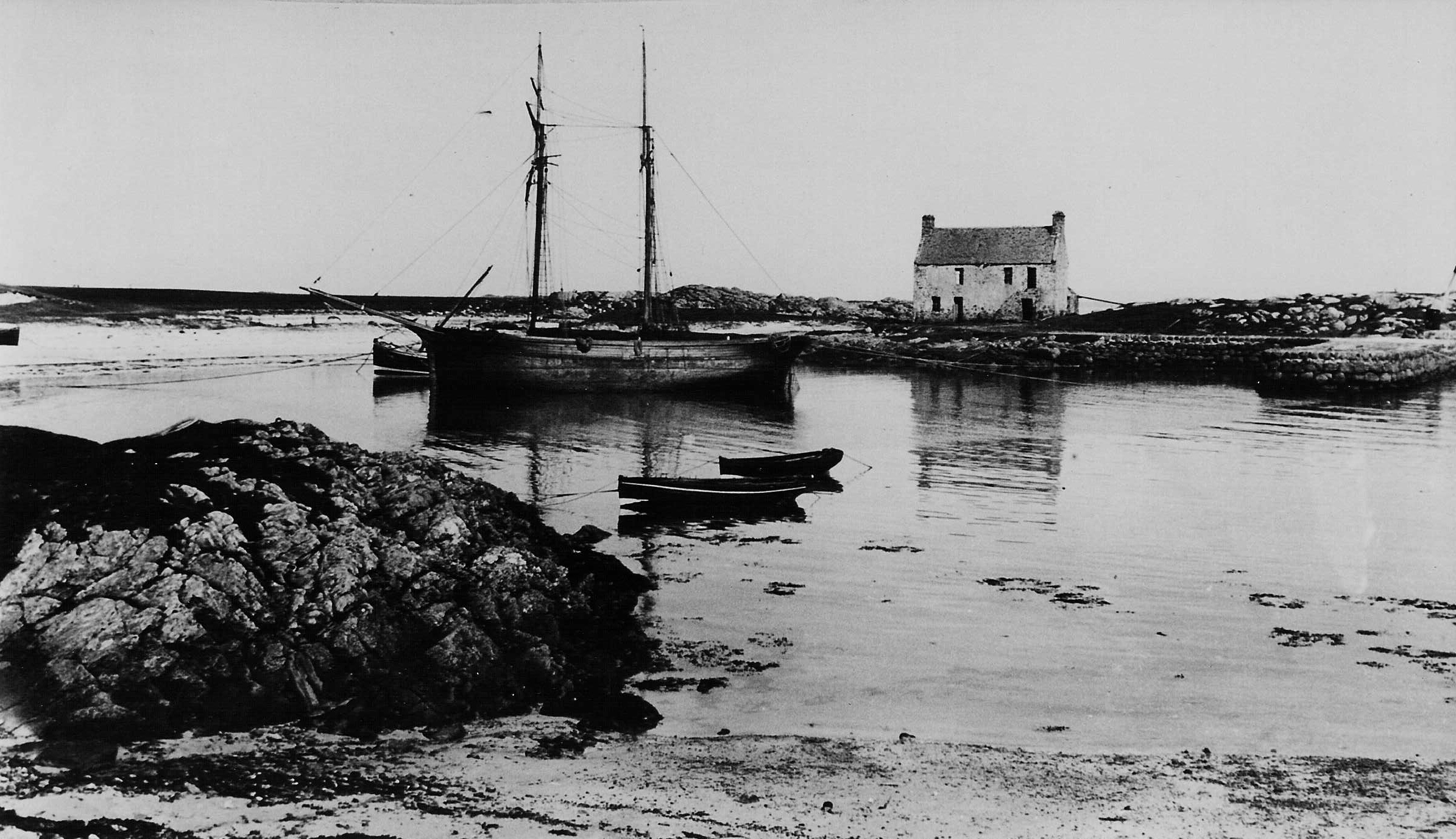
The ‘Mary Stewart’ in Scarinish harbour in the 1930s

Photograph of the schooner ‘Mary Stewart’ in Scarinish harbour in the 1930s.

e23.jpg

Courtesy of Mrs Netta Martin

Taken in the early 1930s, this view of Scarinish harbour shows the topsail schooner ‘Mary Stewart’ in her final resting place. For the previous thirty years she had traded up and down the west coast carrying coal and other cargo.

Also anchored in the harbour are two lobster boats. Commercial lobster fishing began on Tiree after 1880 when the railway to Oban was opened, allowing shellfish to be sent live to the London markets for the first time.

Said to have been originally built as a church, the building in the background was used as a store by the owners of the ‘Mary Stewart’. It was pulled down to make the road to the pier during World War II.

Black and white photograph of Scarinish harbour.

Scarinish harbour with the Mary Stewart, probably taken in the 1930s. The building in the background was originally built as a church, then used intermittently as a prison and latterly as a store by the owners of the Mary Stewart. It was pulled down to make roads during World War II.