


Black and white photograph Murdoch and Peggy Cameron and Ian Atkins taken in 1948.
The shop in Balevullin in 1948 where Murdoch Cameron did his butchering. L-R: Peggy and Murdoch Cameron, Ian Atkins.

Black and white photograph Murdoch and Peggy Cameron and Ian Atkins taken in 1948.
The shop in Balevullin in 1948 where Murdoch Cameron did his butchering. L-R: Peggy and Murdoch Cameron, Ian Atkins.
Black and white photograph of Donald MacKechnie, Kilmoluaig.
Donald MacKechnie, Kilmoluaig, (Maggie Campbell`s father) in his naval uniform.
Marion MacDonald churning butter at Sandaig
Photograph of Marion MacDonald churning butter at Sandaig in the 1940s.

Courtesy of Ms Linda Gowans
Marion MacDonald was photographed by George Holleyman churning butter outside her thatched house in Sandaig during World War II. The churn consists of a narrow wooden barrel (about 300 mm wide and 650 mm tall) and a plunger. At the end of the plunger is a wooden disc with holes drilled in it.
Milk would be left to stand in a metal basin and the cream skimmed off using a saucer or clam shell into an earthenware butter crock. The cream would be strained through muslin into the scalded churn and agitated using the plunger.
Once the butter had formed, it was put into cold water then slapped between the hands to remove excess liquid. The remaining buttermilk would be drunk or used for baking.
Black and white photograph of Marion MacDonald, Sandaig.
Marion MacDonald is pictured churning butter outside her thatched house in Sandaig, Tiree. The churn consists of a narrow wooden barrel (about 300 mm wide and 650 mm tall) and a plunger. At the end of the plunger is a wooden disc with holes drilled in it. Milk would be left to stand in a metal basin and the cream skimmed off using a saucer or clam shell into an earthenware butter crock. The cream would be strained through muslin into the scalded churn and agitated using the plunger. Once the butter had formed, it was put into cold water then slapped between the hands to remove excess liquid. The remaining buttermilk would be drunk or used for baking.
Black and white photograph of John MacKinnon, Lodge Farm.
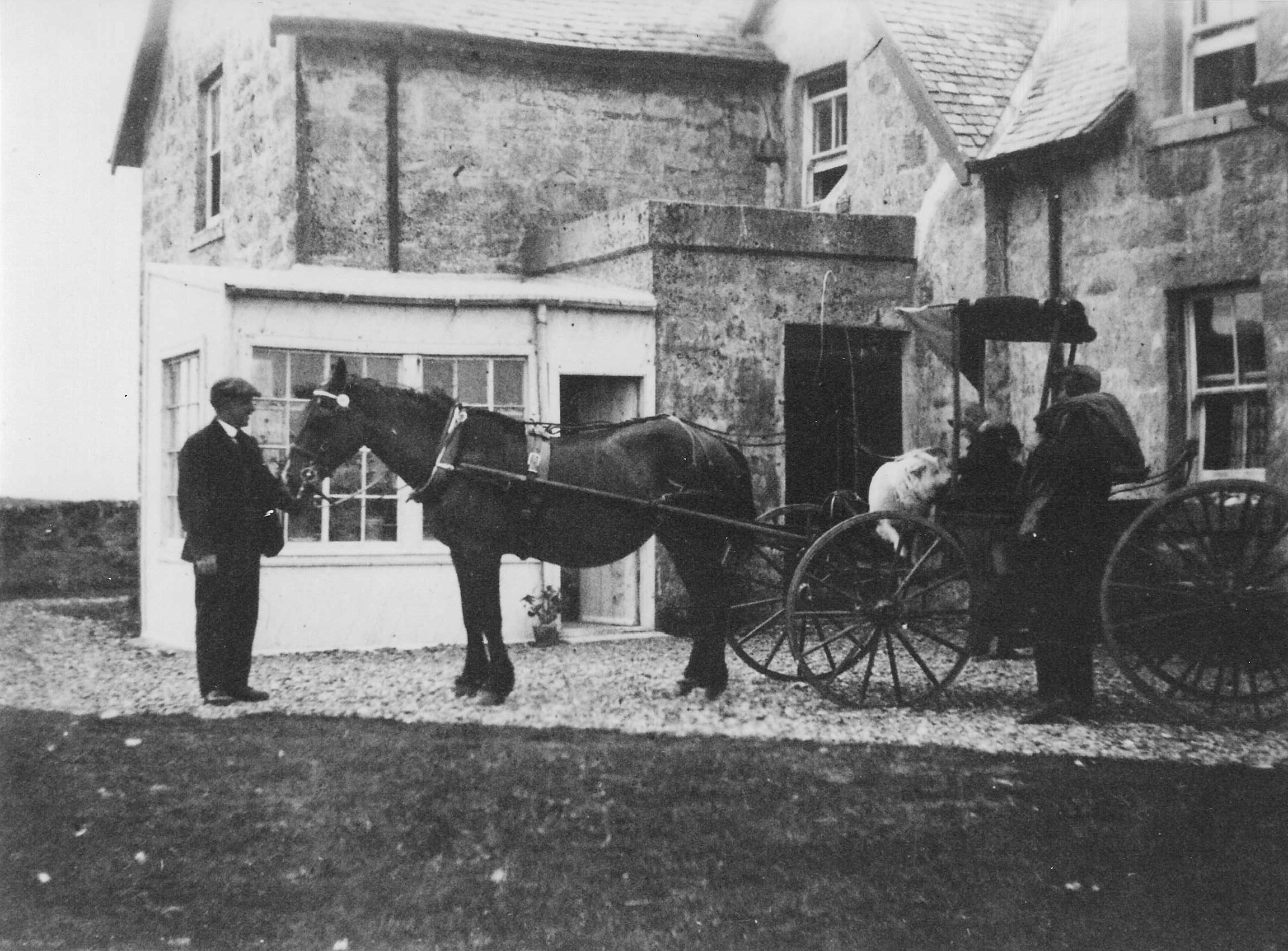
John MacKinnon of Lodge Farm, Kirkapol is pictured here outside the Lodge with Lady Victoria Campbell’s buckboard. The daughter of the 8th Duke of Argyll, Lady Victoria contracted polio in 1859 when 5 years old and was lame for the rest of her life. When rough seas or low tides made it impossible for passengers to board the lighter for the mail-boat at either of the small piers at Scarinish harbour, the boat was run in as far as possible on the beach at Gott Bay. ‘Faithful John’ would drive the horse and buckboard through the water to the stranded lighter to transfer Lady Victoria, fortunately always without accident.
Collection of five original photographs and one postcard.
The postmistress and postmen on horse and traps in Scarinish (1997.168.6 – A6); MacArthurs` shop in Scarinish (1997.175.1 – E1); postcard of Mannal (1997.175.2 – E3); Tiree regatta 1939 (photo number unknown); Scarinsh harbour and the old prison (photo number unknown); Tiree Youth Club 1950 (photo number unknown).
The staff at the knitwear factory at Crossapol in the early 1970s
Photograph of the staff at the knitwear factory at Crossapol in the early 1970s.

Courtesy of Mr Robert Beck
Hebridean Knitwear Ltd was first attracted to Tiree through the initiative of the local vet Robert Beck and in 1969 opened a knitwear factory in the old United Free Church at Kirkapol until a purpose-built factory was completed at Crossapol.
Of the seven young women in the photograph, Hughina MacCallum, Betty Duff, Ann Burns, Ann Munn, Jean MacKay, Flora Brown and June Weston, the six in white overalls were sent to Coatbridge for six months’ training. On their return, they trained new operatives.
During the recession of the early 1980s, Hebridean Knitwear went into liquidation. The factory was briefly taken over by a Lanarkshire concern but closed for good in 1984. The building now houses the council offices and the Tiree branch of Argyll College.
Black and white photograph of the workers at the knitwear factory.
The workers at the knitwear factory in Crossapol in the early 1970s. L-R: Hughina MacCallum; Betty Duff (boarded out with the MacKays, Balephuil); Ann Burns (boarded out with the MacLeans, Balinoe); Ann Munn, Heanish; Jean MacKay, Balemartine; Flora Brown, Hillside, Balevullin , June Weston, Bungalow, Heylipol. (Original in Filing Cabinet 2 drawer 1)
Collection of four original photographs and two postcards.
Postcard of renovated house in Scarinish (1997.149.1 – A34); Postcard of Ruaig school (1997.148.35 – B19); group of unknown people (1997.148.36 – B20); Wartime revue (1997.148.37 – B21); Margaret Brown, Gott (1997.150.1 – B23); Scarinish pier with Eairdsidh na pacaid (1997.163.1 – C18); Bringing in the hay ( 1997.160.10 – D31).
Black and white photograph of Scarinish harbour.
Scarinish harbour with the Mary Stewart, probably taken in the 1930s. The building in the background was originally built as a church, then used intermittently as a prison and latterly as a store by the owners of the Mary Stewart. It was pulled down to make roads during World War II.
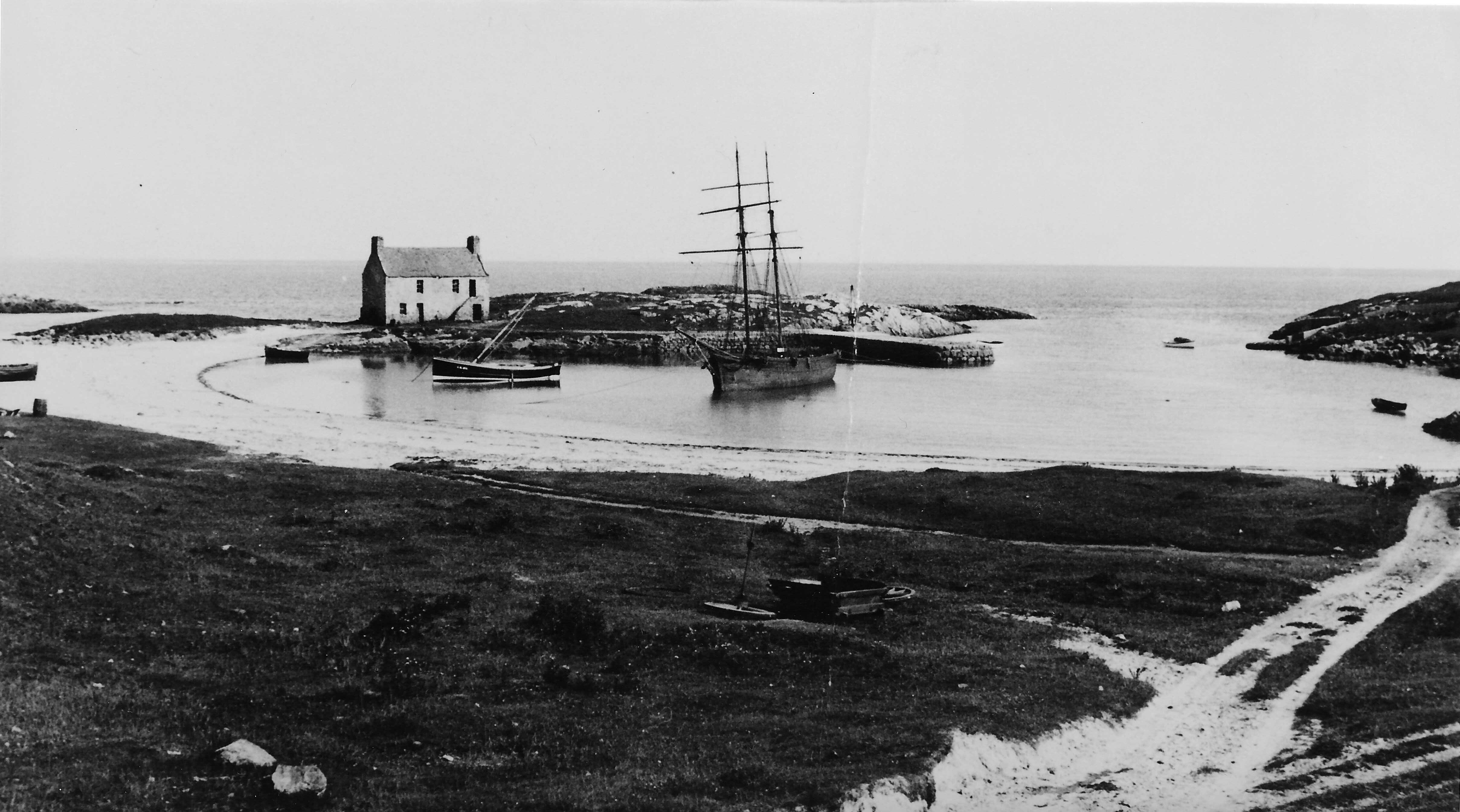
Black and white photograph of six Tiree craggans.
Six Tiree craggans photographed by George Holleyman between 1941 and 1943, and published in the paper ‘Tiree Craggans’, by G. A. Holleyman, in Antiquity 21, December 1947, pp 205-211. On the original slide, the craggans are captioned individually: 1 from Sandaig, 2 from Balevullin, 3-6 made by Hugh MacNeil in 1942.
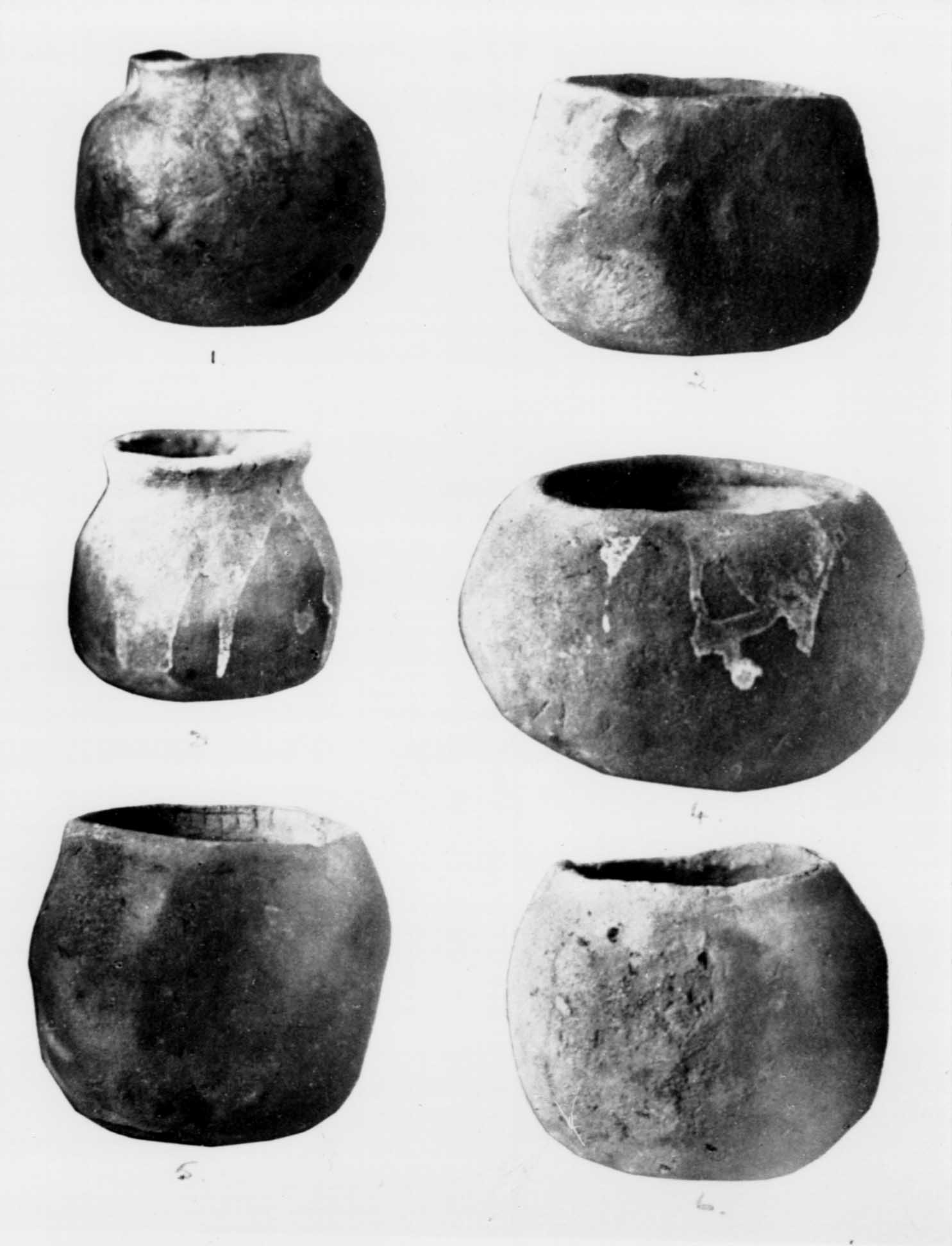
The ‘Mary Stewart’ in Scarinish harbour in the 1930s
Photograph of the schooner ‘Mary Stewart’ in Scarinish harbour in the 1930s.
Courtesy of Mrs Netta Martin
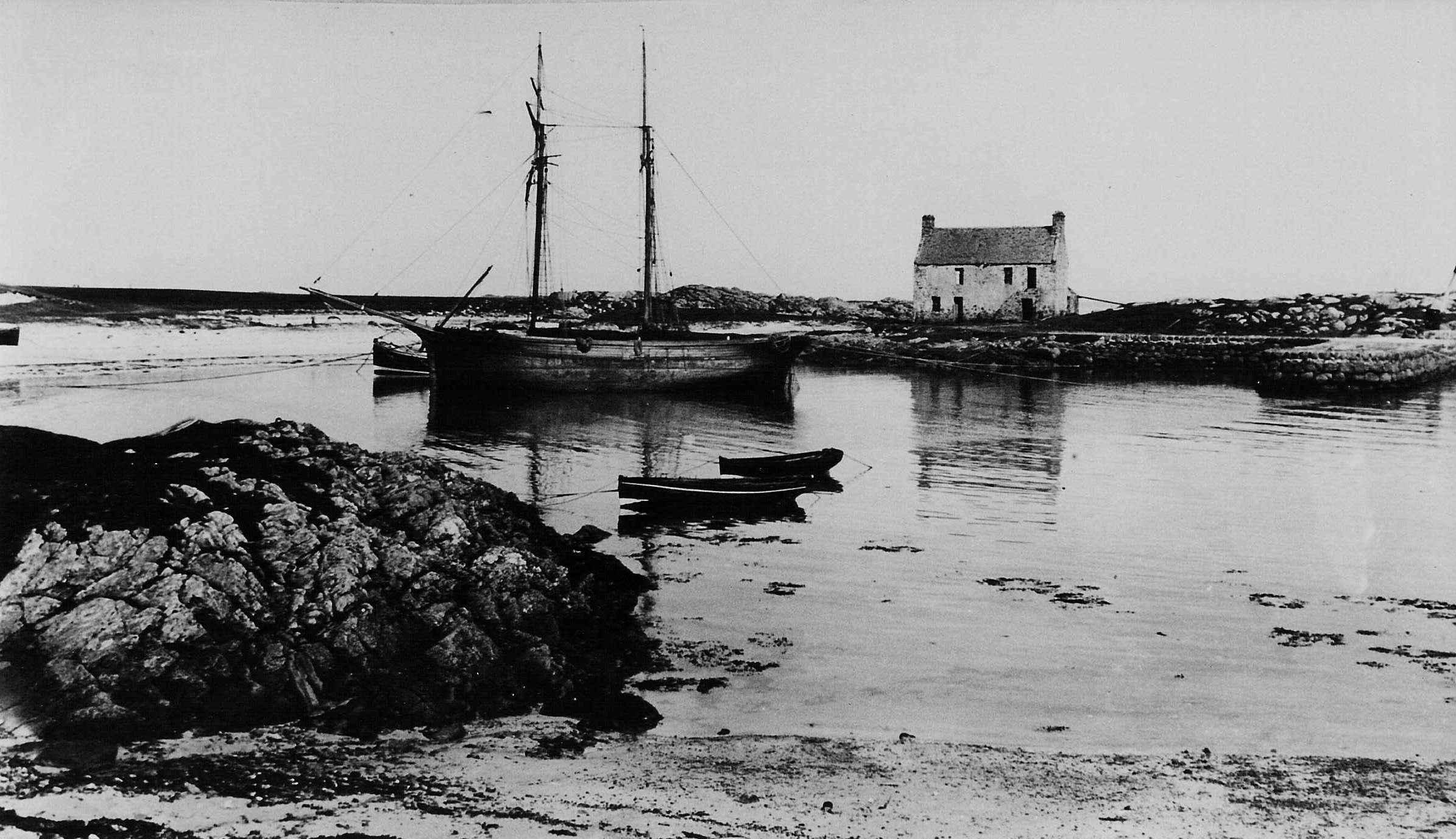
Taken in the early 1930s, this view of Scarinish harbour shows the topsail schooner ‘Mary Stewart’ in her final resting place. For the previous thirty years she had traded up and down the west coast carrying coal and other cargo.
Also anchored in the harbour are two lobster boats. Commercial lobster fishing began on Tiree after 1880 when the railway to Oban was opened, allowing shellfish to be sent live to the London markets for the first time.
Said to have been originally built as a church, the building in the background was used as a store by the owners of the ‘Mary Stewart’. It was pulled down to make the road to the pier during World War II.
Black and white photograph of Scarinish harbour.
Scarinish harbour with the Mary Stewart, probably taken in the 1930s. The building in the background was originally built as a church, then used intermittently as a prison and latterly as a store by the owners of the Mary Stewart. It was pulled down to make roads during World War II.