Cross-incised stone at St Patrick’s Chapel
Photograph of a cross-incised stone at St Patrick’s Chapel on Kennavara.
Courtesy of Mrs Grace Campbell
Up on Kennavara for a picnic, the young man in this photograph of 1920 is hiding behind the smaller of two incised stones at St Patrick’s Chapel which bear Latin crosses on both faces. Another cross is carved into a boulder to the south-east of the chapel.
On the shoreline below the chapel is a naturally formed swallow-hole sixty centimetres in diameter and over one metre deep which is known locally as St Patrick’s Vat or Well. It is traditionally regarded as a baptismal font.
There is no evidence that St Patrick ever came to Tiree but there is a Tiree tale that St Comgall, the founder of Bangor Abbey in Northern Ireland and a contemporary of St Columba, founded a monastery on Kennavara.
Black and white photograph of St Patrick`s Chapel on Kennavara in 1920.
The cross-marked stone at St Patrick`s Chapel on Kennavara in 1920.
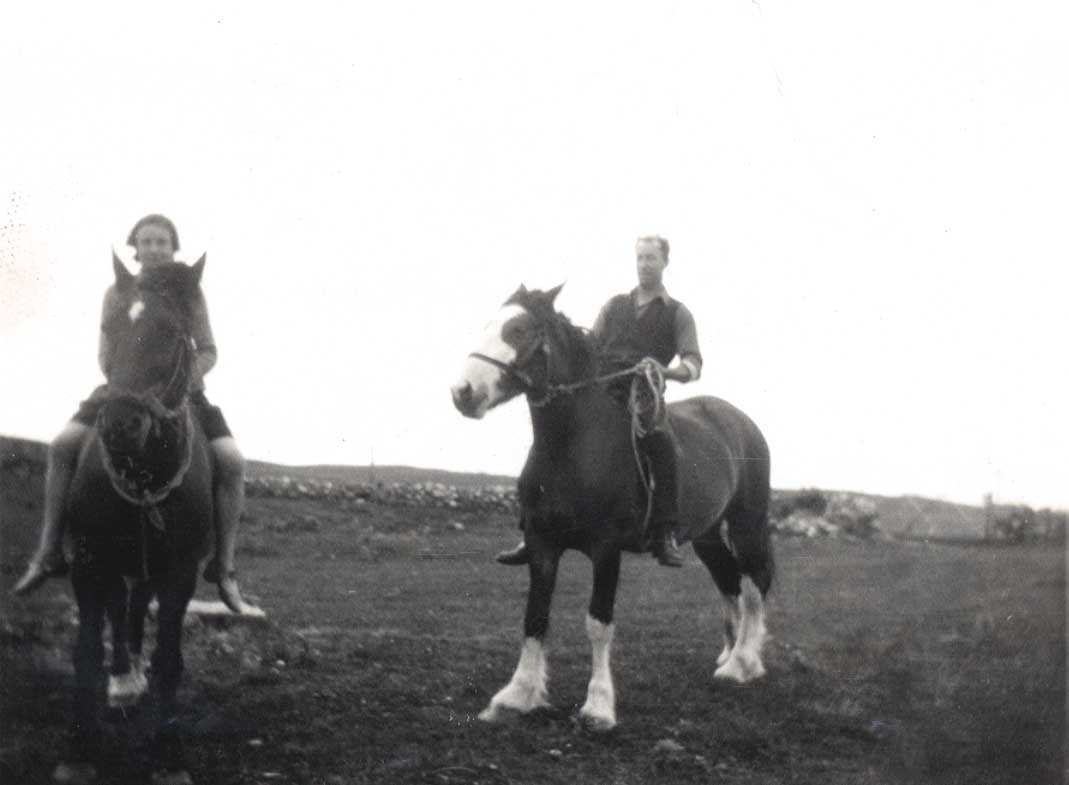
Black and white photograph of Grace Campbell and Duncan MacPhee.
L-R: Grace Campbell of Tullymet and Duncan MacPhee of Scarinish astride Russell and Gypsy in the late 1930s.
Black and white photograph of Gott Bay pier under construction.
Gott Bay pier under construction in the 1910s.
Black and white photograph of Colin and Johnny Brown on 1921.
Colin and Johnny Brown of the Scarinish Hotel in 1921.
Black and white photograph of shepherd Donald MacDonald
Shepherd Donald MacDonald of Ruaig.
Black and white photograph of crofters carting marram grass for thatching.
Two crofters carting marram grass for thatching behind Ben Hough in the 1930s or 1940s.
Carting marram grass
Photograph of two crofters carting marram grass from behind Ben Hough in the 1930s.
Courtesy of Mrs Grace Campbell
The two men are transporting marram grass, known locally as bent or muran, from behind Ben Hough at the west end of Tiree. The dried grass is used for thatching roofs while the roots were used as a scourer for cleaning tables and floors.
The grass is cut by sickle or scythe between September and March, outwith its growing season, and is much harder work than cutting corn or hay. The longer the stem the better, as a more waterproof roof is ensured and less work required.
Muran thrives best in shifting sand and grows stronger after cutting. There is less on Tiree today than there used to be. This may be due to the use of fertilisers which encourage the growth of other grasses and the out-wintering of cattle which shelter in the dunes and trample and eat it.
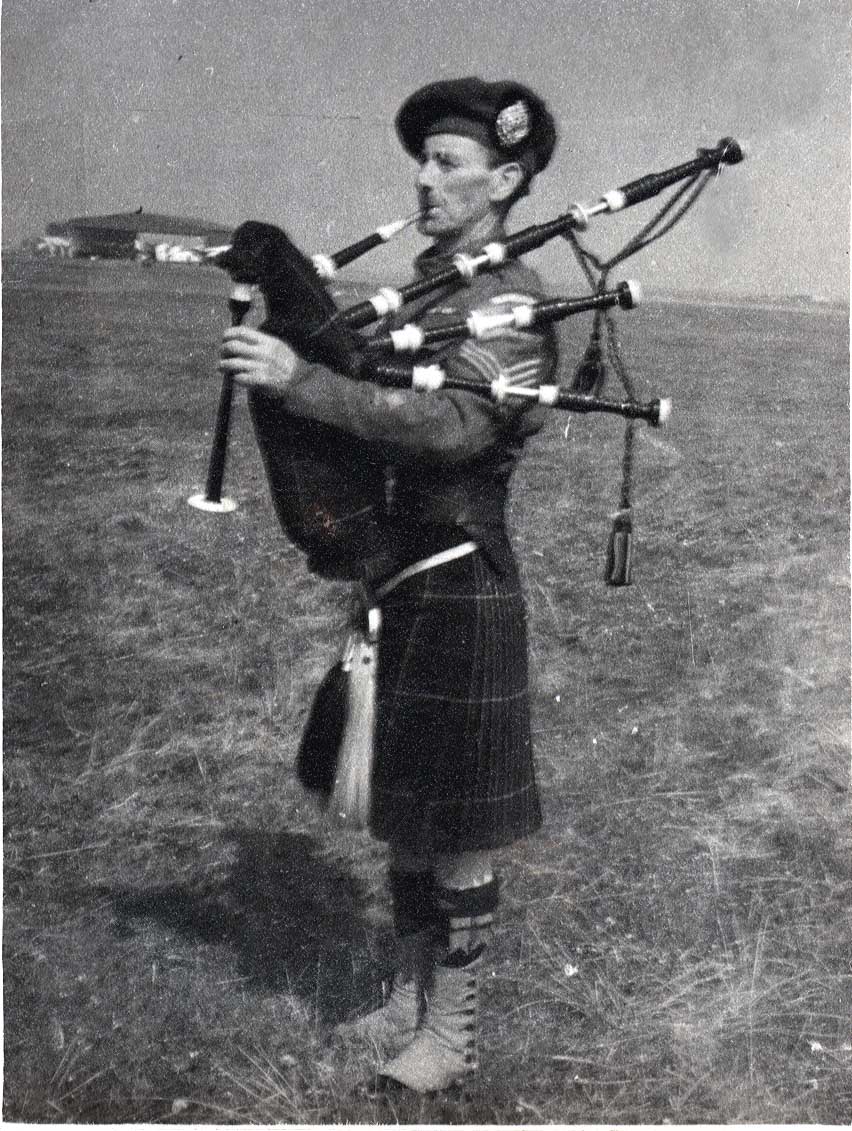
Black and white photograph of piper Hugh MacArthur in 1944.
Piper Hugh MacArthur in 1944.
Black and white photograph of Hillcrest Balephetrish.
Hillcrest and stackyard, Balephetrish.
Black and white photograph of the MacArthurs` shop in Scarinish.
The MacArthurs` shop in Scarinish in the early 20th century. L-R: Donald MacArthur, Jessie MacDonald, Margaret Robertson, Morag MacPhail.
Black and white photograph of Soroby graveyard in 1944.
Soroby graveyard in 1944 with a line of war graves on the right.