


Colour photograph of Dun nan Nighean in Balephuil in 2000.
Dùn nan Nighean at Balephuil photographed by Dr John Holliday in 2000.


Colour photograph of Dun nan Nighean in Balephuil in 2000.
Dùn nan Nighean at Balephuil photographed by Dr John Holliday in 2000.
Photograph of Dùn nan Nighean at Balephuil in 2000

The remains of twenty-five fortresses from the Iron Age (600 BC – 400 AD) survive on Tiree. It is likely that these were unsettled times caused by a worsening of the climate, a growing population, thinning of the first farmed soils and the use of new iron weapons.
These fortresses, all now called ‘dùn’ in modern Gaelic, are either forts large enough to hold a community of 30 to 40 people, small duns made to shelter one family or brochs with double-skinned walls containing a staircase and guard cell, probably standing around 8 metres tall.
The forts and duns had simple defences and usually stood on inaccessible crags away from their accompanying farms. Tradition has it that a group of nuns was cornered at Dùn nan Nighean and slaughtered by the Vikings. There is also said to have been an escape tunnel out of the dun.
Colour photograph of Dùn Ìbrig at Baugh in 2000.
Dùn Ìbrig at Baugh photographed by Dr John Holliday in 2000.

Colour photograph of Mairi Lyndsey Campbell and the Princess Royal at Hynish in June 1991.
Mairi Lyndsey Campbell of Cornaigbeg presenting a bouquet to the Princess Royal at the opening of the Alan Stevenson Centre at Hynish in June 1991.

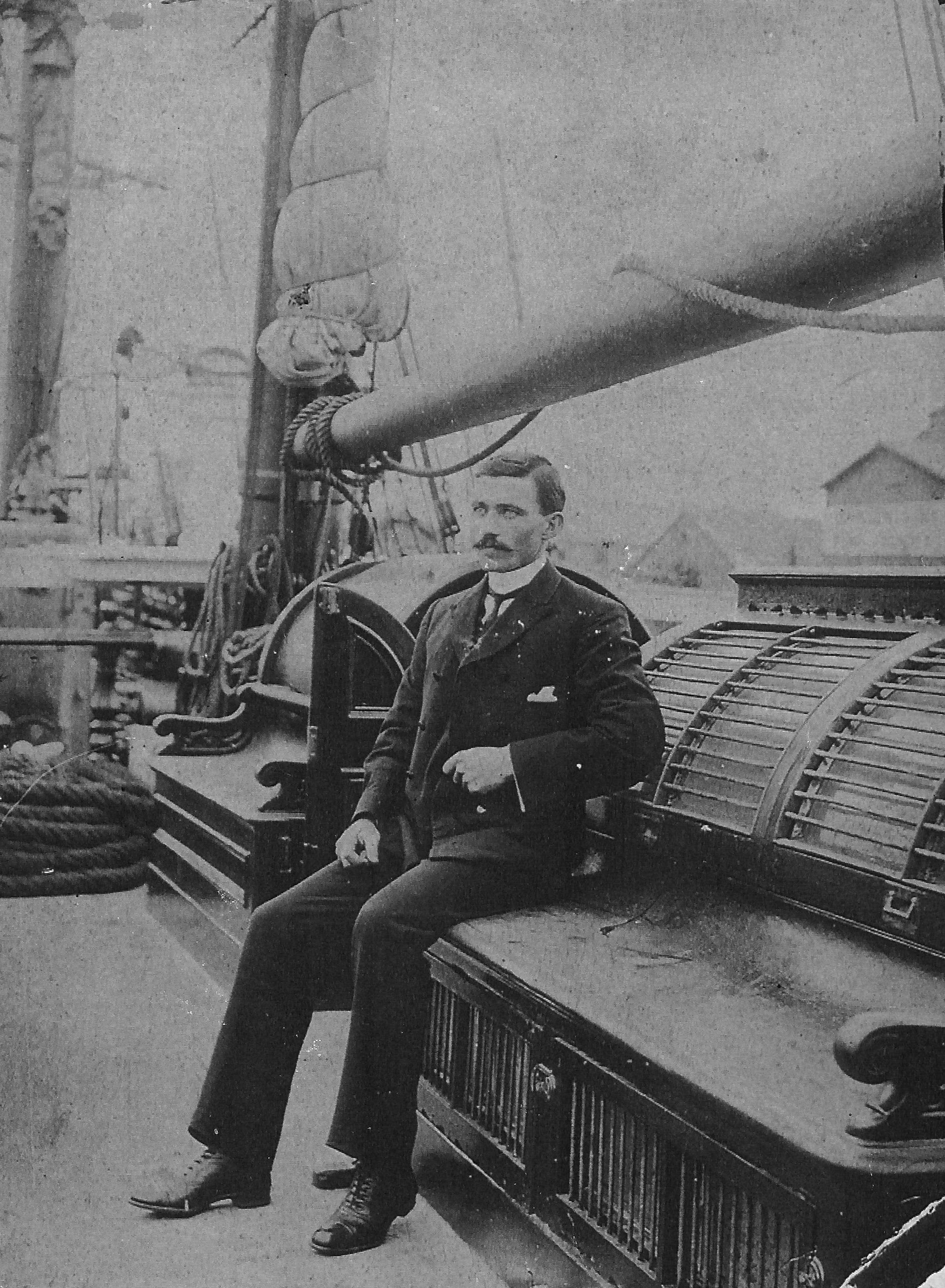
Copied photograph of Captain John MacLean of Cornaigbeg.
Captain John MacLean of Cornaigbeg who gained his captain`s certificate in Melbourne, Australia on 27/8/1913. (Copy of information on back of photograph in Filing Cabinet 8 drawer 3)
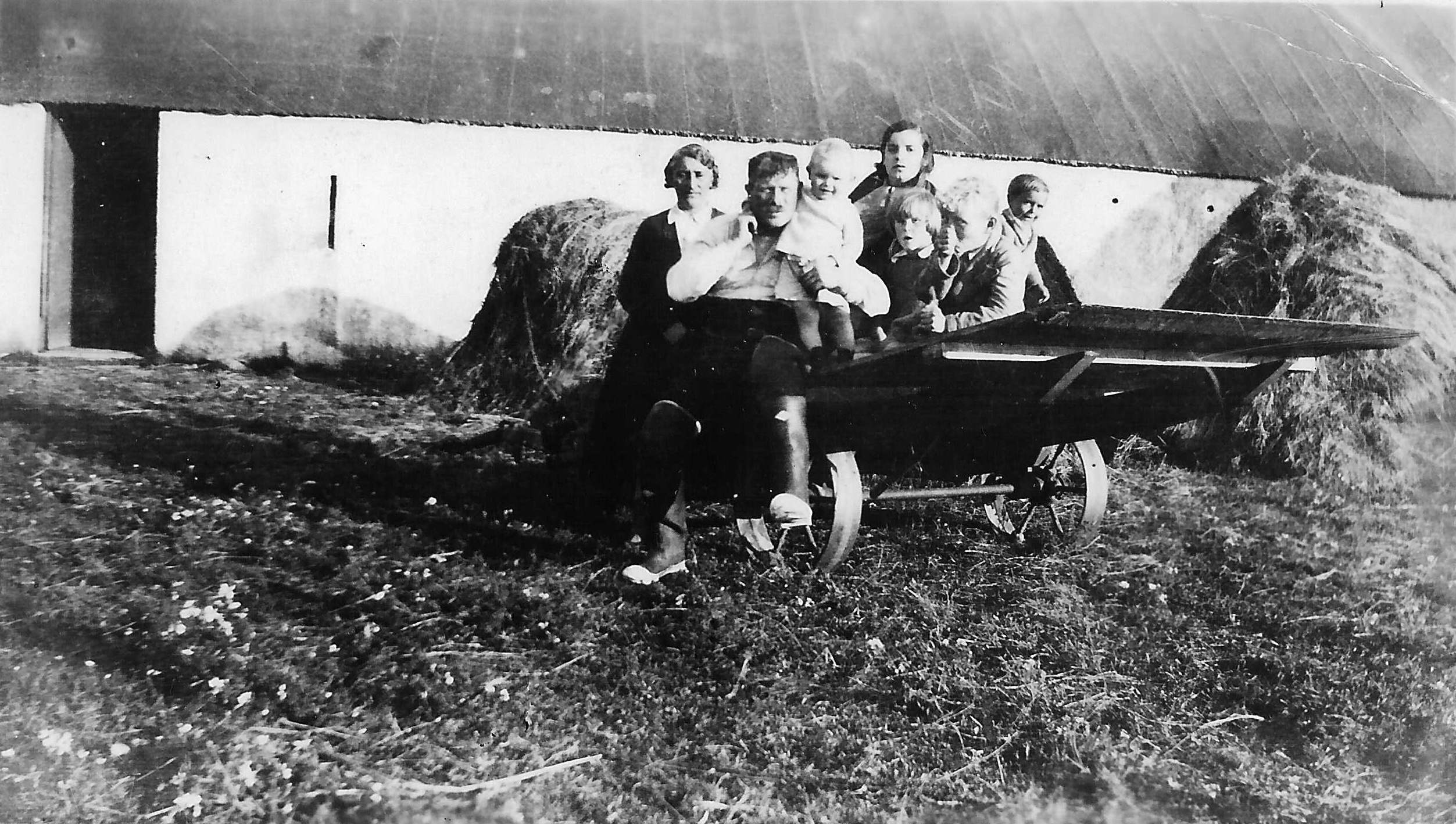
Photograph of George Paterson and his family in the stackyard of his farm at 6 Crossapol in 1937. L-R: (back) Sarah MacPhee née Paterson (George’s sister); George Paterson; his wife Margaret (Meta) with baby Angus; (front) Hamish MacPhee, Sarah’s son; George and Meta’s children, Iain and Mairi.
 Courtesy of Mrs Mairi Campbell
George’s father, Donald Paterson of Balinoe, emmigrated to Pategonia in the 1880s. Patagonia, in the south of Argentina and Chile, was cleared of its indigenous people in the 1880s to make way for large sheep farms. Many men from the Hebrides went out to share in the bonanza.
In 1885 Donald wrote to his brother asking him to send out his birth certificate and baptismal record so he could take possession of twelve square miles of land. He found the native Indians very kind and friendly and recommended shepherding in Patagonia where the pay was good.
Donald married in Patagonia and had a family. He brought his two sons George and John home to Tiree. George was seven years old at the time and could speak Gaelic and Spanish but not a word of English.
The Paterson family of Crossapol in 1937
Photograph of the Paterson family of Crossapol in 1937.
Courtesy of Mrs Mairi Campbell
The Paterson family are pictured in 1937 sitting on a rick-lifter outside their steadings at Crossapol. The cart was used to move stùcanan (small stacks of corn) from the fields to an iodhlann, the stackyard behind the house, where about six to eight of them were carefully built into a mulan (corn stack).
Initially the cut corn was bound into sguaban (sheaves), eight to ten of which were lined up into an adag. Once the seed had hardened, after about ten days if the weather was good, the adagan would be put into a stùc which can stand up to the winds that are common at that time of year.
Stùcanan could be left out if the weather deteriorated. If there was a dry spell, however, the adagan could be taken straight to the stackyard, as every time the corn was handled some grain was lost.
Black and white photograph of the Paterson family of Crossapol in 1937.
The steadings at 6 Crossapol in 1937. The cart was used to move ricks from the fields to the stackyard. L-R: Sarah MacPhee née Paterson (George’s sister); George Paterson with his son Angus; Betty MacLean née MacPhee, Sarah’s daughter (at back); George and Meta’s children, Mairi and Iain; Hamish MacPhee, Sarah’s son.
Black and white photograph of the stackyard at Corrairigh, Cornaigbeg.
The stackyard and new steadings at Corrairigh, Cornaigbeg in the 1930s.

Colour photograph of Grace Baxter and John Neil Brown in the mid-60s.
Grace Baxter and her nephew John Neil Brown haymaking at Cornaigbeg in the mid-60s.

Colour photograph of the range in Iain MacKinnon`s croft house in Kilmoluaig.
The range inside Iain MacKinnon`s (Iain Chaluim) thatched house in Kilmoluaig.
