


Colour photograph of Dun nan Nighean in Balephuil in 2000.
Dùn nan Nighean at Balephuil photographed by Dr John Holliday in 2000.


Colour photograph of Dun nan Nighean in Balephuil in 2000.
Dùn nan Nighean at Balephuil photographed by Dr John Holliday in 2000.
Photograph of Dùn nan Nighean at Balephuil in 2000

The remains of twenty-five fortresses from the Iron Age (600 BC – 400 AD) survive on Tiree. It is likely that these were unsettled times caused by a worsening of the climate, a growing population, thinning of the first farmed soils and the use of new iron weapons.
These fortresses, all now called ‘dùn’ in modern Gaelic, are either forts large enough to hold a community of 30 to 40 people, small duns made to shelter one family or brochs with double-skinned walls containing a staircase and guard cell, probably standing around 8 metres tall.
The forts and duns had simple defences and usually stood on inaccessible crags away from their accompanying farms. Tradition has it that a group of nuns was cornered at Dùn nan Nighean and slaughtered by the Vikings. There is also said to have been an escape tunnel out of the dun.
Colour photograph of Dùn Ìbrig at Baugh in 2000.
Dùn Ìbrig at Baugh photographed by Dr John Holliday in 2000.

Colour photograph of An Dunan, Salum in 2000.
An Dùnan at Salum showing the causeway to shore, photographed by Dr John Holliday in 2000.

Colour photograph of a standing stone at Caoles in 2000.
Standing stone at Caoles photographed by Dr John Holliday in 2000.

Colour photograph of a standing stone at Hough in 2000.
Standing stone at Hough photographed by Dr John Holliday in 2000.

A’ Charragh Bhiorach at Balinoe
Photograph of the standing stone at Balinoe in 2000.

Numerous remains from the Bronze Age (2500 – 600 BC) have been found on Tiree and it is probable that the people who left them were the first to occupy the island in any numbers. These early farmers were using metal for the first time and making pottery with turned out rims known as ‘Beakers’.
New religious customs appeared. The dead were buried sitting upright in cists or cremated and the ashes put in funerary urns. Hollowed out cup markings were fashioned on significant rocks and standing stones and stone circles were erected.
The standing stone at Balinoe, 3.6 metres high with a base 1.9 metres by 1.1 metres, is known locally as A’ Charragh Bhiorach (the pointed stone). It must be remembered that this is not the original name as Gaelic came to be spoken here 3,000 years after it was erected.
Colour photograph of A` Charragh Bhiorach at Balinoe in 2000.
Standing stone at Balinoe known as A’ Charragh Bhiorach, the sharp pillar, or Spitheag an Fhoimheir, chip of the giant, photographed by Dr John Holliday in 2000.
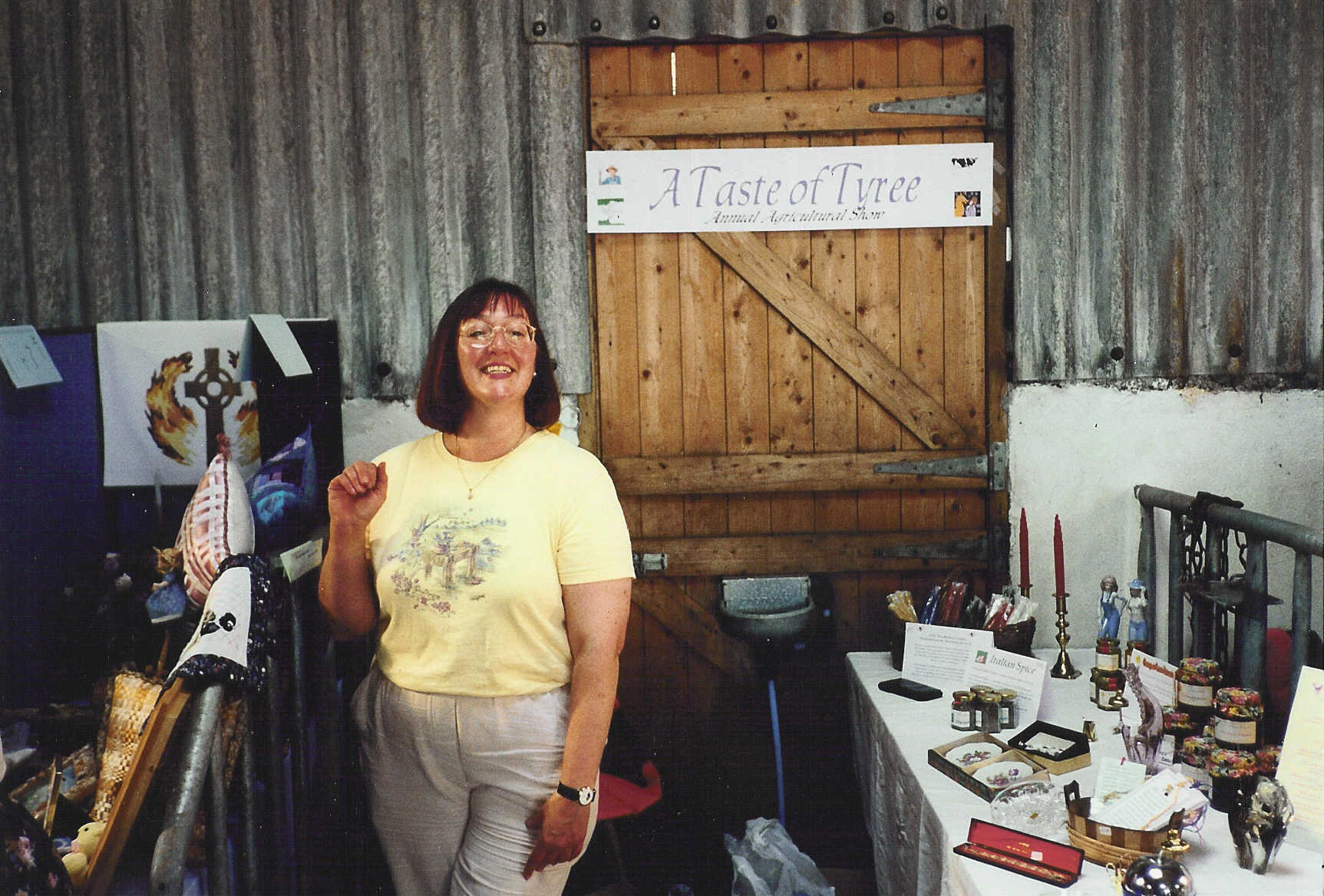
Colour photograph of Mary MacLean of Scarinish in 2000.
Mary MacLean of Scarinish at the Cattle Show held at Whitehouse in 2000.
Colour photograph of a stuc of oats in September 2001.
Stùc of oats grown by Hugh Archie MacCallum at Whitehouse, Cornaigbeg in September 2001.

Former crannog at Loch na Buaile near Scarinish
Photograph of the site of a crannog at Loch na Buaile near Scarinish in 2000

The people of Iron Age Tiree built houses known as crannogs which were protected by water. These may have been a defence against invaders or possibly to keep rats away from corn. The one at Loch na Buaile near Scarinish was connected to the loch side by a four metre long causeway.
The possible remains of three others have been found on Tiree at Eilean Aird nam Brathan and Eilean Mhic Conuill in Loch Bhasapol and at Loch na Gile on the Balephetrish sliabh. The site of Island House, the Tiree residence of the Duke of Argyll, may originally also have been a crannog.
Similar buildings on the mainland were built around 400 BC. Many were used in unsettled times off and on until the 17th century.
Colour photograph of the remains of a crannog in Loch na Buaile in 2000.
Remains of a crannog at Loch na Buaile near Scarinish photographed by Dr John Holliday in 2000.