


Black and white postcard of Scarinish around 1910.
Scarinish around 1910.
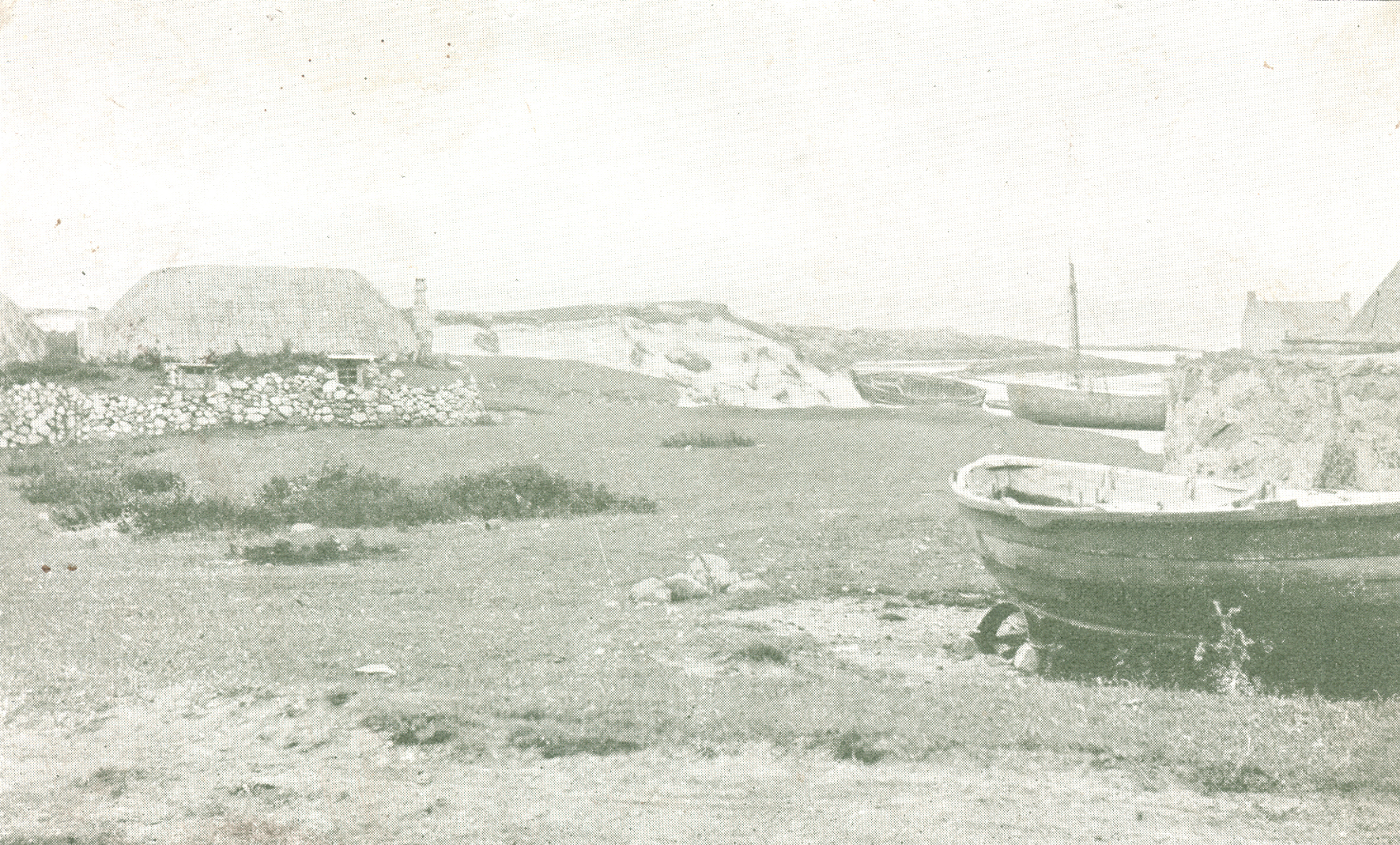

Black and white postcard of Scarinish around 1910.
Scarinish around 1910.
Black and white photograph of the MacLean family of Vaul.
The MacLean family of Vaul photographed before World War II.

Black and white photograph of Donald O. MacLean and Johnny Brown in 1936.
Church Hall, Scarinish, 1936. L-RL Donald O. Maclean and Johnny Brown. Willie Bunting`s van is third in line.

Willie Bunting of Balemartine
Photograph of Willie Bunting during World War II.

The first Tiree man to enlist after the outbreak of World War II was Willie Bunting of Balemartine. He is pictured in this photograph (second right in the front row) after completing his training at Newcastle. Prior to this, he worked for Johnny Brown at the Scarinish Hotel as a motor mechanic and taxi driver.
In 1939 he asked Johnny for a couple of days off work and went to Stirling Castle where he joined the army. On his return in 1945, Johnny handed him a large brown envelope containing his wages for the time he was away.
After the war Willie worked on Tiree as a haulier, then left for Glasgow in the early 1950s to work as a mechanic. He returned to the island in 1969 to work as an engineer in the power house in Crossapol.
Black and white photograph of Willi Bunting at start of WWII.
Willie Bunting (2nd right front) after training at Newcastle in 1939-40.
Colour photograph of Clachan, Cornaigmore in 1999.
Clachan, Cornaigmore in 1999. (Original in Filing Cabinet 4 drawer 3)

Copied colour photograph of Duncan MacPhee in 1995.
Duncan MacPhee of Scarinish opening a display about HMS Tiree at Tiree High School on 28th May 1995.

Black and white photograph of the first plane in Tiree in 1929.
The first plane to land on Tiree at a Tiree Association Sports Day in 1929. Captain A. N. Kingwill was hired to fly the plane to the island, bringing with him the day’s newspapers. Short flights on the plane were on offer at 2/6d (12p) a time and Captain Kingwill gave a display of stunt-flying.

Black and white photograph of Alasdair MacDonald of Balephuil.
Alasdair MacDonald of Balephuil Sliabh harvesting with a Clydesdale horse.

Kirkapol Church
Postcard of Kirkapol Church

Courtesy of Mrs Ishobel MacDonald
Built in 1842, Kirkapol Church serves the eastern half of Tiree. It is almost square and resembles a typical non-conformist chapel in design. The masonry is local rubble with sandstone dressings and quoins of pink granite brought from the Ross of Mull.
The church contains a memorial to the Rev. Hector MacKinnon, a native of Tiree, who began his ministry here (1892-94) and later became so powerful a preacher he was called the ‘Spurgeon of the North’.
Nearby are the remains of a former parish church dating from the 14th century dedicated to St Columba and a smaller 13th century chapel, both probably built on the sites of earlier churches. The name Kirkapol derives from the Norse for Church Town.
Black and white postcard of Kirkapol Church.
Postcard of Kirkapol Church in the 1950s. (Original in Filing Cabinet 5 drawer 1)
Colour photograph of Colin MacFadyen`s thatched house at Milton in 1978.
Colin MacFadyen`s thatched house at the point at Milton in 1978. L-R: Callum Smyth and Colin MacFadyen.
