


Black and white photograph of the new road to Silversands, Vaul.
Photograph from a small album from Silversands, Vaul, titled `The new road to Silversands`, probably taken in the late 1920s to early 1930s.


Black and white photograph of the new road to Silversands, Vaul.
Photograph from a small album from Silversands, Vaul, titled `The new road to Silversands`, probably taken in the late 1920s to early 1930s.
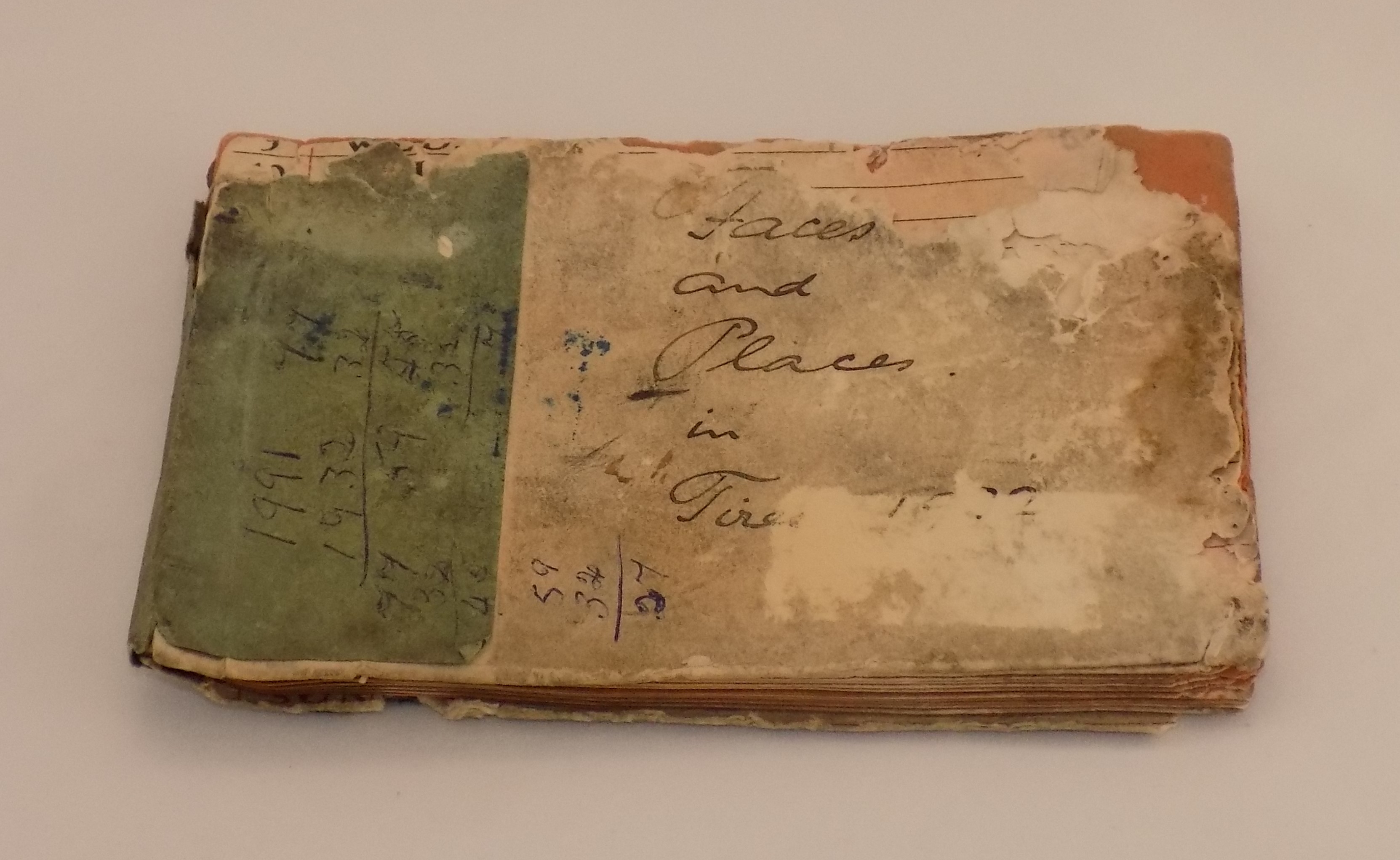
Small photo album titled `Places and Faces in Tiree 1932`.
Small photograph album titled `Places and Faces in Tiree 1932` said to come from Silversands and containing 17 black and white photographs with captions.
The Whitehouse MacLeans with a horse-drawn reaper in around 1920.
Photograph of the MacLean family from Whitehouse with a horse-drawn reaper.

Courtesy of Mr Angus MacLean
The MacLean family from Whitehouse, Cornaigbeg are pictured cutting corn with a horse-drawn reaper. This was a tremendous advance on the sickle and scythe. Use of the scythe needed strength and skill and one man could cut only a quarter acre in a day.
Two men sat on the reaper, one to guide the horses which walked beside the standing corn while the other tilted the reaper’s platform when enough corn for a sheaf had gathered. He then pushed it off with an angled rake. The sheaves were tied by people following behind the reaper.
Binders pulled by three horses replaced the reaper. Mechanically operated implements drawn by tractors eventually took over after World War II.
Black and white photograph of cutting corn at Whitehouse.
Cutting corn by reaper at Whitehouse, Cornaig. L-R: Donald MacLean (Big Donald), Charles MacLean (Curly), Tom MacLean, Hector MacLean (Curly’s father), Donald MacLean (father of Tom and Big Donald), unknown, Murdoch MacLean (Curly’s brother).
Cutting corn by a reaper was a tremendous step forward from the sickle and scythe. Sickle work was done mainly by women. Four or five would work together cutting handfuls of corn at a time which were then tied together by the men. The scythe had a blade approx. 2.5 ft long (85 cm) and was handled by the men. A man could cut fully a quarter acre in a day.
The reaper was powered by horses. A cross-member board 4 ins by 2 ins (10 cm x 5 cm) and 4.5 ft long (137 cm) was bolted to the cutting blade of the reaper by hinges, allowing it to operate up and down. Ten strips of wood 4 ins by 1 in (10 cm x 2.5 cm) and 2.5 ft long (75 cm) were placed at 4 inch (10 cm) intervals at right angles to the cross-member. A pedal which was attached to the cross-member was pressed down by the worker’s right foot. This allowed the corn to gather on the platform. He then released the pedal and the platform tilted to the ground. The corn was finally pushed off with the tilting rake. Enough corn to make a whole sheaf then lay on the ground in readiness for the people following behind to tie it. Note the central figure, Hector MacLean, has a tilting rake specially designed to remove corn from the platform.
Binders pulled by 3 horses replaced the reaper. Mechanically operated implements drawn by tractors eventually took over.
Black and white photograph of Iain, the herd boy.
Photograph from a small album from Silversands, Vaul, titled `Maighstir Iain`, as either (1) Iain MacFarlane, (brother of Lachie MacFarlane of Hynish) identified by Chrissie, Lachie`s widow. Iain died at sea at the beginning of WWII. Or (2) Jimmy Purdon, the first child `boarded out` with Elsie MacKinnon, Kirkapol. Identified by his brother via Fiona MacKinnon, Lodge Farm in 2010. Probably taken in the late 1920s to early 1930s.

Iain MacFarlane
Photograph of Iain MacFarlane with Eachunn the cat.

This photograph of the late 1920s or early 1930s shows Iain MacFarlane when he was working as ‘am buachaille’ or herd boy in the east end of Tiree. Herding was done by boys when they left school at 14 and sometimes by old men.
As the common grazings and many fields were unfenced, their job was to keep cattle, sheep and horses within the township boundaries and out of the crops. Until wire fencing was introduced in the 1890s, fields were sometimes enclosed with turf or stone walls.
From May to October, Iain would have stayed in a ‘bothag’, a small round building constructed of stone and roofed with turfs over a timber frame. He died at sea at the beginning of World War II.
Black and white photograph of Iain, the herd boy, with Eachann the cat.
Photograph from a small album from Silversands, Vaul, titled `Iain, the herd laddie`, identified as Iain MacFarlane, (brother of Lachie MacFarlane of Hynish) by Chrissie, Lachie`s widow. Iain died at sea at the beginning of WWII. Probably taken in the late 1920s to early 1930s.
Black and white photograph of a coal puffer.
Coal puffer probably taken on Gott Bay in the late 1920s to early 1930s.

Black and white photograph of people aboard an unknown ship.
Group photograph from a samml album from Silversands, Vaul, of six unknown men aboard an unknown ship, probably taken in the late 1920s to early 1930s.

Black and white photograph of Iain, the herd boy.
Photograph from a small album from Silversands, titled `The herd laddie` taken in the late 1920s to early 1930s. Herding was done by boys when they left school at 14. As the common grazings and many fields were unfenced, their job was to keep cattle, sheep and horses within the township boundaries and out of the crops. Until wire fencing was introduced in the 1890s, fields were sometimes enclosed with turf or stone walls. From May to October, Iain would have stayed in a ‘bothag’, a small round building constructed of stone and roofed with turfs over a timber frame.

D. & H. MacArthur’s shop
Photograph of D. & H. MacArthur’s shop in Scarinish at the beginning of the 20th century.

Courtesy of Mrs Flora MacKinnon
Situated in Scarinish close to the ferry terminal, D. & H. MacArthur’s was the main shop on the island. It comprised a general store, a Post Office and a hardware department upstairs. The MacArthur family lived on the top floor.
The lean-to structure on the left is Taigh an t-Sàil where preserving salt was stored. Salted meat or fish would be packed in large barrels similar to those in the foreground. The wicker baskets to the left of the main doorway were used to import pan loaves from Glasgow.
There was no running water in the building but a well and pump outside. In 1948 disaster struck when a fire which began in the back paraffin store destroyed the shop. A new Co-operative store was built on the same site.
Black and white photograph of D & H MacArthur`s general store in Scarinish taken in the 1930s.
Situated in Scarinish close to the ferry terminal, D & H MacArthur’s was the main shop on the island. It comprised a general store, a Post Office and a hardware department upstairs. The MacArthur family lived on the top floor. The lean-to structure on the left is Taigh an t-Sàil where preserving salt was stored. Salted meat or fish would be packed in large barrels similar to those in the foreground. The wicker baskets to the left of the main doorway were used to import pan loaves from Glasgow. The building burned down during World War II and a new Co-operative store built on the same site.
Black and white photograph of Archie MacEachern and Donald MacLean.
Archie (Leipan) MacEachern and Donald MacLean, Ard Beg, outside the smiddy at Creag Mhor, Cornaigbeg.