


Box of slate pencils.
Plywood box covered with purple paper except on the lid which is illustrated in colour with a Union Jack and scenes from the battles of Trafalgar and Waterloo. Contains four slate pencils. Trademark `The Box`, made in Germany.


Box of slate pencils.
Plywood box covered with purple paper except on the lid which is illustrated in colour with a Union Jack and scenes from the battles of Trafalgar and Waterloo. Contains four slate pencils. Trademark `The Box`, made in Germany.
Block forming part of pulley found in Hynish.
Block forming part of pulley found in a shed opposite Milton House in Hynish by Patrick Lorimer.
Lachlan MacPhail carting seaweed
Photograph of Lachlan MacPhail carting seaweed

Courtesy of Mr Ailig MacArthur
Lachlan MacPhail, originally from Luing, is pictured with a cartload of seaweed outside the shepherd’s cottage where he lived in Crossapol. A fork has been stuck in the back of the cart to stop the seaweed slipping off.
Gathered from March to May, the seaweed is spread on grass or on ground to be planted with corn or potatoes. Red seaweed known as ‘bàrr-dearg’ was considered the best for this purpose but only came ashore on certain tides usually in the month of May.
The soils of Tiree are predominantly light and sandy and need feeding with organic matter every year to keep their fertility. Although not considered as good a fertiliser as manure, seaweed improves the condition of the soil and aids water retention.
Black and white photograph of Lachlann MacPhail, Crossapol.
Lachlan MacPhail from Luing with a cartload of seaweed outside the shepherd’s cottage where he lived in Crossapol, Tiree, probably taken in the early 20th century.
Black and white photograph of Gott Bay pier.
Gott Bay pier, probably taken in the early 20th century.

Black and white postcard of Port an Tobair, Balemartine.
Port an Tobair, Balemartine, with three fishing dinghies in the foreground, probably photographed in the early 20th century.

Black and white photograph of Scarinish harbour.
Scarinish harbour with the Mary Stewart, probably taken in the 1930s. The building in the background was originally built as a church, then used intermittently as a prison and latterly as a store by the owners of the Mary Stewart. It was pulled down to make roads during World War II.
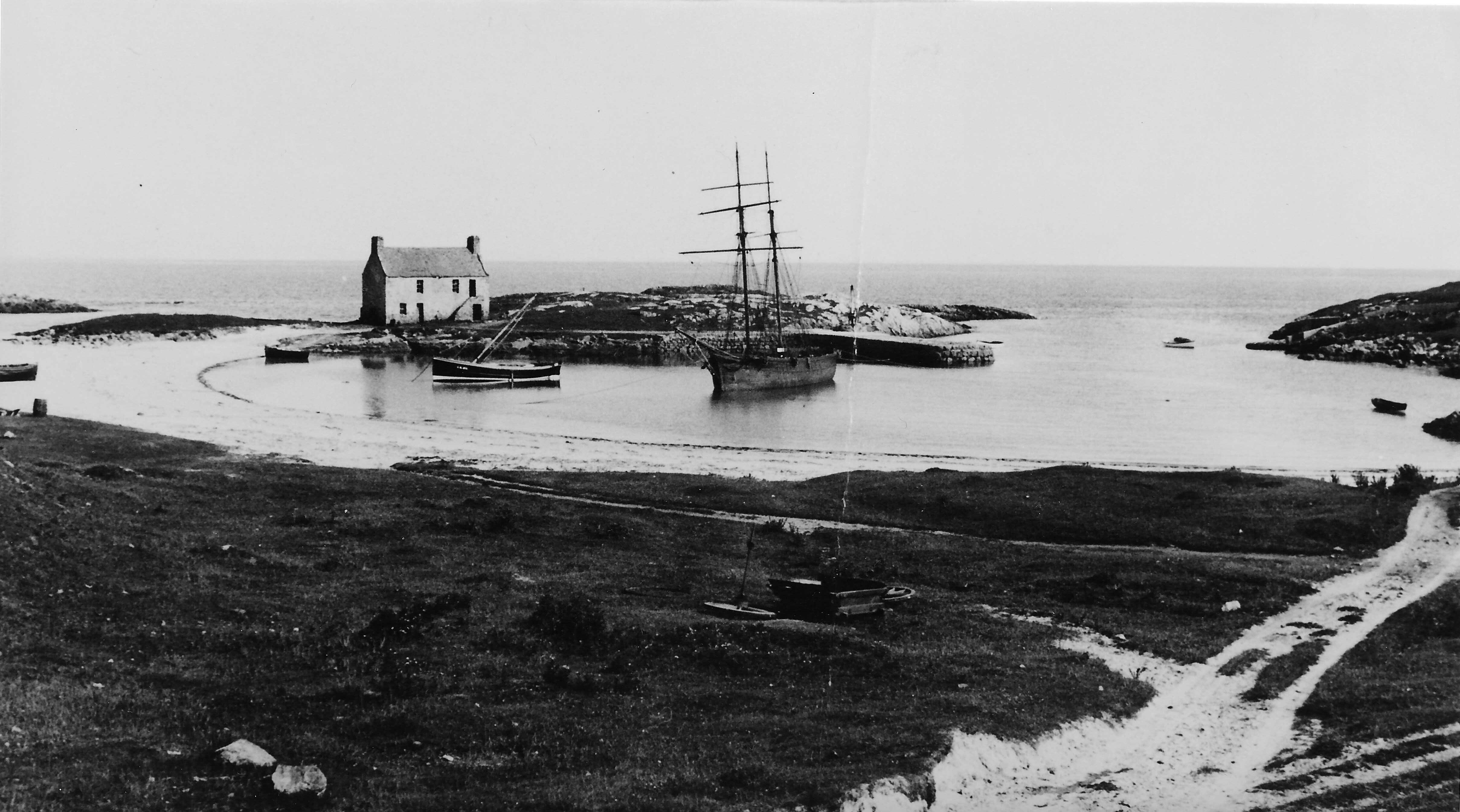
The ‘Mary Stewart’ in Scarinish harbour in the 1930s
Photograph of the schooner ‘Mary Stewart’ in Scarinish harbour in the 1930s.
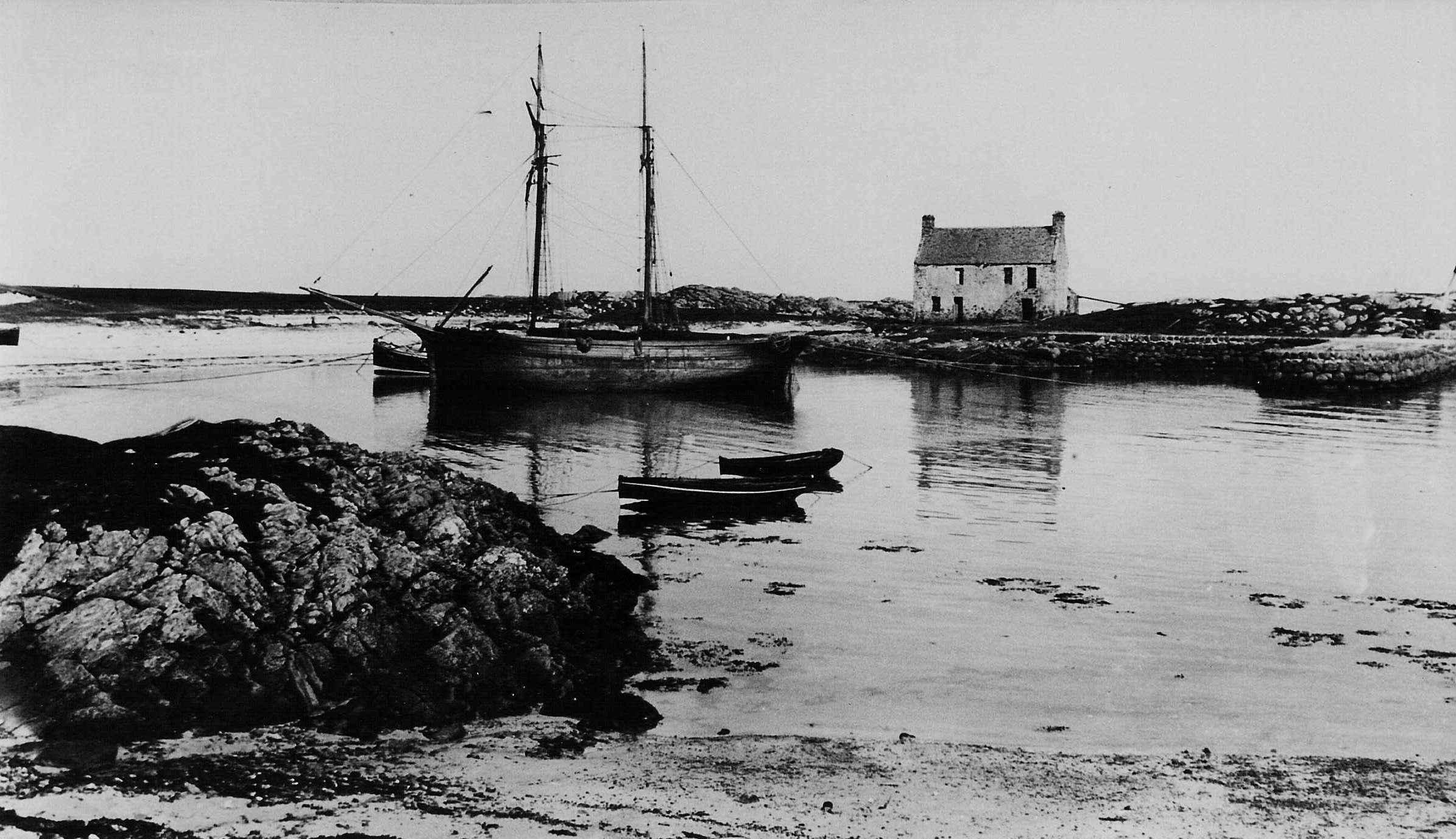
Courtesy of Mrs Netta Martin
Taken in the early 1930s, this view of Scarinish harbour shows the topsail schooner ‘Mary Stewart’ in her final resting place. For the previous thirty years she had traded up and down the west coast carrying coal and other cargo.
Also anchored in the harbour are two lobster boats. Commercial lobster fishing began on Tiree after 1880 when the railway to Oban was opened, allowing shellfish to be sent live to the London markets for the first time.
Said to have been originally built as a church, the building in the background was used as a store by the owners of the ‘Mary Stewart’. It was pulled down to make the road to the pier during World War II.
Black and white photograph of Scarinish harbour.
Scarinish harbour with the Mary Stewart, probably taken in the 1930s. The building in the background was originally built as a church, then used intermittently as a prison and latterly as a store by the owners of the Mary Stewart. It was pulled down to make roads during World War II.
Black and white photograph of the new road to Silversands, Vaul.
Photograph from a small album from Silversands, Vaul, titled `The new road to Silversands`, probably taken in the late 1920s to early 1930s.

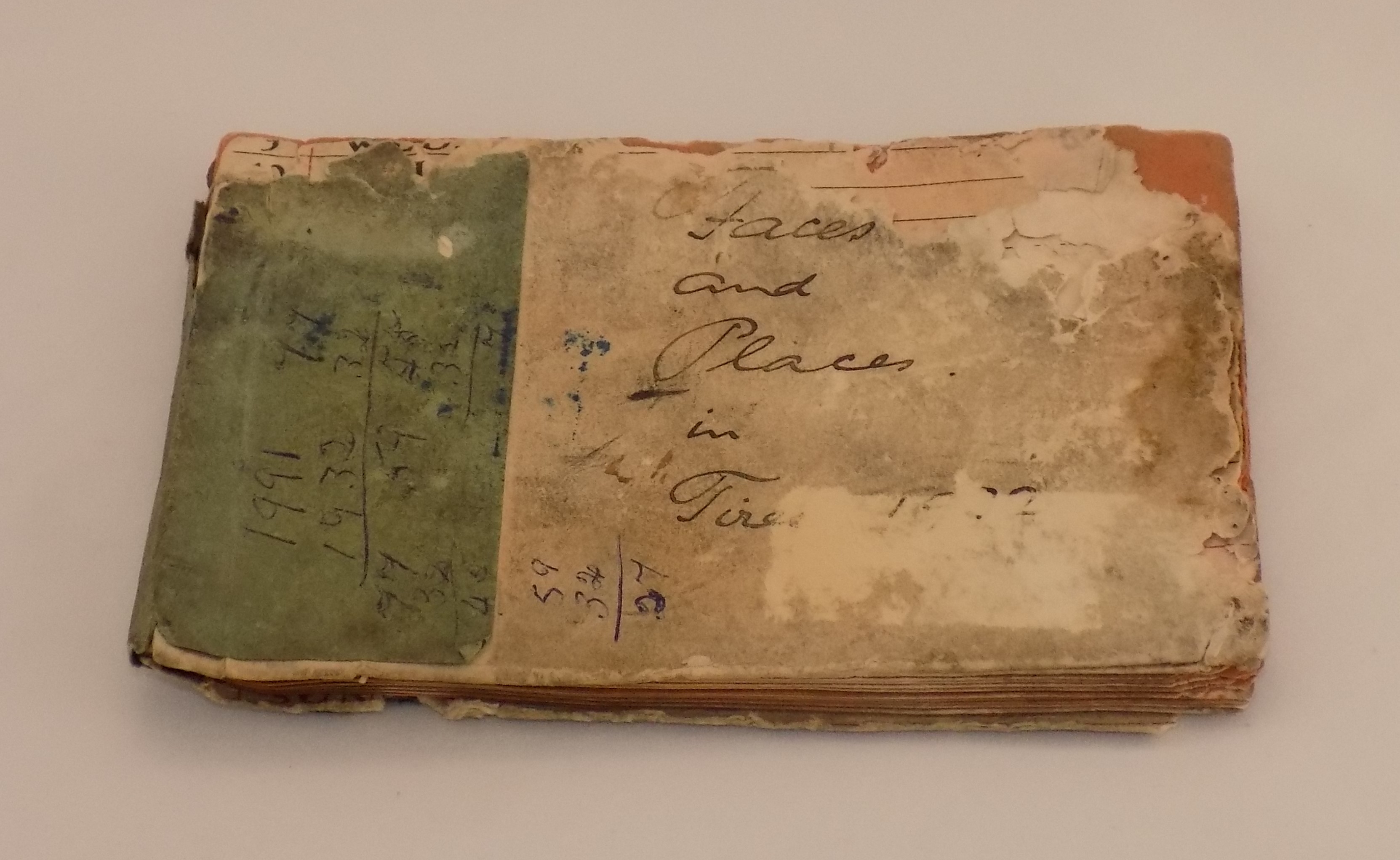
Small photo album titled `Places and Faces in Tiree 1932`.
Small photograph album titled `Places and Faces in Tiree 1932` said to come from Silversands and containing 17 black and white photographs with captions.
The Whitehouse MacLeans with a horse-drawn reaper in around 1920.
Photograph of the MacLean family from Whitehouse with a horse-drawn reaper.

Courtesy of Mr Angus MacLean
The MacLean family from Whitehouse, Cornaigbeg are pictured cutting corn with a horse-drawn reaper. This was a tremendous advance on the sickle and scythe. Use of the scythe needed strength and skill and one man could cut only a quarter acre in a day.
Two men sat on the reaper, one to guide the horses which walked beside the standing corn while the other tilted the reaper’s platform when enough corn for a sheaf had gathered. He then pushed it off with an angled rake. The sheaves were tied by people following behind the reaper.
Binders pulled by three horses replaced the reaper. Mechanically operated implements drawn by tractors eventually took over after World War II.
Black and white photograph of cutting corn at Whitehouse.
Cutting corn by reaper at Whitehouse, Cornaig. L-R: Donald MacLean (Big Donald), Charles MacLean (Curly), Tom MacLean, Hector MacLean (Curly’s father), Donald MacLean (father of Tom and Big Donald), unknown, Murdoch MacLean (Curly’s brother).
Cutting corn by a reaper was a tremendous step forward from the sickle and scythe. Sickle work was done mainly by women. Four or five would work together cutting handfuls of corn at a time which were then tied together by the men. The scythe had a blade approx. 2.5 ft long (85 cm) and was handled by the men. A man could cut fully a quarter acre in a day.
The reaper was powered by horses. A cross-member board 4 ins by 2 ins (10 cm x 5 cm) and 4.5 ft long (137 cm) was bolted to the cutting blade of the reaper by hinges, allowing it to operate up and down. Ten strips of wood 4 ins by 1 in (10 cm x 2.5 cm) and 2.5 ft long (75 cm) were placed at 4 inch (10 cm) intervals at right angles to the cross-member. A pedal which was attached to the cross-member was pressed down by the worker’s right foot. This allowed the corn to gather on the platform. He then released the pedal and the platform tilted to the ground. The corn was finally pushed off with the tilting rake. Enough corn to make a whole sheaf then lay on the ground in readiness for the people following behind to tie it. Note the central figure, Hector MacLean, has a tilting rake specially designed to remove corn from the platform.
Binders pulled by 3 horses replaced the reaper. Mechanically operated implements drawn by tractors eventually took over.