


Black and white photograph of Charlie MacLean in 1929.
Charlie MacLean (Curly) of Cornaigbeg photographed on 21/7/1929 at the wheel of a Morris Cowley in Caoles. (Original 2005.9.8 in Filing Cabinet 8 drawer 3)


Black and white photograph of Charlie MacLean in 1929.
Charlie MacLean (Curly) of Cornaigbeg photographed on 21/7/1929 at the wheel of a Morris Cowley in Caoles. (Original 2005.9.8 in Filing Cabinet 8 drawer 3)
Black and white photograph of Donald and Margaret MacDonald.
Donald MacDonald (Domhnall Iain) of 10 Cornaigbeg with his wife Margaret who came from Melness in Sutherland, pictured outside their old house in the 1920s.

Audio cassette recording of Hugh Archie MacCallum interviewed by Maggie Campbell on 28/9/2002.
Hugh Archie MacCallum talks to Maggie Campbell in September 2002 about the Cornaigbeg crofts, the crofters’ names and patronymics; old and new methods of farming, seaweed and its uses, cattle shows; shebeens, shops, cobblers, the grocer’s horse-drawn van; the old schoolhouse at Cornaig and the United Free Church at Whitehouse; the evil eye; the shipwreck of the Malve during World War I. Eòghann Èairdsidh ’Ic Chaluim a’ bruidhinn ri Magaidh Chaimbeul anns an t-Sultain 2002 mu croitean Chòrnaig Bhige, ainmean agus sloinneadhan nan croitearan, dòighean sean agus ùr air croitearachd, feamainn, fèill cruidh, shebeens, bùthan, greasaichean, carbad bùtha air a tharraing le each, an t-seann sgoil Chòrnaig agus an Eaglais Shaor aig an Taigh Gheal, an droch shùil, am Malve a chaidh air na sgeirean aig àm a’ Cheud Chogadh.
Book of three Gaelic plays titled `Tri Comhraidhean`.
Gaelic play `Na Fasain Ura` written by Morag MacDonald which 1st prize in the 1927 Mod. (Morag was a teacher at Balemartine School and aunt of Flora MacPhail, Skipnish.)
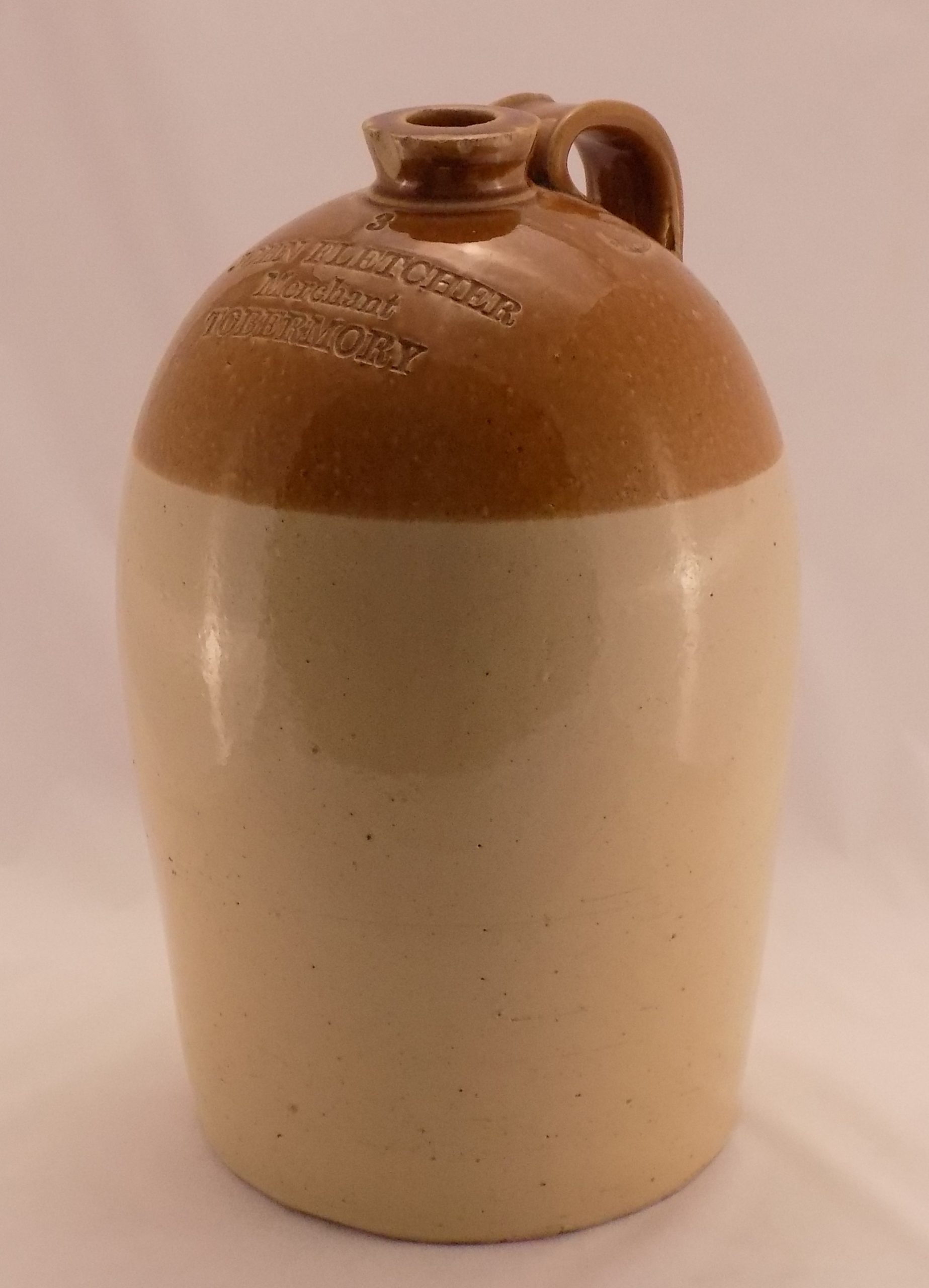
Large glazed stoneware flagon, 425 mm high, bottom three-quarters uncoloured, top quarter in orange-brown, made by Henry Kennedy, Barrowfield Pottery, Glasgow and stamped on the front with `3 JOHN FLETCHER Merchant TOBERMORY`.
Knickers made from a flour sack
Photograph of a pair of knickers made from a flour sack.

These women’s knickers were made in Tiree from a flour sack in the first quarter of the 20th century. The isolation of the crofting community on Tiree made it necessary to make do with the materials to hand.
The knickers were sewn by machine with flat seams and decorated with hand-made tatting round the legs. The waist may have been elasticated or tightened with a drawstring.
Flour was purchased in 140 lb (65 kg) sacks made from closely woven cotton. The seams would have been unpicked and the material plastered with black soap (‘siaban dubh’) to remove the printing before putting it outside to bleach in the sun. The flour producer’s name, Harter, is still visible.
Block forming part of pulley found in Hynish.
Block forming part of pulley found in a shed opposite Milton House in Hynish by Patrick Lorimer.
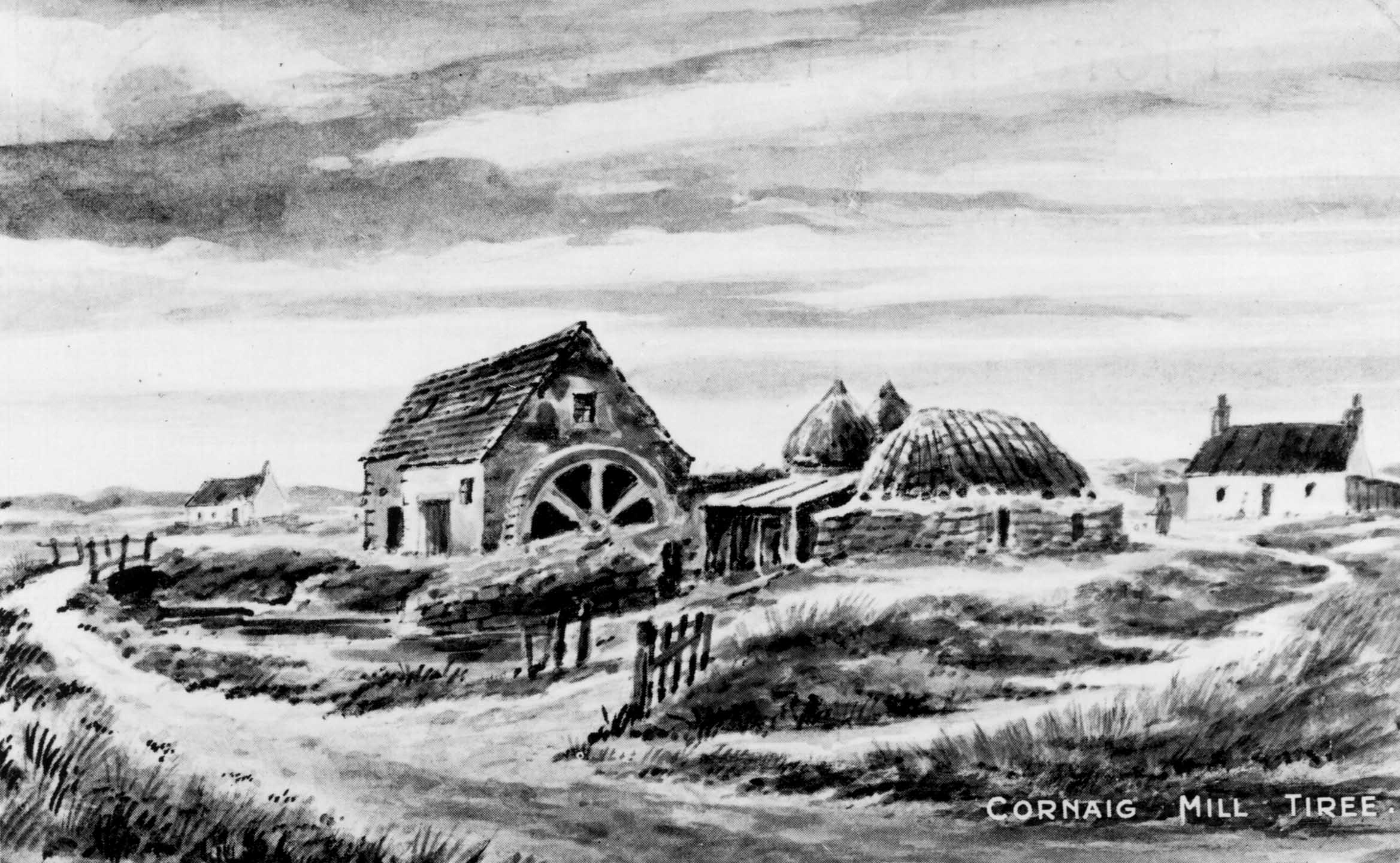
Black and white postcard of Cornaig mill.
Postcard of a painting of Cornaig mill, probably produced in the early 20th century.
Lachlan MacPhail carting seaweed
Photograph of Lachlan MacPhail carting seaweed

Courtesy of Mr Ailig MacArthur
Lachlan MacPhail, originally from Luing, is pictured with a cartload of seaweed outside the shepherd’s cottage where he lived in Crossapol. A fork has been stuck in the back of the cart to stop the seaweed slipping off.
Gathered from March to May, the seaweed is spread on grass or on ground to be planted with corn or potatoes. Red seaweed known as ‘bàrr-dearg’ was considered the best for this purpose but only came ashore on certain tides usually in the month of May.
The soils of Tiree are predominantly light and sandy and need feeding with organic matter every year to keep their fertility. Although not considered as good a fertiliser as manure, seaweed improves the condition of the soil and aids water retention.
Black and white photograph of Lachlann MacPhail, Crossapol.
Lachlan MacPhail from Luing with a cartload of seaweed outside the shepherd’s cottage where he lived in Crossapol, Tiree, probably taken in the early 20th century.
Black and white photograph of Gott Bay pier.
Gott Bay pier, probably taken in the early 20th century.
