


Black and white photograph of Maggie.
Photograph from a small album from Silversands, Vaul, titled Maggie, probably taken in the late 1920s to early 1930s.


Black and white photograph of Maggie.
Photograph from a small album from Silversands, Vaul, titled Maggie, probably taken in the late 1920s to early 1930s.
The Coaling Station at Brock
Photograph of a coal puffer beached on Gott Bay at Brock in the 1930s.

Around the middle of the 19th century, when local peat deposits had run out and peat was no longer readily available from adjacent islands, coal was shipped to Tiree in sailing smacks and schooners owned and sailed by Tiree men.
Later in the century and into the 1900s, coal was brought in by steam-driven lighters known as puffers. As there are no secure harbours in Tiree, the puffers, like the schooners before them, were beached at spring tides on several of the sandy bays around the island.
The coal was discharged into horse-drawn carts of a half tonne nominal capacity. One such coaling station was at Brock on the east end of the island.
Black and white photograph of the coaling station, Brock.
Photograph from a small album from Silversands, Vaul, titled `The Coaling Station, Brock` of a puffer discharging coal into horse-drawn carts, probably taken in the late 1920s to early 1930s. Around the middle of the 19th century, when local peat deposits had run out and peat was no longer readily available from adjacent islands, coal was shipped to Tiree in sailing smacks and schooners owned and sailed by Tiree men. Later in the century and into the 1900s, coal was brought in by puffers. As there are no secure harbours in Tiree, the puffers like the schooners before them were beached at spring tides on several of the sandy bays around the island. The coal was discharged into horse-drawn carts of a half tonne nominal capacity. One such coaling station was at Brock on the east end of the island.
Black and white photograph of a collier on the beach at Brock.
Photograph from a small album from Silversands, Vaul, titled `Collier on the beach at Brock` of a puffer waiting to discharge coal into horse-drawn carts, probably taken in the late 1920s to early 1930s. For additional information see catalogue for 1997.176.7.

Black and white photograph of the new road to Silversands, Vaul.
Photograph from a small album from Silversands, Vaul, titled `The new road to Silversands`, probably taken in the late 1920s to early 1930s.

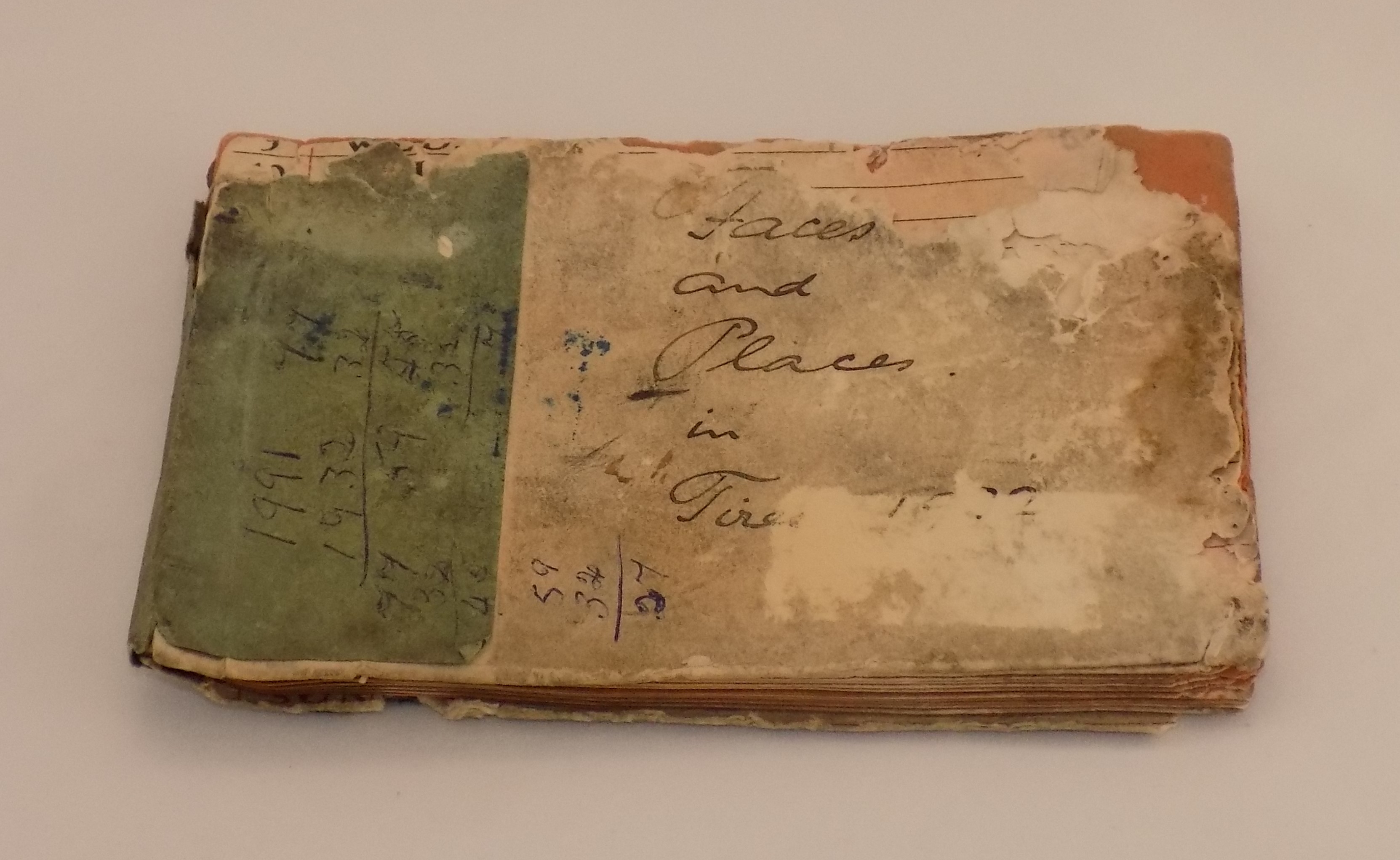
Small photo album titled `Places and Faces in Tiree 1932`.
Small photograph album titled `Places and Faces in Tiree 1932` said to come from Silversands and containing 17 black and white photographs with captions.
The Whitehouse MacLeans with a horse-drawn reaper in around 1920.
Photograph of the MacLean family from Whitehouse with a horse-drawn reaper.

Courtesy of Mr Angus MacLean
The MacLean family from Whitehouse, Cornaigbeg are pictured cutting corn with a horse-drawn reaper. This was a tremendous advance on the sickle and scythe. Use of the scythe needed strength and skill and one man could cut only a quarter acre in a day.
Two men sat on the reaper, one to guide the horses which walked beside the standing corn while the other tilted the reaper’s platform when enough corn for a sheaf had gathered. He then pushed it off with an angled rake. The sheaves were tied by people following behind the reaper.
Binders pulled by three horses replaced the reaper. Mechanically operated implements drawn by tractors eventually took over after World War II.
Black and white photograph of cutting corn at Whitehouse.
Cutting corn by reaper at Whitehouse, Cornaig. L-R: Donald MacLean (Big Donald), Charles MacLean (Curly), Tom MacLean, Hector MacLean (Curly’s father), Donald MacLean (father of Tom and Big Donald), unknown, Murdoch MacLean (Curly’s brother).
Cutting corn by a reaper was a tremendous step forward from the sickle and scythe. Sickle work was done mainly by women. Four or five would work together cutting handfuls of corn at a time which were then tied together by the men. The scythe had a blade approx. 2.5 ft long (85 cm) and was handled by the men. A man could cut fully a quarter acre in a day.
The reaper was powered by horses. A cross-member board 4 ins by 2 ins (10 cm x 5 cm) and 4.5 ft long (137 cm) was bolted to the cutting blade of the reaper by hinges, allowing it to operate up and down. Ten strips of wood 4 ins by 1 in (10 cm x 2.5 cm) and 2.5 ft long (75 cm) were placed at 4 inch (10 cm) intervals at right angles to the cross-member. A pedal which was attached to the cross-member was pressed down by the worker’s right foot. This allowed the corn to gather on the platform. He then released the pedal and the platform tilted to the ground. The corn was finally pushed off with the tilting rake. Enough corn to make a whole sheaf then lay on the ground in readiness for the people following behind to tie it. Note the central figure, Hector MacLean, has a tilting rake specially designed to remove corn from the platform.
Binders pulled by 3 horses replaced the reaper. Mechanically operated implements drawn by tractors eventually took over.
Board-mounted photographs of visits to the Lodge 1911-1921.
Originals photographs taken during visits to the Lodge 1911-1921, copied as C27-C37, D1-D30, H37 and J1.
Black and white photograph of Elizabeth Milne in Lady Victoria`s buckboard.
Elizabeth Milne with Lady Frances Balfour`s samoyed Vaul in Lady Victoria` buckboard.
Black and white photograph of Archie MacDonald, Melness.
Archie MacDonald of Melness, Cornaigbeg at the 1921 Horse Show.
Black and white photograph of Duncan MacKinnon, Lodge Farm, 1921.
Duncan MacKinnon of Lodge Farm, Kirkapol, playing the pipes in 1921.
