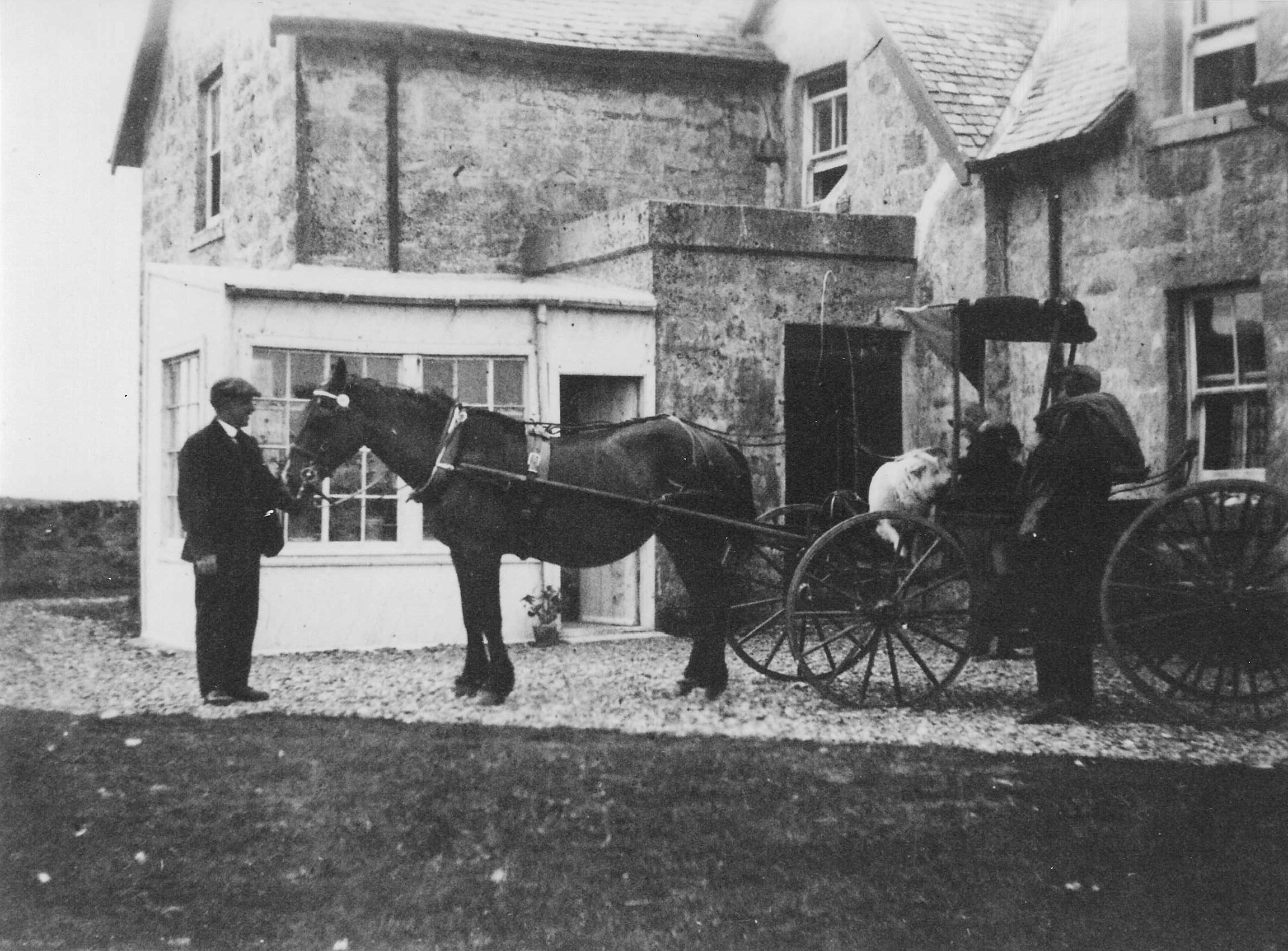
Lachlan MacPhail carting seaweed
Photograph of Lachlan MacPhail carting seaweed
Courtesy of Mr Ailig MacArthur
Lachlan MacPhail, originally from Luing, is pictured with a cartload of seaweed outside the shepherd’s cottage where he lived in Crossapol. A fork has been stuck in the back of the cart to stop the seaweed slipping off.
Gathered from March to May, the seaweed is spread on grass or on ground to be planted with corn or potatoes. Red seaweed known as ‘bàrr-dearg’ was considered the best for this purpose but only came ashore on certain tides usually in the month of May.
The soils of Tiree are predominantly light and sandy and need feeding with organic matter every year to keep their fertility. Although not considered as good a fertiliser as manure, seaweed improves the condition of the soil and aids water retention.
Black and white photograph of Lachlann MacPhail, Crossapol.
Lachlan MacPhail from Luing with a cartload of seaweed outside the shepherd’s cottage where he lived in Crossapol, Tiree, probably taken in the early 20th century.
Black and white photograph of Donald MacKechnie, Kilmoluaig.
Donald MacKechnie, Kilmoluaig, (Maggie Campbell`s father) in his naval uniform.
Black and white photograph of John MacKinnon, Lodge Farm.
John MacKinnon of Lodge Farm, Kirkapol is pictured here outside the Lodge with Lady Victoria Campbell’s buckboard. The daughter of the 8th Duke of Argyll, Lady Victoria contracted polio in 1859 when 5 years old and was lame for the rest of her life. When rough seas or low tides made it impossible for passengers to board the lighter for the mail-boat at either of the small piers at Scarinish harbour, the boat was run in as far as possible on the beach at Gott Bay. ‘Faithful John’ would drive the horse and buckboard through the water to the stranded lighter to transfer Lady Victoria, fortunately always without accident.
Hugh MacKinnon and the first plane on Tiree
Photograph of Hugh MacKinnon and the first plane on Tiree.
Courtesy of Mrs Netta Martin
Hugh MacKinnon (Eòghann Dhòmhnaill), known as the Contractor, is pictured here on the Reef with the first plane to land on Tiree. The two-seater Moth piloted by Captain A. N. Kingwill was brought over from Renfrew by the Tiree Association for their Sports Day in July 1929.
The Contractor owned one of the few cars on Tiree at the time and took the pilot to his house for lunch. The first passengers on a short trip over the island included the Contractor himself and John MacLean (Iain a’ Ghaffer) of Kilkenneth.
Kingwill went on to fly with Sir Alan Copburn’s flying circus and made the first scheduled landing at a municipal airport later that year when he piloted a Moth into Wythenshawe Airport at Manchester.
Black and white photograph of the Tiree Association Sports Day in the late 1920s.
Tiree Association Sports Day, 1927 or 1928. Since its foundation in 1900, the Tiree Association has organised an annual Sports Day on Tiree which continues to this day. In 1927 or ’28, Captain A. N. Kingwill was hired to fly the first plane to the island, bringing with him the day’s newspapers. Short flights on the plane were on offer at 2/6d (12p) a time and Captain Kingwill gave a display of stunt-flying. Hugh MacKinnon, a local contractor from Crossapol, pictured behind the wheel of his car in E24, presented him with a medal.
Black and white photograph of the Tiree Association Sports Day.
Tiree Association Sports Day, 1927 or 1928. Since its foundation in 1900, the Tiree Association has organised an annual Sports Day on Tiree which continues to this day. In 1927 or ’28, Captain A. N. Kingwill was hired to fly the first plane to the island, bringing with him the day’s newspapers. Short flights on the plane were on offer at 2/6d (12p) a time and Captain Kingwill gave a display of stunt-flying. Hugh MacKinnon, a local contractor from Crossapol (pictured behind the wheel of his car in E24) presented him with a medal.
Black and white photograph of Iain, the herd boy.
Photograph from a small album from Silversands, Vaul, titled `Maighstir Iain`, as either (1) Iain MacFarlane, (brother of Lachie MacFarlane of Hynish) identified by Chrissie, Lachie`s widow. Iain died at sea at the beginning of WWII. Or (2) Jimmy Purdon, the first child `boarded out` with Elsie MacKinnon, Kirkapol. Identified by his brother via Fiona MacKinnon, Lodge Farm in 2010. Probably taken in the late 1920s to early 1930s.
Iain MacFarlane
Photograph of Iain MacFarlane with Eachunn the cat.
This photograph of the late 1920s or early 1930s shows Iain MacFarlane when he was working as ‘am buachaille’ or herd boy in the east end of Tiree. Herding was done by boys when they left school at 14 and sometimes by old men.
As the common grazings and many fields were unfenced, their job was to keep cattle, sheep and horses within the township boundaries and out of the crops. Until wire fencing was introduced in the 1890s, fields were sometimes enclosed with turf or stone walls.
From May to October, Iain would have stayed in a ‘bothag’, a small round building constructed of stone and roofed with turfs over a timber frame. He died at sea at the beginning of World War II.
Black and white photograph of Iain, the herd boy, with Eachann the cat.
Photograph from a small album from Silversands, Vaul, titled `Iain, the herd laddie`, identified as Iain MacFarlane, (brother of Lachie MacFarlane of Hynish) by Chrissie, Lachie`s widow. Iain died at sea at the beginning of WWII. Probably taken in the late 1920s to early 1930s.
Black and white photograph of a coal puffer.
Coal puffer probably taken on Gott Bay in the late 1920s to early 1930s.
Black and white photograph of people aboard an unknown ship.
Group photograph from a samml album from Silversands, Vaul, of six unknown men aboard an unknown ship, probably taken in the late 1920s to early 1930s.
Black and white photograph of Iain, the herd boy.
Photograph from a small album from Silversands, titled `The herd laddie` taken in the late 1920s to early 1930s. Herding was done by boys when they left school at 14. As the common grazings and many fields were unfenced, their job was to keep cattle, sheep and horses within the township boundaries and out of the crops. Until wire fencing was introduced in the 1890s, fields were sometimes enclosed with turf or stone walls. From May to October, Iain would have stayed in a ‘bothag’, a small round building constructed of stone and roofed with turfs over a timber frame.