


Map showing crofts to be created (1892). One inch to one mile.
Map showing crofts to be created (1892). Produced by the Royal Commission (Highlands and Islands).

Map showing crofts to be created (1892). One inch to one mile.
Map showing crofts to be created (1892). Produced by the Royal Commission (Highlands and Islands).
List of Tiree mariners 1895-1901 extracted from documents at the National Archives at Kew.
Extracts from Crew Lists & Agreements 1895-1901 held at the National Archives at Kew giving, under each ship, the names of Tiree sailors, their age and address, rank, the dates of the voyage, and the sailor`s previous ship.
School merit certificate dated 1893 for Alexander MacLean who attended Cornaigmore Public School.

Printed scan of a handwritten employment reference dated 9/11/1897 for former Post Office employee Alexander C. MacLean of Kilmoluaig, written by Hugh MacDonald, sub-postmaster at Cornaigmore PO.

Black and white photograph of John MacKinnon and his wife Christena Clark in front of their farmhouse on Lot 31, Concession 11, Kincardine Township, Bruce Co, Ontario, Canada.
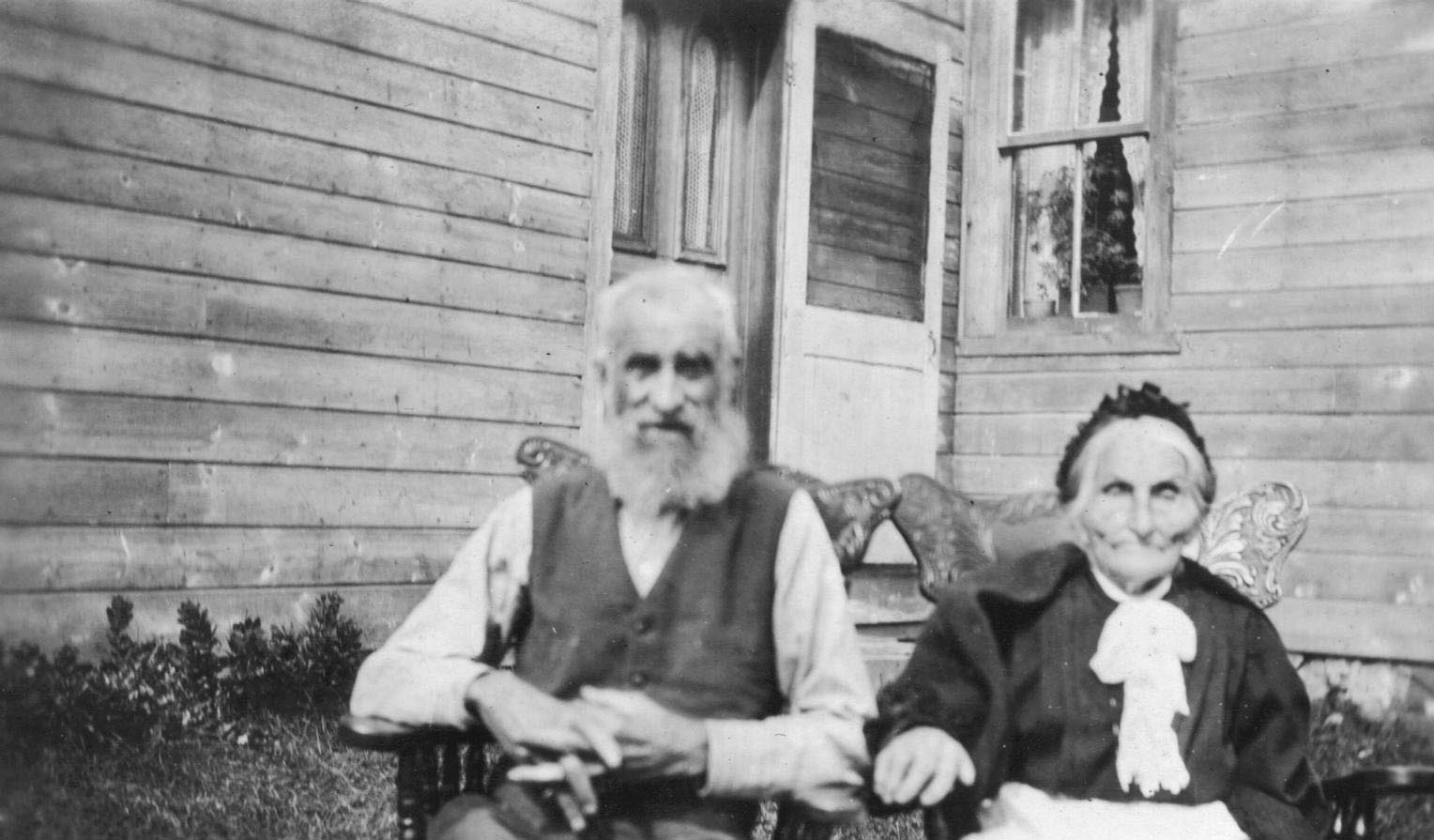
John’s niece, Retta MacKinnon preserved the following memories of her Uncle John (see http://freepages.genealogy.rootsweb.ancestry.com/~russmcgillivray/mackinnon/page1.html )
“Uncle John always prayed in Gaelic at church for the communion service, also said the grace in Gaelic, as did my father, but Uncle John always began his grace the same way – “Holaidh o Ghia”.
Uncle John did not mince words when he spoke. I was down at Uncle Johns for supper one night, and as usual was plied with meat, potatoes, vegetables, biscuits, fruit and pie. I unfortunately make the remark “I ate too much supper”, as more food was pressed on me. Uncle John looked at me as if I were a worm and said, “Your Uncle John is ashamed of you, not knowing when to stop eating.” Cousin Finnie [John’s son], sitting beside me, pressed my hand in sympathy! We were all a little afraid of Uncle John.
A council from the various churches met at the Association meeting in Tiverton to question a young minister, who was to be ordained. Some members of the Council asked a number of catchy questions, and the young man was finding it a bit difficult to answer though he had answered the fundamentals well. Suddenly Uncle John stood up and said, “That will do now! You are asking him questions that you can`t answer yourselves!” The young man came to him after the meeting and thanked him.
We respected Uncle John, but only once did I make him smile, and it was like ice breaking up after a long winter.”
Black and white photograph of fishing smacks at Pictou Island at the end of the 19th century. People from Tiree who emigrated there at that time, would have fished from these boats.

Black and white photograph of the lighthouse at the east end of Pictou Island at the end of the 19th century.
The lighthouse at the east end of Pictou Island at the end of the 19th century, with lightkeeper Andrew MacFarlane (1855-1927), his wife Flora MacPherson (1862-1931) and their children. The fathers of Andrew and Flora both came from Mull.

Black and white photograph of Neil Brown (1819-1905) from Heylipol, with some of his family.
Neil Brown (1919-1905) from Heylipol with his fourth daughter Margaret (b. 1864), his son-in-law Hugh Grant and grandson, either Donald (b. 1895) or Neil (b. 1903), photographed in Canada.

Black and white photograph of the farm at Little Souris, Manitoba owned by John MacLean, the Balephuil bard.
Dewart Farm owned by John MacLean, the Balephuil bard, and his wife Flora, located in Little Souris, Manitoba in the Brandon Hills area, aound 1900.

Flora MacLean in the 1890s
Photograph of Flora MacLean of Manitoba in the 1890s.

Courtesy of Mrs Betty MacKinnon
In this photograph taken in the 1890s Flora MacLean is pictured in the Brandon area of Manitoba with her feet on a bearskin rug. A remarkable woman, Flora pioneered three times during her long life; she lived to be ninety-eight.
Her parents, Donald and Ann MacLean, emigrated from Middleton with their nine children in 1847, though Flora’s mother and a brother did not survive the voyage. When Bruce County opened up in 1852, the family pioneered in Kincardine. It was here that Flora met and married the bard John MacLean, newly arrived from Balephuil.
The couple went west along with two other MacLean families and were the first permanent settlers in the Brandon area of Manitoba. After the death of her husband, Flora at the age of eighty moved with her daughter and son-in-law to The Pas then Flin Flon, frontier towns about 500 miles north of Winnipeg.
Sepia photograph of Flora MacLean, the wife of John MacLean, the Balephuil bard, taken in the 1890s.
Flora emigrated in 1847 to Canada. She pioneered in Brock and Kincardine Twps, and was among the first settlers in Manitoba. She met John MacLean, the Balephuil bard, in Tiverton and they married in 1879. Flora was a widow at the time with a daughter Kate. She died in 1836, the oldest person in North Manitoba.