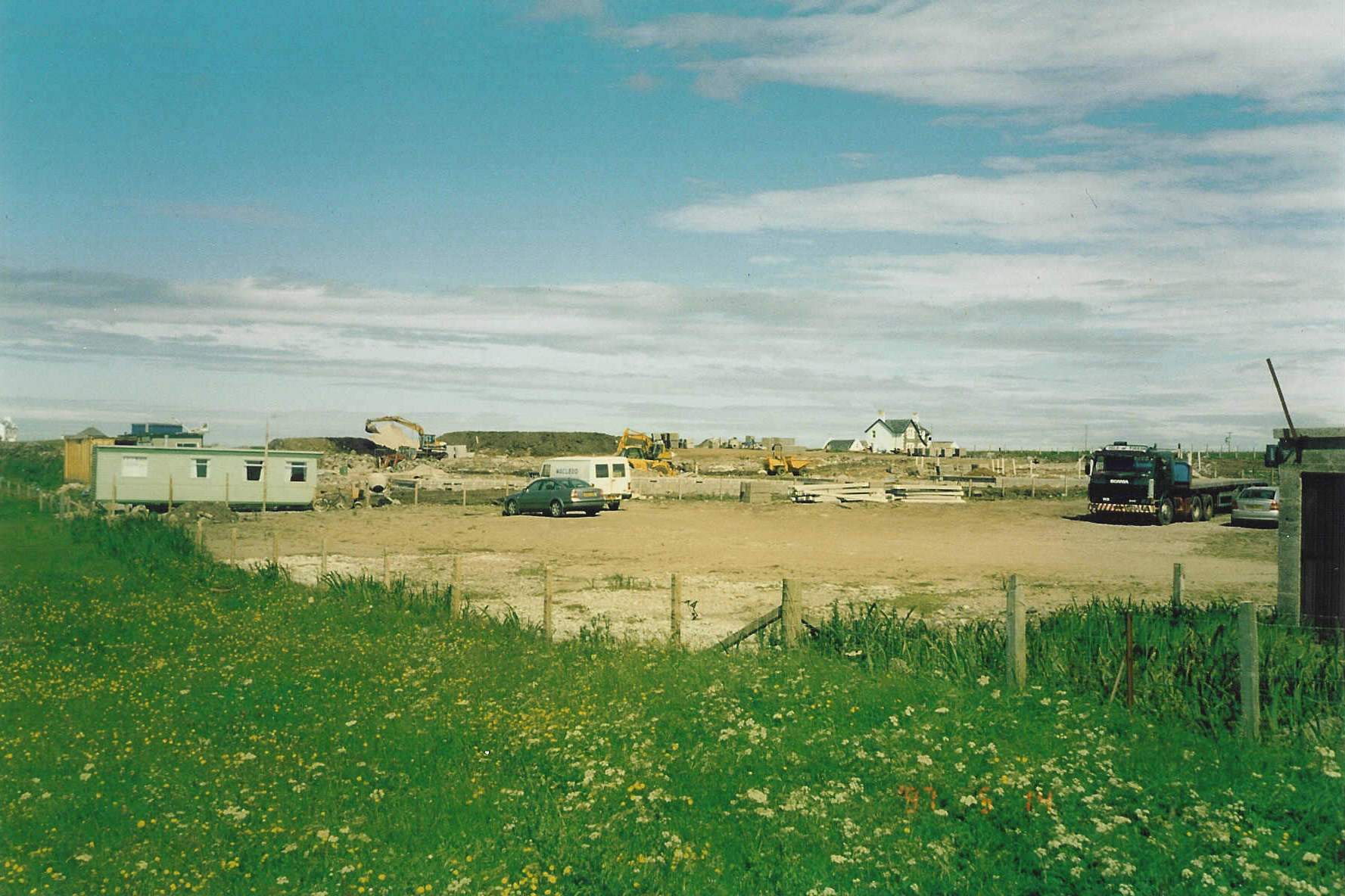
Photograph of the site of the MacArthurs’ shop in Balinoe taken in 2002.
The MacArthurs’ shop in Balinoe had one of the first horse-drawn vans, which was replaced between the wars by two motor vans. Calum, who ran the shop and croft with his brothers Colin, Archie and Duncan, was a great businessman.
Once, on his rounds, he was told that he would never be able to sell whelks (winkles), regarded at that time as a poor man’s food. Rising to the challenge, he took a bag around with him the next week and sold the lot in one day!
Around the entrance to the shop there used to be an alleyway of willow trees almost as high as the house, which was known as Taigh nan Craobh (house of the trees).
Colour photograph of the site of the MacArthurs` shop in Balinoe taken in 2002.
The site of the MacArthurs` shop in Balinoe, once known as `Taigh nan Craobh` from the alleyway of willow trees around the entrance to the shop there, photographed by John Holliday in 2002.
Photograph of the site of Jack Munn’s shop at Baugh taken in 2002.
Donald Munn of Baugh and his wife Margaret Lamont had six children: Hugh, Donald, Dan Tulloch, John (known as Jack), Mary and Ann. Donald started a coal business, bringing puffers into Port a’ Mhuilinn below the house, and a shop called ‘The Store’.
Jack took over the shop, as well as the tenancy of Baugh farm. Being a full-time farmer meant that the shop was more often open in the evenings. He also ran a horse-drawn van, which would make the trip to Caolas every second Saturday with goods from his shop.
On his return through Scarinish, the boys of the township would lie in wait and try to clamber unseen on to the back of the cart in the hope of some free sweets, but old Jack was too fly for them and would send the tip of his whip curling around their ears. The shop closed around 1940.
Colour photograph of the site of Jack Munn`s shop at Baugh taken in 2002.
The site of Jack Munn`s shop at Baugh, photographed by John Holliday in 2002.
Photograph of the site of James MacIntyre’s shop in Gott taken in 2002.
James MacIntyre (Seumas a’ Ghobhainn) started a shop in his house in Gott around 1937. He sold everything, ‘from a needle to an anchor’, and often bought eggs from his customers at 6d per dozen in exchange for groceries.
He was a very kindly man, and is remembered walking on a drenching evening from his shop to a house in Ruaig with a jar of paraffin because the housewife had run out. He used to tease the children visiting the shop for sweets, saying, “Bhasaich bodach Rowntree!” (Mr Rowntree has died!)
The shop often looked somewhat disorganised to the casual visitor with boxes seemingly everywhere, but his wife was a shrewd businesswoman and knew exactly where everything was. James also operated a van (or rather a converted car), selling goods around the island.
Colour photograph of the site of James MacIntyre`s shop in Gott taken in 2002.
The house in Gott once owned by James MacIntyre who ran a shop there, photographed by John Holliday in 2002.
MD recording of the first part of a talk about Tiree lore in An Talla on 31/3/2006.
Talk in An Talla on 31st March 2006 about Tiree lore, introduced by Dr Margaret MacKay and featuring, among others, Angus MacLean of Scarinish, Dr John Holliday, Duncan Grant of Ruaig and Alasdair Sinclair of Brock. (Continued on AC405)
The mill at Cornaig was powered by water from Loch Bhasapol. Drainage into the loch from Kilmoluaig sliabh was controlled by the miller using a small dam. He could also control the level of the loch by using a sluice-gate at the top of the mill lade.
The water was led down a sluice to the vertical wheel, which was ‘breast-driven’, hitting the wheel halfway down. This was less efficient that an overshot wheel where the water hit the wheel higher up but was the best that could be achieved as the loch level is only slightly higher than the mill.
The amount of water hitting the wheel determined the speed at which it turned. The miller could vary this by raising or lowering a flap at the bottom of the lade, which directed more or less water on to the wheel.
Colour photograph of the mill lade at Cornaigmore.
The mill lade at Cornaigmore taken by Dr John Holliday in 2003.