


Iron spade head.
Iron spade head painted black, used for trenching in heavy soil and found by George Holleyman between 1941-3 in a ruined thatched cottage in Ruaig.


Iron spade head.
Iron spade head painted black, used for trenching in heavy soil and found by George Holleyman between 1941-3 in a ruined thatched cottage in Ruaig.
Tiree craggan
Photograph of a Tiree craggan.

Courtesy of Mr George Holleyman
George Holleyman, an archaeologist in the RAF police posted to Tiree during World War II, collected this small clay pot known as a craggan which he later donated to An Iodhlann.
Made by hand from local clay without the aid of a potter’s wheel, Tiree craggans were believed to have special curative properties, particularly in the case of tuberculosis of the lungs. The craggan was heated on the fire until very hot, removed with tongs and taken to the byre where it was filled with milk straight from the cow. This was heated again and administered to the invalid.
In a paper about Tiree craggans published in the journal ‘Antiquity’ in 1947, Holleyman wrote: ‘Each township had its potter who was always a woman…’ Flora MacNeill of Balevullin, who died aged eighty in the 1920s, was the last known craggan-maker on Tiree.
Serving mallet.
Serving mallet carved from a single piece of whalebone and used, most probably by sailors, to splice rope. Found by George Holleyman in a ruined cottage in Caoles in 1942.


Wooden butter pat.
Wooden butter pat acquired by George Holleyman from Barrapol between 1941-3.

Horn spoon.
Horn spoon found by George Holleyman in a small rubbish tip at Balevullin between 1941-3.

Wooden case containing 60 Iron Age pottery shards.
(Documented on E00033) Wooden case (350 x 300 mm) containing 60 Iron Age pottery shards collected by George Holleyman from a sand-hill site at Balevullin during 1941-3. Two shards are accessioned separately with photos: 2000.91.12 & 2000.91.13
Fragment of an Iron Age vase
Photograph of a fragment of an Iron Age vase.

Courtesy of Mr George Holleyman
The fragment consists of three adjoining pieces of the rim of a finely made Vaul ware vase, plain except for a single horizontal incised line apparently running right round the vessel. The sherds are orange-brown in colour and have a light grey core.
The vase would have stood about 180-200 mm high with a rim diameter of about 130-150 mm and was made by the First Iron Age, or perhaps the Late Bronze Age, inhabitants of Tiree.
The sherds were found in a sand-hill site at Balephuil in the early 1940s by George Holleyman, later a Fellow of the Society of Antiquaries of London, who was posted to RAF Tiree during World War II.
Wooden case containing 66 pottery shards.
Wooden case (550 x 325 mm) containing 66 pottery shards collected by George Holleyman from a sand-hill site at Balevullin during 1941-3. Documented on E00033. Reviewed by Dr Euan MacKie in summer 2000 (see 2000.167). Items further identified by Dr Ewan Campbell, Senior Lecturer in Archaeology in Glasgow, in July 2018: Norse ‘platter; early medieval; 16th-18th century.

Eight Mesolithic flints
Photograph of eight Mesolithic flints.

Courtesy of Mr George Holleyman
These flints are almost certainly of Mesolithic age, that is, made by the hunter-gatherer groups who populated Scotland before the arrival of the first farmers in the 4th millennium BC. Microlithic (small stone) tools like this were used all over northern and western Europe at this time.
Measuring 27-55 millimetres in length, the six scrapers have been given a sharp, curved edge by pressure-flaking and were probably used to dress hides. The slim boring tool also has pressure-flaking along the long edges. The flint core has had several parallel-sided flakes, known as ‘blades’, struck off the flat area.
The flints were found in a sand-hill site at Balephuill in the early 1940s by George Holleyman, later a Fellow of the Society of Antiquaries of London, who was posted to RAF Tiree during World War II.
George Holleyman at Hough
Photograph of George Holleyman FSA at the stone circle at Hough.
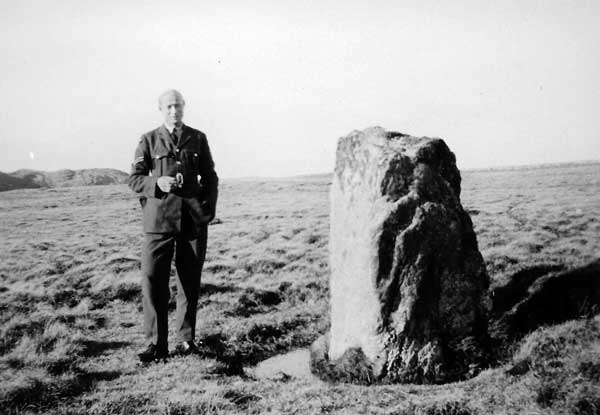
Courtesy of Ms Linda Gowans
George Holleyman is pictured during World War II standing beside the only remaining upright stone of a stone circle at Hough. A keen prehistoric archaeologist, he was posted to the RAF Station in Tiree in 1941 where he was to remain for two and a half years.
During this period, he travelled around the island capturing on camera a way of life that has since disappeared. He also collected numerous bronze objects, Stone Age flints and Iron Age pottery shards from sites at Balevullin, Kilmoluaig and Balephuil which he donated to An Iodhlann in 2000.
An antiquarian bookseller in Brighton, he will be best remembered for his archaeological work on the late Bronze Age sites at Pumpton Plain and Itford Hill in the Sussex downs. He was made a Fellow of the Society of Antiquaries in 1949.