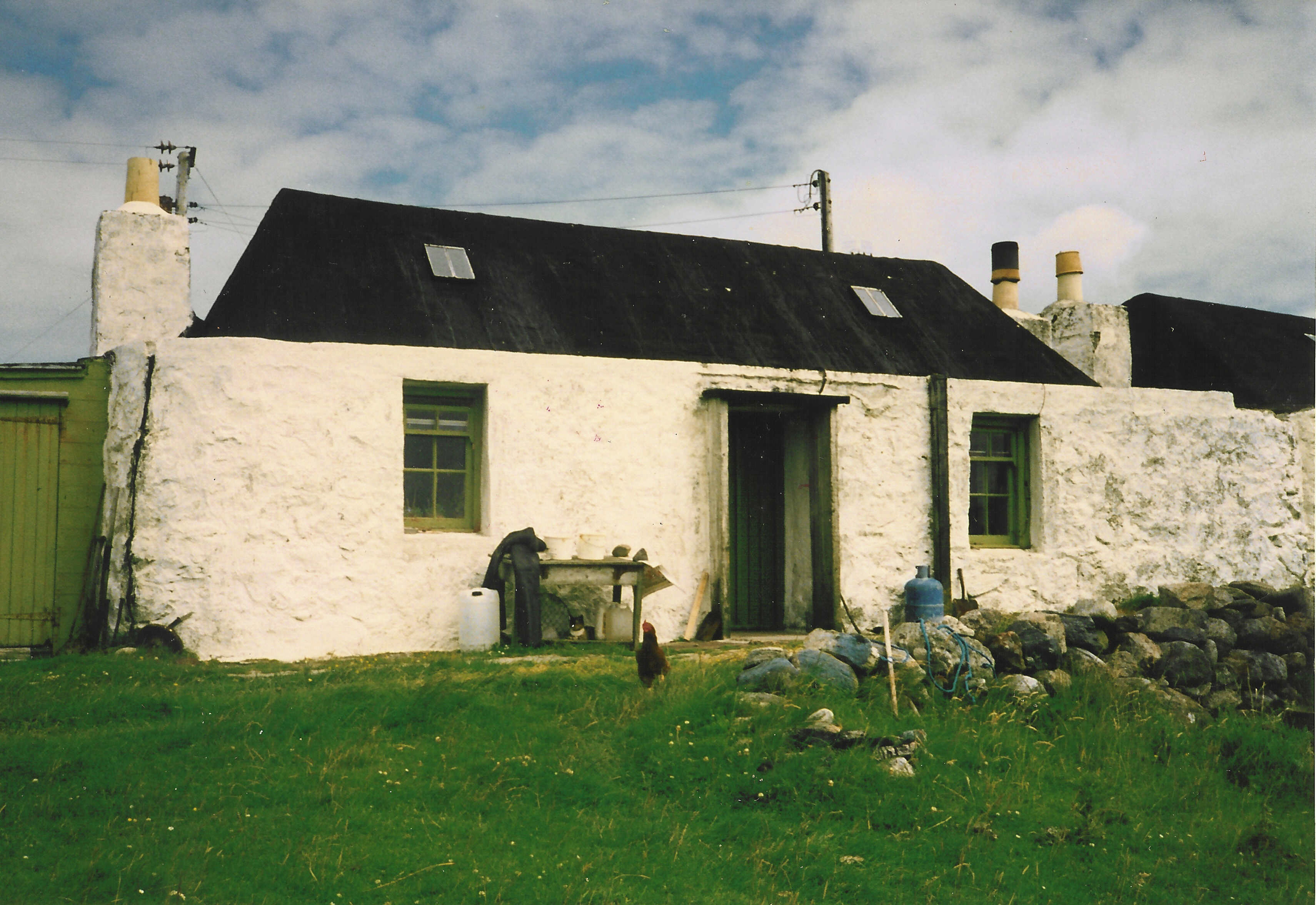
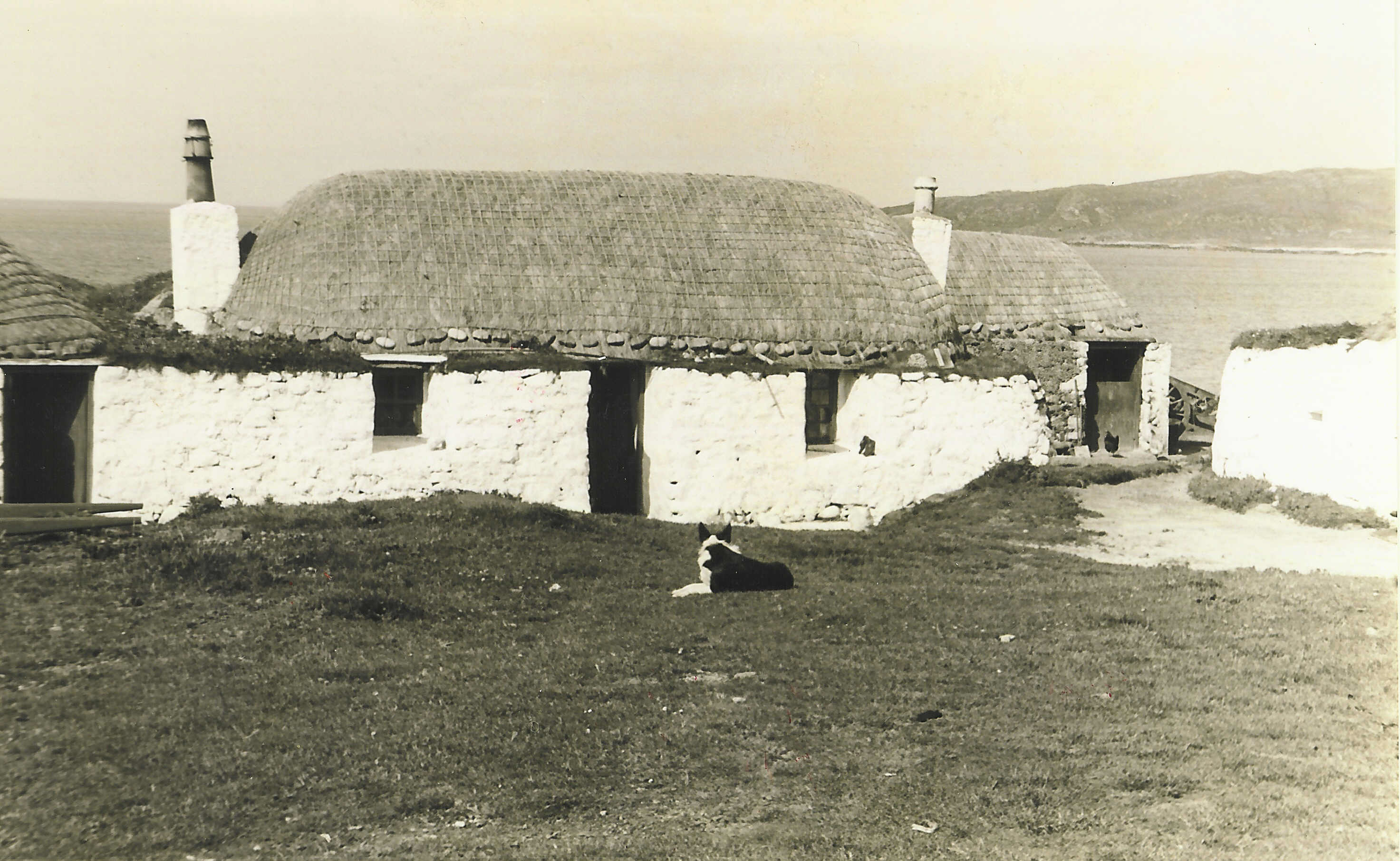
Kenovay thatched house
Photograph of a thatched house in Kenovay in 1990.
The beautiful thatched houses of Tiree (known as ‘taighean-tugha’) are one of the island’s most distinctive features. They are simple buildings with no unnecessary, fussy details. Before 1900 almost all the buildings on the island, at least three to four hundred of them, were thatched.
After 1900, however, many traditional houses changed their roofing from thatch to tarred felt and larger, two-storey stone built or poured concrete houses funded by the Board of Agriculture became popular after the World War I.
Numbers of the traditional thatched houses have steadily declined over the last hundred years. An Argyll and Bute Council survey in 1985 found twenty-three thatched buildings on the island and today there are only ten.
Colour photograph of the thatched house in Kenovay in 1990.
Thatched house in Kenovay in 1990. (Original in Filing Cabinet 8 drawer 2)
Thatched house in Kilmoluaig
Photograph of a thatched house in Kilmoluaig in 1990.
Tiree’s thatched houses have immensely thick double walls, around five feet thick and six to seven feet high, filled with sand and rubble known as ‘glutadh’. They were built without mortar and with hip ends as opposed to the more usual gable ends seen on the mainland.
The older houses, pre-1850, were built using un-dressed stones found in the fields and at the shore. Their walls are rougher and the corners rounded. The roof rests on the inner wall, the stones of which are tilted downwards so that rainwater drains away from the rooms inside.
The ground at the back of the house is usually higher than at the front. If built on a slope, they would be slightly dug in at the back to give them greater shelter.
Colour photograph of the Alasdair MacDonald`s thatched house in Kilmoluaig in 1990.
Alasdair MacDonald`s thatched house in Kilmoluaig in 1990. (Original in Filing Cabinet 8 drawer 2)
Paperback book `Common-Place` featuring `Turas` at Gott Bay pierhead.
Book about an exhibition in Glasgow at the Lighthouse, Scotland`s Centre for Architecture, Design and the City, which features `Turas`, Tiree Art Enterprise`s project at the pierhead.
Copied newspaper article about An Turas at the pierhead.
Article about `An Turas`, the tunnel built for Tiree Arts Enterprise in 2002.
Newsletter of the Friends of the Thatched Houses `Cuairt- Litir`, No 2, December, 1988.
Newsletter of the Friends of the Thatched Houses with articles in English and Gaelic and a photograph of Taigh Eilidh Sheumais Bhain in Balephuil.
Colour photograph of Taigh MhicArtair in Milton.
Taigh MhicArtair in Milton photographed by Morton Boyd in the 1940s or 1950s.
Black and white photograph of Willie MacNeill of the Land, Barrapol.
Willie MacNeill (Uilleam an tailleir) from the Land, Barrapol thatching Kate MacDonald`s house in Bail` Ur, Balephuil. The white-washed concrete roof of Taigh MacKay can be seen on the left. Photographed by Morton Boyd in the 1940s or 1950s.
Thatched house in Salum
Photograph of John Lachie MacInnes’ thatched house in Salum.
Courtesy of Mr Alan Boyd
J. Morton Boyd photographed John Lachie MacInnes’ house in Salum in the 1960s. This was the last house in Tiree to have its thatch held down by sìoman-ruadh or coir rope. Straw rope was used until the mid-19th century; nowadays chicken wire or plastic netting is used instead.
Tiree houses were made as far as possible from local materials – stone, lime, clay, straw rope and the thatch. Only glass and wood for the roof timbers, doors and windows were imported. They look utterly immovable but nothing could be further from the truth.
Islanders moved around a great deal, either by choice or because the factor gave them no option. The thatch had to be discarded but the turfs and roof timbers were taken down and put into the back of a cart and the stones moved on sledges, load by load, to the new site.
Colour photograph of John Lachie MacInnes`s house in Salum.
John Lachie MacInnes`s house in Salum photographed by Morton Boyd in the 1940s or 1950s.
Black and white photograph of Taigh Dhonnchaidh Bhain in Bail` Ur, Balephuill.
Taigh Dhonnchaidh Bhain in Bail` Ur, Balephuill, photographed by Morton Boyd in the 1940s or 50s.
Colour photograph of Kate MacDonald and Johnny MacKay in Bail` Ur.
Kate MacDonald (Ceit Chalein) and Johnny MacKay in Bail` Ur, Balephuil, photographed by Jean Irwin.