


Photocopied extract from `The Scottish Islands` by George Scott-Moncrieff, pp 58-63.
Description of Tiree with two illustrations of Tiree houses with felt roofs.

Photocopied extract from `The Scottish Islands` by George Scott-Moncrieff, pp 58-63.
Description of Tiree with two illustrations of Tiree houses with felt roofs.
Hardback book `The Souterrains of Southern Pictland` by F. T. Wainwright.
Excavation reports of two souterrains at Ardestie and Carlungie in Angus and a summary of what is known about about all recorded souterrains between the Dee and the Forth.
Black and white photograph of Taigh Sarah in Vaul in the 1920s.
Taigh Sarah in Vaul in the 1920s. L-R: Margaret Doig`s father; Sarah MacFarlane (Sarah Neill); a friend of Mr Doig. Sarah was a widow; all her family except for one son died of TB. Her house was built by the township `in a day`. A porch was added in the 1930s. The roof was tarred with heated road tar which, if put on too hot, ran down the walls.

‘Taigh Sarah’ in Vaul
Photograph of Sarah MacFarlane outside her house in Vaul in the 1920s.
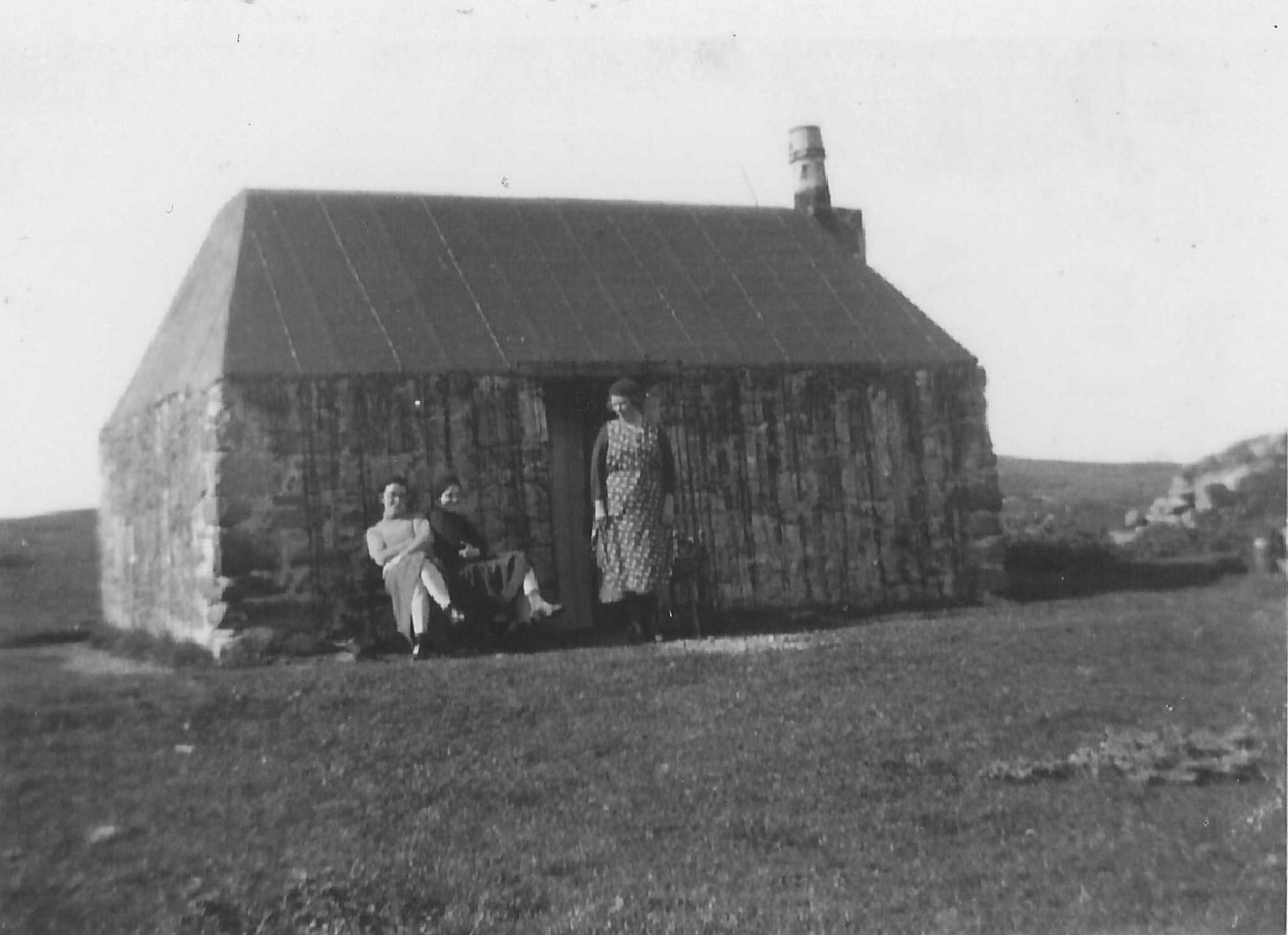
Courtesy of Mrs Nan MacClounnan
Sarah MacFarlane (Sarah Nèill) is pictured on the right outside her house in Vaul in the 1920s. Sarah was a widow; all her family except for one son had died of tuberculosis, a disease that was prevalent in Tiree in the 19th and early 20th centuries.
After it was established in the 1880s that TB was contagious, it was made a notifiable disease, although it was not recognised until much later that the infection could also be transmitted through milk from infected cows.
Sarah’s original house was destroyed as it was thought a source of infection and a new one was built by the men of the township ‘in a day’. A porch was added in the 1930s. The felt roof was water-proofed with heated road tar which ran down the walls if put on in hot weather.
Black and white photograph of Taigh Sarah in Vaul in the 1920s.
Taigh Sarah in Vaul in the 1920s. L-R: unknown, Margaret Johnston nee Pettigrew, Margaret Doig`s mother; Sarah MacFarlane (Sarah Neill).
Black and white photograph of Margaret Doig`s parents in the 1920s.
Tiree in the 1920s. L-R: Harry Johnston,Margaret Doig`s father; unknown; unknown; Harry`s wife, Margaret Pettigrew; unknown; unknown. Mary Flora MacKinnon of Rhum View married Jimmy Pettigrew, Margaret`s brother.
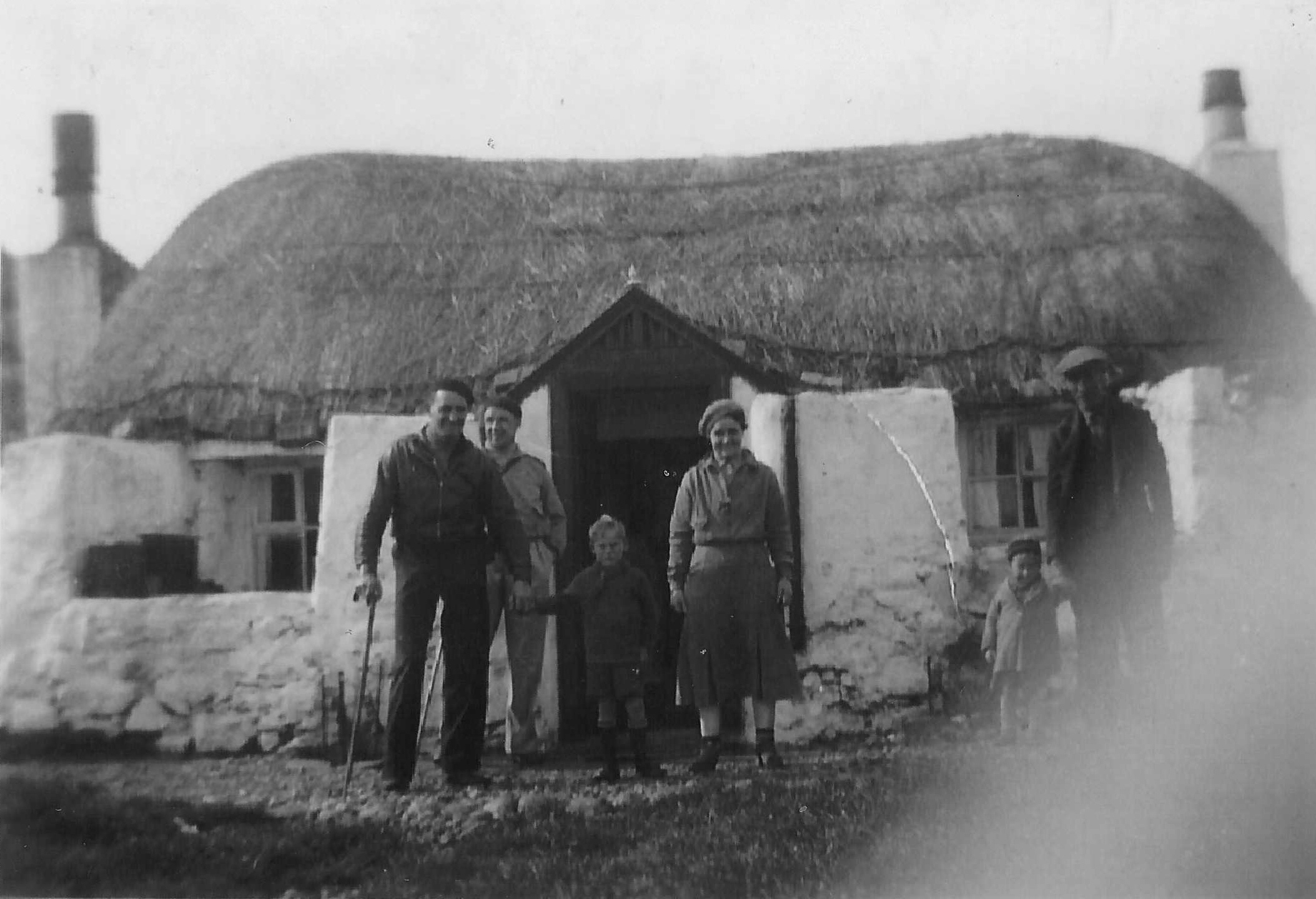
David MacClounnan, Katina and Kate MacDonald
Photograph of David MacClounnan, Katina and Kate MacDonald of Balephuil in 1946.

Courtesy of Ms Katina MacDonald
David MacClounnan, Katina and her mother Kate MacDonald are pictured outside Kate’s thatched house at Balephuil in 1946. The thatch is tied down with coir rope known as ‘sìoman-ruadh’ (red rope).
Old herring nets and more recently chicken wire have also been used to secure the thatch, the rolls being joined at the ridge. A rope is then threaded through the bottom of the net and weighted with beach stones which fray the rope least.
Although thatching is considered a skilled craft nowadays, most men would expect to thatch their own roofs with the help of other men from the township.
Black and white photograph of David MacClounnan, Katina and Kate MacDonald of Balephuil in 1946.
David MacClounnan, Katina and her mother Kate MacDonald, all of Balephuil, taken in 1946. Note the thatch tied with `sioman ruadh` (red rope).
Kate MacDonald of Balephuil
Photograph of Kate MacDonald standing on the ‘tobhta’ of her house in Balephuil in the 1940s.

Courtesy of Ms Katina MacDonald
Tiree’s thatched houses are built with double walls, between five feet thick and six or seven feet high, filled with sand and rubble known as the hearting. Since the roof rests on the inner wall, the top of the hearting and outer wall form a wide ledge known as ‘an tobhta’.
When the walls are un-mortared this can be left open and grass and sometimes flowers grow there. In summer the dogs would often lie there in the sun and sometimes sheep would climb up to graze.
Nowadays the spaces between the stones are usually filled with mortar so that the walls can no longer ‘breathe’ and the tobhta is sealed with concrete.
Black and white photograph of Kate MacDonald of Balephuil taken in the 1940s.
Kate MacDonald of Balephuil standing on the tobhta of her house, taken in the 1940s.
Alasdair MacDonald of Kilmoluaig
Photograph of Alasdair MacDonald outside his house in Kilmoluaig in the early1980s.

Courtesy of Mrs Rena MacPhail
Alasdair MacDonald of Kilmoluaig is pictured outside his house during its renovation in the early 1980s. Starting at the wall-head, the turfs are laid upside down on the roof timbers and slightly overlapping. They are held in place by small wooden pins.
The turfs are cut from the moor or ‘sliabh’ during May to August when the ground is fairly dry. A well-developed root system is needed in the turf to hold the soil together during handling. It would take an experienced cutter five days to cut the 1,000 turfs need for an average roof.
If the turfing is done properly, the roof should be watertight without any thatch. If the thatch is kept renewed, the turfs should last for more than a hundred years.
Colour photograph of Alasdair MacDonald of Kilmoluaig in the early 1980s.
Alasdair MacDonald outside his house in Kilmoluaig in 1980 or 1981 during renovation work. Note the turves or `sgrothan` laid on top of the rafters.
Colour photograph of Alasdair MacDonald`s house in Kilmoluaig in the early 1980s.
Alasdair MacDonald`s house in Kilmoluaig during renovation work in the early 1980s. Note the overlapping turves or sgrothan laid on top of the rafters.

Hardback book `The Past in the Present: What is Civilisation?` by Arthur Mitchell.
Ten of the Rhind lectures on archaeology delivered by Arthur Mitchell in 1876 and 1878.