


Colour photograph of snowman at Cornaigbeg.
Snowman in the garden of Cnoc a` Mhurain, Cornaigbeg in December 2000.


12045 Results Found
Displaying page 1142 of 1205 pages of results:
Colour photograph of snowman at Cornaigbeg.
Snowman in the garden of Cnoc a` Mhurain, Cornaigbeg in December 2000.
Colour photograph of Cornaigbeg in the snow.
Cornaigbeg in the snow, December 2000.

Black and white photograph of building Gott Bay pier.
Building the new pier at Gott Bay, c. 1910.

Two men building a corn stack
Photograph of two men building a corn stack.

Courtesy of Mrs Mairi Campbell
The two men are building a corn stack or ‘mulan’ which will provide winter feeding for horses, cattle and hens and seed for spring sowing. In the background is a row of haystacks. Corn stacks were built with the heads of the sheaves to the centre so the finished stack contained a column of seed.
Four sheaves were placed upright in the centre with further sheaves added around the centre, working clockwise. The sheaves were always kept with the seed uppermost so any moisture would run away from it down the straw.
The diameter of the stack was carefully measured using a special rope, either six or seven fathoms long, marked with a knot at one end and a block at the other. The stack was re-measured every two rows to keep it straight. These traditional methods are still in use today by a few crofters on the island.
Black and white photograph of building a cornstack at Whitehouse.
The two men are building a corn stack which will provide winter feeding for horses, cattle and hens and seed for spring sowing. In the background is a row of haystacks. At harvest time, the cut corn would be bundled by hand into sheaves, six of which would be stood together to form stooks. When sufficiently dry, the stooks would be transported by horse and cart to the stackyard. Corn stacks were built with the heads of the sheaves to the centre so the finished stack contained a column of seed. These traditional methods are still in use today by a few crofters on the island.
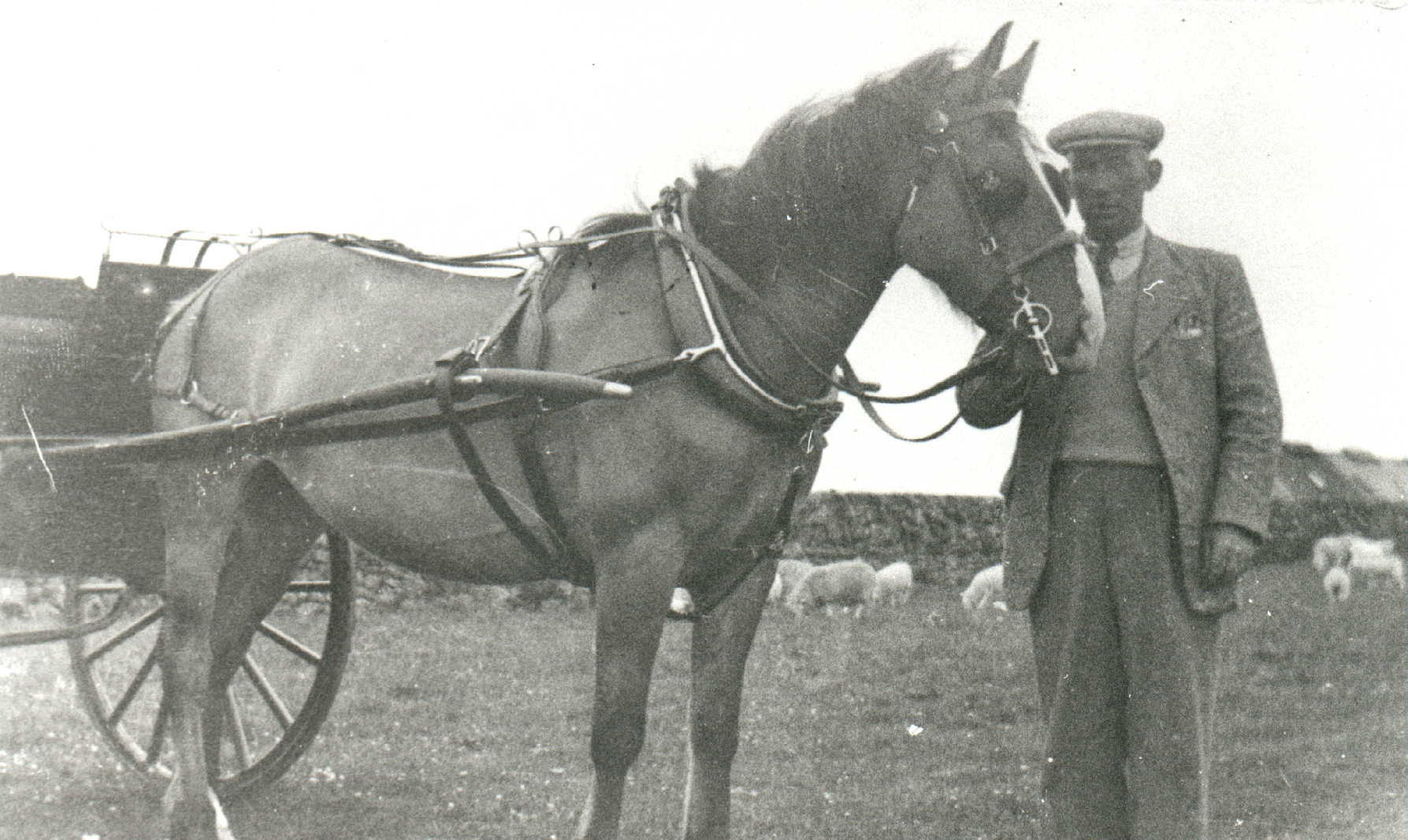
Black and white photograph of Alasdair Brown, Kilkenneth.
Alasdair Brown, Kilkenneth with horse and cart, c.1920s or 1930s.
John and Christina MacPhail of Balinoe
Photograph of John and Christina MacPhail of Balinoe.
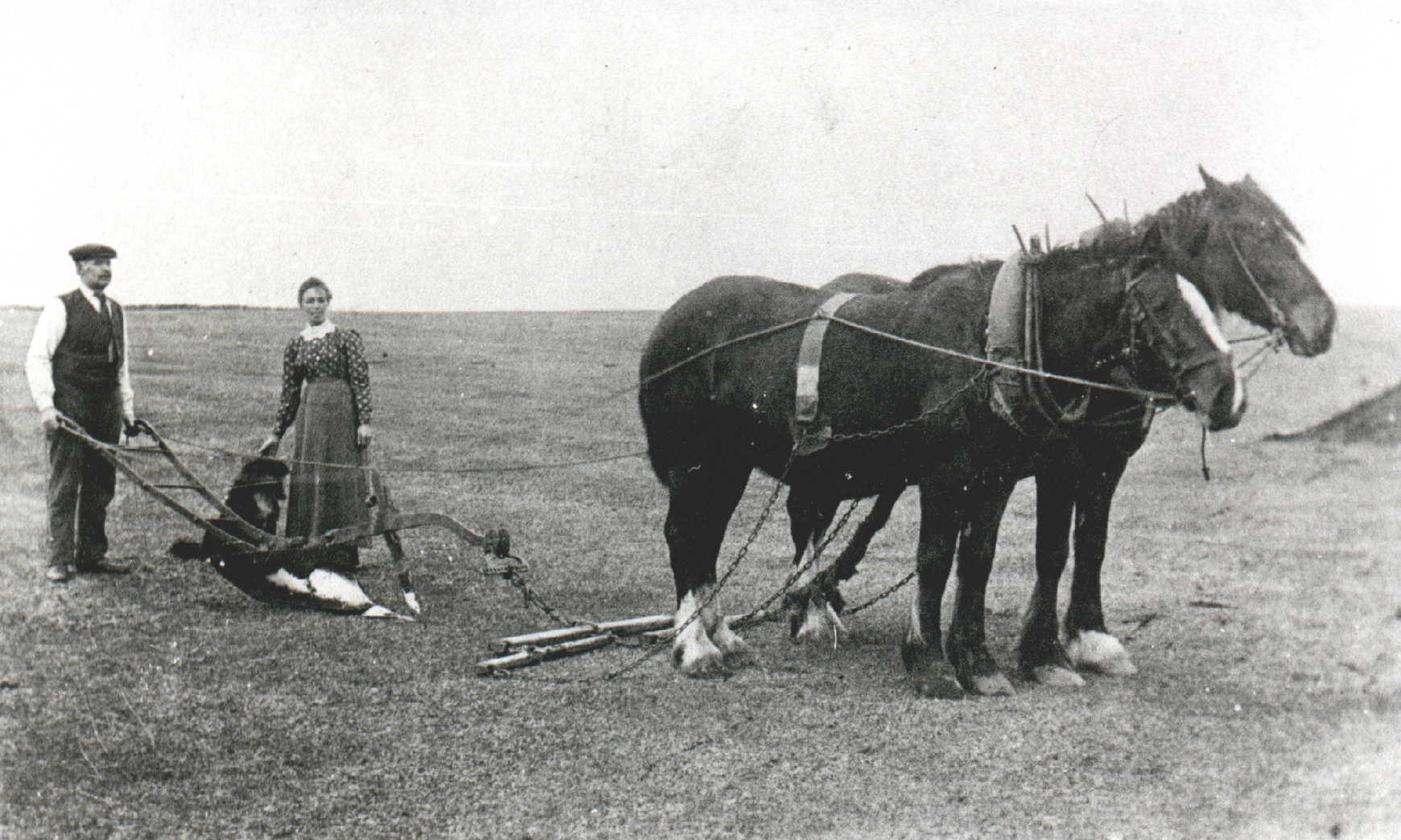
Courtesy of Mrs Mairi Campbell
John MacPhail (Iain Eacha’ Ruaidh) and his wife, Christina (Hutty Nèill an Tuathanaich), of Balinoe are pictured with a standard plough used for preparing the ground for sowing corn and potatoes.
Out of his working clothes, the crofter is celebrating the end of his spring ploughing. The polished ploughshare is oiled and ready to be returned to the implement shed until the autumn when it will be used for opening potato drills.
The plough is hitched to two exceptionally well-bred Clydesdales of the Tiree type. Introduced in the 1870s, Clydesdales were crossed with local ponies to produce lighter and faster draught animals for which Tiree was famous in the early 20th century.
Black and white photograph of John and Christina MacPhail of Balinoe.
L-R: John MacPhail (Iain Eacha` Ruaidh) of Balinoe and his wife Christina (Hutty Neill an Tuathanaich) with a plough drawn by two exceptionally well-bred Clydesdales of the Tiree type. Out of his working clothes, the crofter celebrates the end of his spring work. Note the polished ploughshare is oiled and ready to be returned to the implement shed till next spring. (Crofting details supplied by Donald MacIntyre, Gott)
Black and white photograph of a coal puffer at Hynish pier.
The coal puffer `Starlight` at Hynish pier, c. 1920 – 1940.

Black and white photograph of two unknown women with a horse.
Two unknown women with a horse, probably 1920s or 30s.

Photocopied newspaper article about the new boat `Clansman` joining the Caledonian MacBrayne fleet.
The arrival of a new boat `Clansman` to the Caledonian MacBrayne fleet, also with information about the `Lord of the Isles` and the routes used by both boats.
Newspaper articles about seaweed cutters losing their jobs in Uist, 1998-99
Two photocopied newspaper articles about the potential loss of jobs in Uist: (1) Kelco – the Girvan-based producer of alginates is to stop buying wet seaweed from the Uists, (2) Meeting about the seaweed industry in the Western Isles following Kelco`s decision to stop taking seaweed from the Uists.