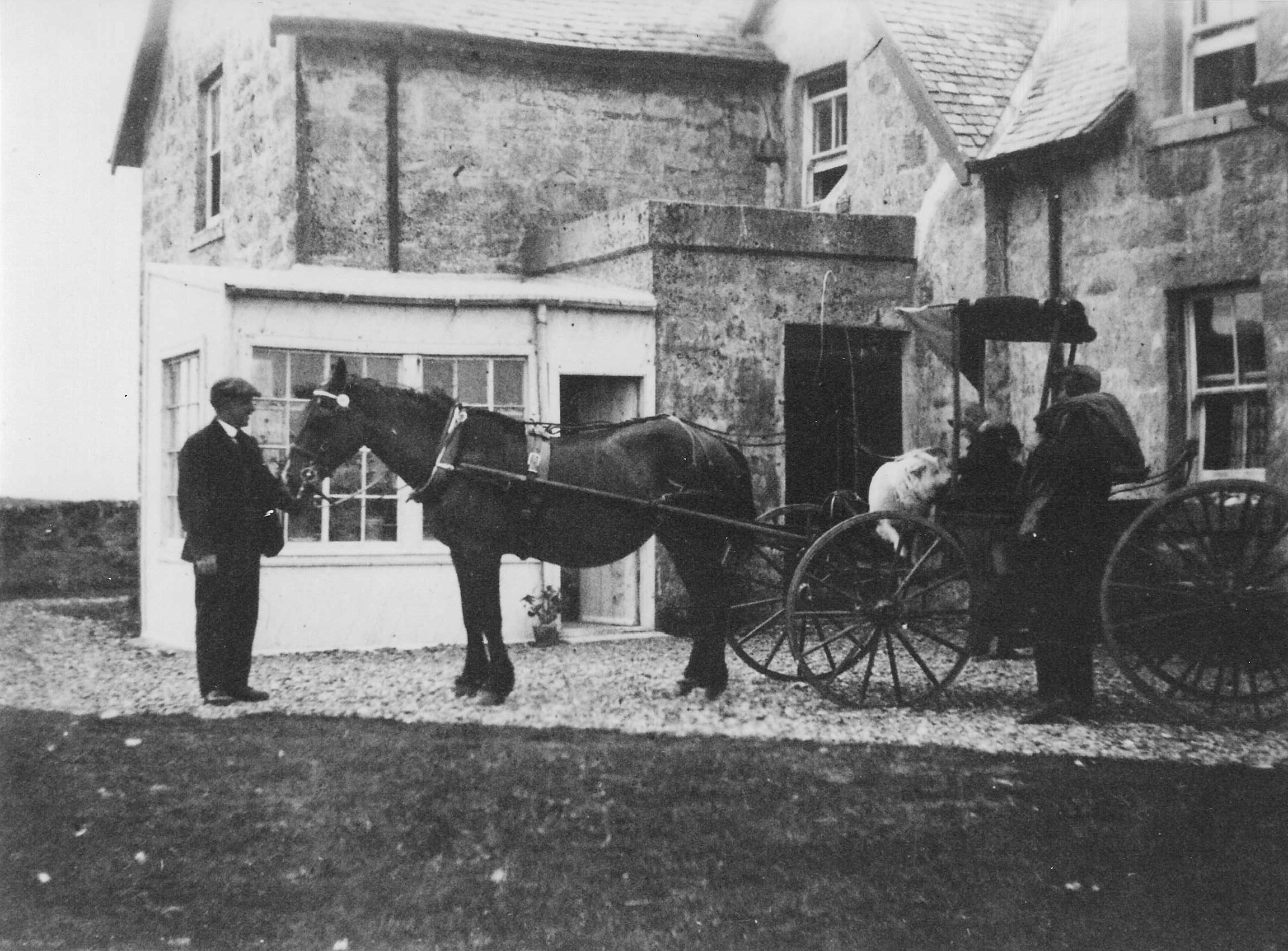
Black and white photograph of John MacKinnon, Lodge Farm.
John MacKinnon of Lodge Farm, Kirkapol is pictured here outside the Lodge with Lady Victoria Campbell’s buckboard. The daughter of the 8th Duke of Argyll, Lady Victoria contracted polio in 1859 when 5 years old and was lame for the rest of her life. When rough seas or low tides made it impossible for passengers to board the lighter for the mail-boat at either of the small piers at Scarinish harbour, the boat was run in as far as possible on the beach at Gott Bay. ‘Faithful John’ would drive the horse and buckboard through the water to the stranded lighter to transfer Lady Victoria, fortunately always without accident.
Black and white photograph of Donald MacKechnie, Kilmoluaig.
Donald MacKechnie, Kilmoluaig, (Maggie Campbell`s father) in his naval uniform.
Black and white photograph Murdoch and Peggy Cameron and Ian Atkins taken in 1948.
The shop in Balevullin in 1948 where Murdoch Cameron did his butchering. L-R: Peggy and Murdoch Cameron, Ian Atkins.
Marion MacDonald churning butter at Sandaig
Photograph of Marion MacDonald churning butter at Sandaig in the 1940s.
Courtesy of Ms Linda Gowans
Marion MacDonald was photographed by George Holleyman churning butter outside her thatched house in Sandaig during World War II. The churn consists of a narrow wooden barrel (about 300 mm wide and 650 mm tall) and a plunger. At the end of the plunger is a wooden disc with holes drilled in it.
Milk would be left to stand in a metal basin and the cream skimmed off using a saucer or clam shell into an earthenware butter crock. The cream would be strained through muslin into the scalded churn and agitated using the plunger.
Once the butter had formed, it was put into cold water then slapped between the hands to remove excess liquid. The remaining buttermilk would be drunk or used for baking.
Black and white photograph of Marion MacDonald, Sandaig.
Marion MacDonald is pictured churning butter outside her thatched house in Sandaig, Tiree. The churn consists of a narrow wooden barrel (about 300 mm wide and 650 mm tall) and a plunger. At the end of the plunger is a wooden disc with holes drilled in it. Milk would be left to stand in a metal basin and the cream skimmed off using a saucer or clam shell into an earthenware butter crock. The cream would be strained through muslin into the scalded churn and agitated using the plunger. Once the butter had formed, it was put into cold water then slapped between the hands to remove excess liquid. The remaining buttermilk would be drunk or used for baking.
Archibald MacLeod of Balevullin
Photograph of Archibald MacLeod thatching an outhouse in Balevullin in the 1940s
Courtesy of Ms Linda M. Gowans
George Holleyman, an archaeologist posted to Tiree during World War II, photographed Archibald MacLeod thatching an outhouse in Balevullin in the early 1940s. Thatching is started down at the tobhta, the ledge at the top of the wall, with the first row of sheaves being put on tips upwards.
After the first row, the sheaves are placed tips downwards until the ridge is reached when they are laid across the top with the tips on alternate sides. The thatch is put on thicker at the back, the windward side, and slightly halfway up the roof to give a more rounded shape.
As new thatch is laid on top of old, the ridge becomes almost flat. At this stage, the thatch has to be partially stripped off before the next layer is applied. Re-thatching is required every two to three years.
Black and white photograph of Archibald MacLeod, Balevullin.
Tiree has the greatest concentration of surviving thatched houses in the Scottish islands. In the photograph, Archibald MacLeod is shown thatching an outhouse in Balevullin. The rafters are first overlain with a layer of thin turf slices carefully cut from the moorland and tapered at the sides so that they lie flush on the roof. The thatching material, usually marram grass, is cut with a scythe between September and March and tied into small sheaves which are then positioned on top of the turf. The completed thatch is secured with wire netting weighted down with heavy beach pebbles. Re-thatching is required every 2-3 years.
Isabella MacLean of Kilmoluaig using a cheese press
Photograph of Isabella MacLean of Kilmoluaig using a cheese press.
Courtesy of Ms Linda Gowans
Isabella MacLean was photographed using a cheese press in Kilmoluaig by George Holleyman, an archaeologist posted to RAF Tiree during World War II. The press was made in the local smiddy. The screw, which turns through an iron hoop set into a large stone, tightens on to the wooden cheese vat, removing excess whey.
Rennet was used to curdle the warmed milk and sometimes salt was added or caraway seeds. The curds were squeezed by hand, wrapped in muslin, put in the cheese vat and pressed. The whey would be fed to calves.
After two to three days, the press would be screwed down another turn. The cheese would be left there for a week then put on a shelf to dry and form a skin. It would be ready for eating in a fortnight.
Black and white photograph of Isabella MacLean, Kilmoluaig.
Isabella MacLean is pictured here using a cheese press made in the local smiddy. The screw, which turns through an iron hoop set into a large stone, tightens on to the wooden cheese vat, removing excess liquid. Rennet was used to curdle the warmed milk and sometimes salt was added, or caraway seeds. The curds were squeezed by hand, wrapped in muslin, put in the cheese vat and pressed. The whey would be fed to calves. After 2-3 days, the press would be screwed down another turn. The cheese would be left there for a week then put on a shelf to dry and form a skin. It would be ready for eating in a fortnight. The cheese press is part of An Iodhlann`s collection.
Mary MacLean of Balevullin
Photograph of Mary MacLean of Balevullin at her spinning wheel.
Courtesy of Ms Linda Gowans
George Holleyman, an archaeologist in the RAF police posted to Tiree during World War II, photographed Mary MacLean at her spinning wheel in the garden of her croft at Balevullin. Mary kept five cows and around twenty-five sheep and grew no crops other than potatoes.
To the right of the photograph is the top stone of a rotary quern. It is thought that rotary querns were introduced to Britain by the Romans around 2,000 years ago. Two women would sit on the ground with the quern between them, feeding grain into the central hole in the upper stone which was rotated by hand using a handle.
This was enormously time-consuming work. In ‘The Statistical Account of Scotland’ of the 1790s, Rev. Archibald MacColl estimated ‘by the lowest calculation, the work of 50 women is yearly lost at grinding’.
Black and white photograph of Mary MacLean, Balevullin.
Mary MacLean spinning wool in her garden at Balevullin, photgraphed by George Holleyman in the early 1940s. Note the drystone walling and quern stone.
Black and white photograph of Mary MacLean, Balevullin.
Mary MacLean with two sheep photographed by George Holleyman outside her thatched cottage in Balevullin in the early 1940s. Note the whale vertebrae in the foreground.
Isabella MacLean of Kilmoluaig with her cows
Photograph of Isabella MacLean with her cows in Kilmoluaig.
Courtesy of Ms Linda Gowans
Isabella MacLean was photographed with her cows by George Holleyman, an archaeologist in the RAF police posted to Tiree during World War II. Her father was a crofter and fisherman, known locally as ‘The Mate’. Isabella herself was known as Bella Mhate.
She lived on her own in a thatched cottage on her eighteen acre croft in Kilmoluaig. The cottage had an earthen floor and all her furniture, including her box bed, was made from driftwood. Lighting was by oil lamp.
Her income came from a herd of six cattle and a flock of around forty sheep. She also had grazing rights on another croft. Neither croft was cultivated but she grew a small patch of potatoes. Bella was also an expert cheese maker.
Black and white photograph of Isabella MacLean, Kilmoluaig.
Isabella MacLean (Bella Mhate) of Kilmoluaig with her cows, photographed by George Holleyman in the early 1940s.
Black and white photograph of Mrs Kennedy, Balevullin.
Mrs Kennedy of Balevullin making a haycock, photographed by George Holleyman.