12045 Results Found
Displaying page 1085 of 1205 pages of results:

1997.184.3

Lachlan MacPhail carting seaweed

Photograph of Lachlan MacPhail carting seaweed

x29.jpg

Courtesy of Mr Ailig MacArthur

Lachlan MacPhail, originally from Luing, is pictured with a cartload of seaweed outside the shepherd’s cottage where he lived in Crossapol. A fork has been stuck in the back of the cart to stop the seaweed slipping off.

Gathered from March to May, the seaweed is spread on grass or on ground to be planted with corn or potatoes. Red seaweed known as ‘bàrr-dearg’ was considered the best for this purpose but only came ashore on certain tides usually in the month of May.

The soils of Tiree are predominantly light and sandy and need feeding with organic matter every year to keep their fertility. Although not considered as good a fertiliser as manure, seaweed improves the condition of the soil and aids water retention.

Black and white photograph of Lachlann MacPhail, Crossapol.

Lachlan MacPhail from Luing with a cartload of seaweed outside the shepherd’s cottage where he lived in Crossapol, Tiree, probably taken in the early 20th century.

1997.184.2

Black and white photograph of the first car on Tiree.

The first car on Tiree with Johnny Brown driving, his grandson Johnny Brown in the passenger seat and an unknown woman from the Lowlands in the back, probably taken in the 1920s..

x31.jpg

1998.250.0

Photocopied collection of documents, poems, books and leaflets from Taigh Port na Spaineach.

Photocopied collection of 49 Gaelic poems, six birth, death and marriage certificates, correspondence relating to pensions, four books of insurance contributions/union membership, bundle of personal letters, bundle of religious tracts, various brochures, instruction leaflets and hymn sheets, found in Taigh na Spaineach and given to An Iodhlann by Derrick Wolstencroft but originally belonging to the family of Iain MacAthur, Taigh MhicArtair. Milton. Originals stored in Main Store West, archive box 53.

1997.183.2

Black and white photograph of the Tiree Association Sports Day.

Tiree Association Sports Day, 1927 or 1928. Since its foundation in 1900, the Tiree Association has organised an annual Sports Day on Tiree which continues to this day. In 1927 or ’28, Captain A. N. Kingwill was hired to fly the first plane to the island, bringing with him the day’s newspapers. Short flights on the plane were on offer at 2/6d (12p) a time and Captain Kingwill gave a display of stunt-flying. Hugh MacKinnon, a local contractor from Crossapol (pictured behind the wheel of his car in E24) presented him with a medal.

e25.jpg

1997.183.1

Hugh MacKinnon and the first plane on Tiree

Photograph of Hugh MacKinnon and the first plane on Tiree.

e24.jpg

Courtesy of Mrs Netta Martin

Hugh MacKinnon (Eòghann Dhòmhnaill), known as the Contractor, is pictured here on the Reef with the first plane to land on Tiree. The two-seater Moth piloted by Captain A. N. Kingwill was brought over from Renfrew by the Tiree Association for their Sports Day in July 1929.

The Contractor owned one of the few cars on Tiree at the time and took the pilot to his house for lunch. The first passengers on a short trip over the island included the Contractor himself and John MacLean (Iain a’ Ghaffer) of Kilkenneth.

Kingwill went on to fly with Sir Alan Copburn’s flying circus and made the first scheduled landing at a municipal airport later that year when he piloted a Moth into Wythenshawe Airport at Manchester.

Black and white photograph of the Tiree Association Sports Day in the late 1920s.

Tiree Association Sports Day, 1927 or 1928. Since its foundation in 1900, the Tiree Association has organised an annual Sports Day on Tiree which continues to this day. In 1927 or ’28, Captain A. N. Kingwill was hired to fly the first plane to the island, bringing with him the day’s newspapers. Short flights on the plane were on offer at 2/6d (12p) a time and Captain Kingwill gave a display of stunt-flying. Hugh MacKinnon, a local contractor from Crossapol, pictured behind the wheel of his car in E24, presented him with a medal.

1997.182.2

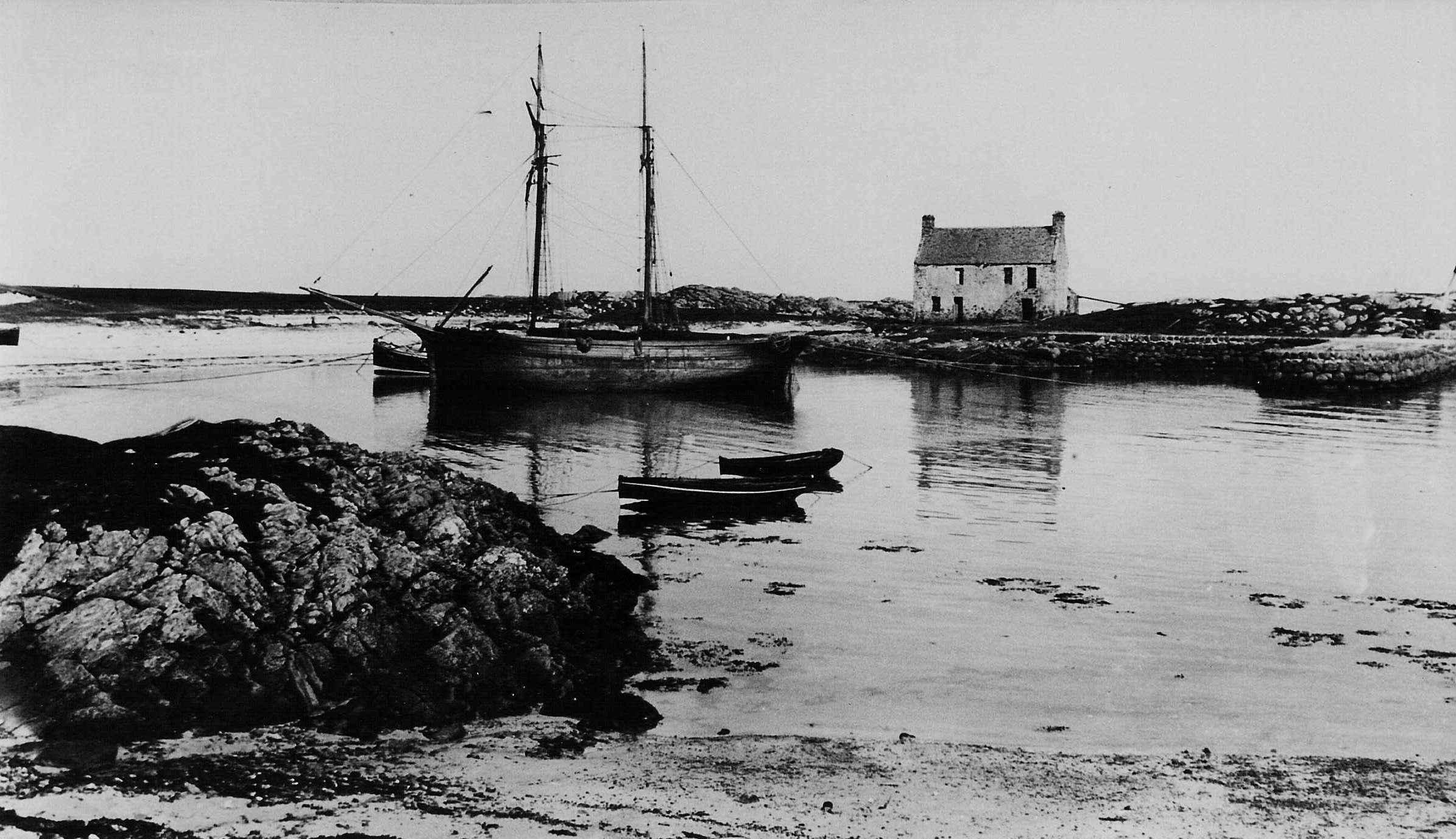
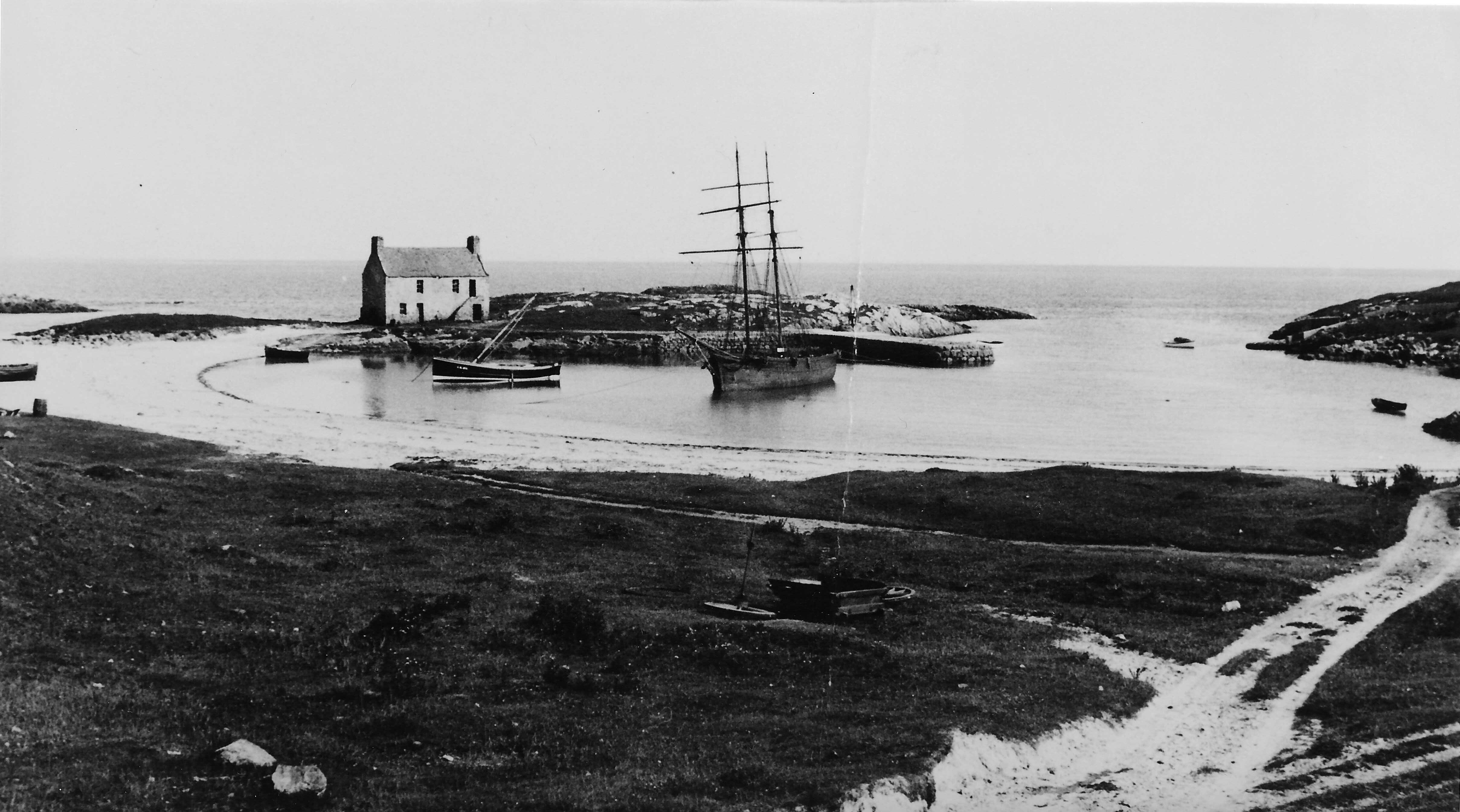
The ‘Mary Stewart’ in Scarinish harbour in the 1930s

Photograph of the schooner ‘Mary Stewart’ in Scarinish harbour in the 1930s.

e23.jpg

Courtesy of Mrs Netta Martin

Taken in the early 1930s, this view of Scarinish harbour shows the topsail schooner ‘Mary Stewart’ in her final resting place. For the previous thirty years she had traded up and down the west coast carrying coal and other cargo.

Also anchored in the harbour are two lobster boats. Commercial lobster fishing began on Tiree after 1880 when the railway to Oban was opened, allowing shellfish to be sent live to the London markets for the first time.

Said to have been originally built as a church, the building in the background was used as a store by the owners of the ‘Mary Stewart’. It was pulled down to make the road to the pier during World War II.

Black and white photograph of Scarinish harbour.

Scarinish harbour with the Mary Stewart, probably taken in the 1930s. The building in the background was originally built as a church, then used intermittently as a prison and latterly as a store by the owners of the Mary Stewart. It was pulled down to make roads during World War II.

1997.182.1

Black and white photograph of Scarinish harbour.

Scarinish harbour with the Mary Stewart, probably taken in the 1930s. The building in the background was originally built as a church, then used intermittently as a prison and latterly as a store by the owners of the Mary Stewart. It was pulled down to make roads during World War II.

e22.jpg

1997.181.2

The staff at the knitwear factory at Crossapol in the early 1970s

Photograph of the staff at the knitwear factory at Crossapol in the early 1970s.

f3.jpg

Courtesy of Mr Robert Beck

Hebridean Knitwear Ltd was first attracted to Tiree through the initiative of the local vet Robert Beck and in 1969 opened a knitwear factory in the old United Free Church at Kirkapol until a purpose-built factory was completed at Crossapol.

Of the seven young women in the photograph, Hughina MacCallum, Betty Duff, Ann Burns, Ann Munn, Jean MacKay, Flora Brown and June Weston, the six in white overalls were sent to Coatbridge for six months’ training. On their return, they trained new operatives.

During the recession of the early 1980s, Hebridean Knitwear went into liquidation. The factory was briefly taken over by a Lanarkshire concern but closed for good in 1984. The building now houses the council offices and the Tiree branch of Argyll College.

Black and white photograph of the workers at the knitwear factory.

The workers at the knitwear factory in Crossapol in the early 1970s. L-R: Hughina MacCallum; Betty Duff (boarded out with the MacKays, Balephuil); Ann Burns (boarded out with the MacLeans, Balinoe); Ann Munn, Heanish; Jean MacKay, Balemartine; Flora Brown, Hillside, Balevullin , June Weston, Bungalow, Heylipol. (Original in Filing Cabinet 2 drawer 1)