


Colour panoramic photograph of pony trekkers in 2001.
Pony trekkers on Gott Bay around 2001.


Colour panoramic photograph of pony trekkers in 2001.
Pony trekkers on Gott Bay around 2001.
Captain Charles MacKinnon (1838-1926)
Photograph of Captain Charles MacKinnon of Ruaig.

Courtesy of Mr Alasdair Sinclair
Born in Ruaig in 1838, Charles MacKinnon embarked on a career as a young man that eventually included almost every kind of sailing ship service. In 1862 he shipped as an ordinary seaman on the tug ‘Bungaree’ which reached Sydney after six months.
The day after docking in Australia he signed on with a local barque, the ‘Woodbine’, and within four years he was its master and part-owner. He then bought the first iron vessel in Australia, the barque ‘Melrose’. He ceased sea-faring in 1882 on accepting an appointment as first Foreman of Magazines, Middle Harbour in Sydney.
Charles was a fluent Gaelic speaker and a founder of the Highland Society of New South Wales. On a trip home in 1901 he remarked to neighbour looking out to sea, ‘Dh’ atharraich a h-uile rud ann an Rubhaig ach Sgeir an Duilsg!’ (Everything in Ruaig has changed except Dulse Rock!)
Black and white photograph of Captain Charles Alfred MacKinnon 1838-1926.
Captain Charles Alfred MacKinnon 1838-1926.Born in Ruaig in 8/3/1838 the son of Archibald and Catherine MacKinnon. Married twice to (1) Christina Isabella MacKinnon and (2) Catherine Elizabeth Eglington. He joined the Scottish fishing fleet, voyaged to North and South America and then Australia. In 1862 he shipped as a seaman on the `Bungaree` voyaging to Australian ports. He then signed articles on the barque `Woodbine` which he later became master of and part-owner. At the end of 1882 he left the sea on accepting an appointment as first Foreman of Magazines, Middle Harbour, which he resigned in 1901 to visit Europe, the USA and Japan. He was a fluent Gaelic speaker, was one of the founders of the Highland Society of New South Wales and was a prominent member of the League of Ancient Mariners. He died in Sydney, new South Wales on 16/3/1926.
Colour panoramic photograph of the view of Caoles from Soa.
Panoramic view of Caoles from Soa taken around 2001.

Black and white photograph of Tiree High School hockey team in the early 1970s.
Tiree High School hockey team, early 1970s, with Headmaster Roy MacPherson and Home Economics teacher Helen Cameron. L-R: Christine Burns, Balinoe; Lorelei MacLellan, daughter of factor Major MacLellan; Ann Sinclair, Greenhill; Kathleen MacLean, Crossapol; Marian MacLean, Cornaigbeg; Helen MacDonald, Mannal; Morvern MacLean, Crossapol; Margaret Nugent, Balephuil; Rosemary Nugent, Balephuil; Janet MacArthur, Middleton; Sheena Wilson.

Black and white photograph of Tiree High School football team in the early 1970s.
Tiree High School football team in the early 1970s with teacher Gordon Connell. L-R: (back) Hugh ‘Doodan’ MacArthur, Caoles; Lachie MacFadyen, Scarinish; Iain MacKinnon, Balephetrish; goalie Raymond Clark, Barrapol; George Straker, Mannal; John Neil Brown, Cornaigbeg; Hugh ‘Paddy’ MacInnes, Salum; (front) Archie MacFadyen, Balemartine; Douglas Rowan, Crossapol; Russell MacIver, Kilmoluaig; Donald ‘Dote’ MacDonald, Vaul; John Omand, Balephetrish; Alasdair MacInnes, Ruaig. The boy leaning over on the left is Murray Omand, Balephetrish.

Colour photograph of the staff at Tiree High School in the early 1970s.
The staff at Tiree High School in the early 1970s. L-R: (standing) Bob Eaves, English; Gordon Duncan, Science; Paul Beresford, French; Gordon Connell, Modern Studies; (sitting) Margaret Eaves, Primary; Bill Rowan, Technical; Roy MacPherson, Head 1970-1979; Cath MacPherson, Primary; Jean Cross, Home Economics; Tom Robertson, Art.

Colour photograph of 9 Barrapol, taken in 2003.
Hector and Johann MacKinnon`s thatched house at 9 Barrapol, photographed by Catriona Hunter in 2003.

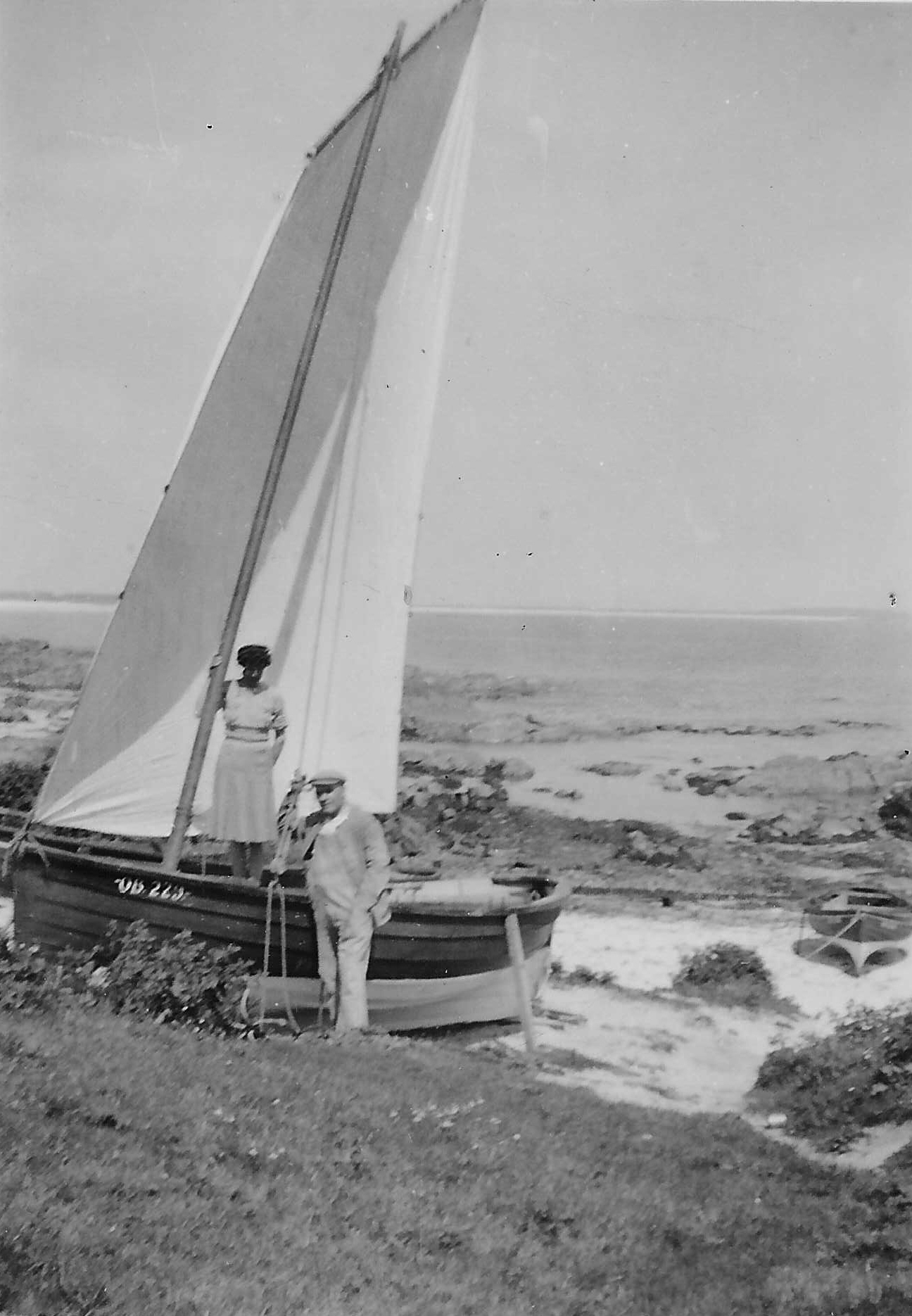
Black and white photograph of Hughina and John MacFarlane around 1940.
Hughina MacDonald (Veendy) and her first husband John MacFarlane at Port an Tobair, Balemartine, preparing for a regatta around 1940.
Black and white postcard of Macolm MacIntyre in 1916.
Blacksmith Malcolm MacIntyre of Gott with his dog sitting on the Ringing Stone in 1916.

Courtesy of Ms Mary MacKinnon
Blacksmith Malcolm MacIntyre of Gott is pictured in this old postcard with his dog sitting on the Ringing Stone. Local legend has it that if the stone is struck so hard that it splits in two then Tiree will sink beneath the waves.
Given its name because of the metallic sound it makes when struck, the Ringing Stone has at least 53 cup markings which date from the Bronze Age. The stone was carried to Tiree by a glacier during the last Ice Age and measures 3.4 metres by 2.4 metres and is 1.8 metres high.
Known today in Gaelic as Clach a’ Choire (rock of the hollow), it features in Blaeu’s map of 1654 as Coire Finmackoull showing it had been linked to the Ossianic heroic ballads of the 13th century.