


Cotton bag originally containing 70 lb of flour, producer`s name faded and illegible.


Cotton bag originally containing 70 lb of flour, producer`s name faded and illegible.
Book `Finlay MacQueen of St Kilda` by W. R. Mitchell.
Biography of Finlay MacQueen (1862 – 1941) from St Kilda. Includes chapters on St Kilda`s cragsmen, crofting, kirk, school, visitors, wartime experience, and evacuation in 1930.
Biographical and artistic information about artists Mary Barnard and Duncan MacGregor Whyte of Oban and Balephuil.
Bound book extracts about Duncan MacGregor Whyte and his wife Mary Barnard from the `Dictionary of Scottish Art & Architecture` by Peter J.M. McEwan , pp 63, 605 and `The Royal Scottish Academy Exhibition 1826-1990` edited by Charles Baile de Laperriere, p 420. Includes a list of works exhibited by Duncan MacGregor Whyte. DMcGW built The Studio at Balephuil and painted many scenes and portraits of Tiree.
Book `Beyond the Bamboo Screen – Scottish Prisoners of War under the Japanese` by Tom McGowran.
Experiences of Prisoners of War in the Far East – including the Argyll & Sutherland Highlanders
Black and white photograph of two unknown women with a horse.
Two unknown women with a horse, probably 1920s or 30s.

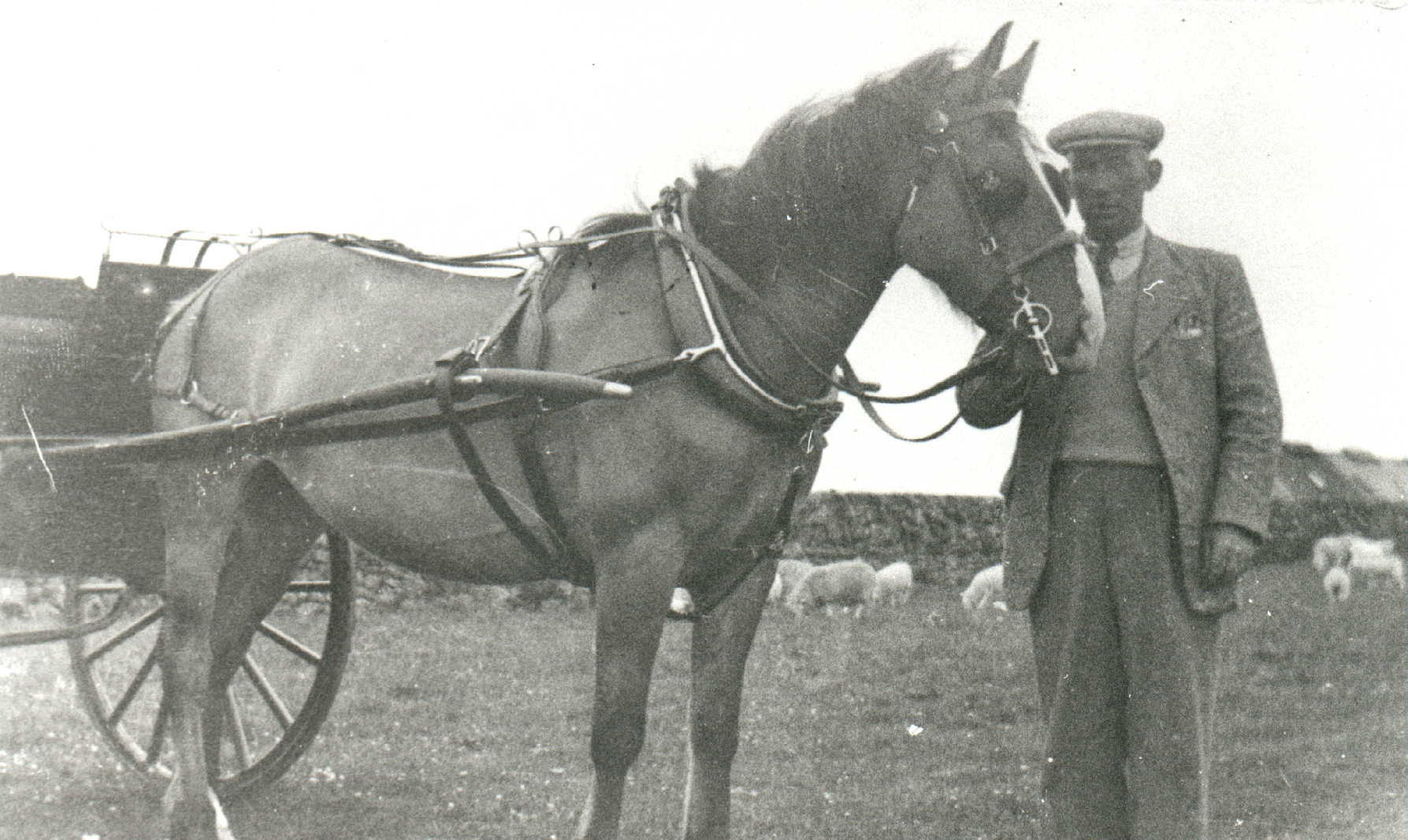
Black and white photograph of Alasdair Brown, Kilkenneth.
Alasdair Brown, Kilkenneth with horse and cart, c.1920s or 1930s.
Two men building a corn stack
Photograph of two men building a corn stack.

Courtesy of Mrs Mairi Campbell
The two men are building a corn stack or ‘mulan’ which will provide winter feeding for horses, cattle and hens and seed for spring sowing. In the background is a row of haystacks. Corn stacks were built with the heads of the sheaves to the centre so the finished stack contained a column of seed.
Four sheaves were placed upright in the centre with further sheaves added around the centre, working clockwise. The sheaves were always kept with the seed uppermost so any moisture would run away from it down the straw.
The diameter of the stack was carefully measured using a special rope, either six or seven fathoms long, marked with a knot at one end and a block at the other. The stack was re-measured every two rows to keep it straight. These traditional methods are still in use today by a few crofters on the island.
Black and white photograph of building a cornstack at Whitehouse.
The two men are building a corn stack which will provide winter feeding for horses, cattle and hens and seed for spring sowing. In the background is a row of haystacks. At harvest time, the cut corn would be bundled by hand into sheaves, six of which would be stood together to form stooks. When sufficiently dry, the stooks would be transported by horse and cart to the stackyard. Corn stacks were built with the heads of the sheaves to the centre so the finished stack contained a column of seed. These traditional methods are still in use today by a few crofters on the island.
Certificate of competency as master of a home trade passenger ship.
Merchant Navy Master`s certificate for Dugald MacKinnon, Heanish dated 6/4/1939.
Newspaper cutting `Albert Goodheir` with photocopy.
Obituary for Albert Goodheir (1912-1995), former minister on Tiree, Esperanto expert and author.
Newspaper article ` Tiree man retires from NFUS area Secretary role` with photocopy.
Retirement of National Farmers Union Scotland secretary of the Perth area, John MacNeill.