Dates: 1920s

2000.130.2

The souterrain in Kilkenneth in 1918

Photograph of John MacIntyre and his son Colin at the opened souterrain in Kilkenneth in 1918.

k89.jpg

Courtesy of Mr Colin MacKinnon

John MacIntyre (Iain Chailein Mhurchaidh) and his son, Colin, are pictured here at the souterrain in Kilkenneth opened by chance when ploughing in 1918. It was later covered over.

Less than a mile away, a Y-shaped passage was exposed in the 1890s in the sand dunes at Tràigh Ghrianail. Measuring 9.2 metres long, 1 metre wide and 1.5 metres high, it was known locally as An Taigh Falaichte (the hidden house) and used for shelter by those working on the shore. It has since disappeared.

Similar underground structures were built on the mainland around 200 AD. They may have been used as byres or stores, or as places to hide from raiders.

Black and white photograph of John MacIntyre at the souterrain in Kilkenneth around 1920.

John MacIntyre at the rear of the horse and his son Colin at the opened souterrain in Kilkenneth around 1920.

2000.84.1

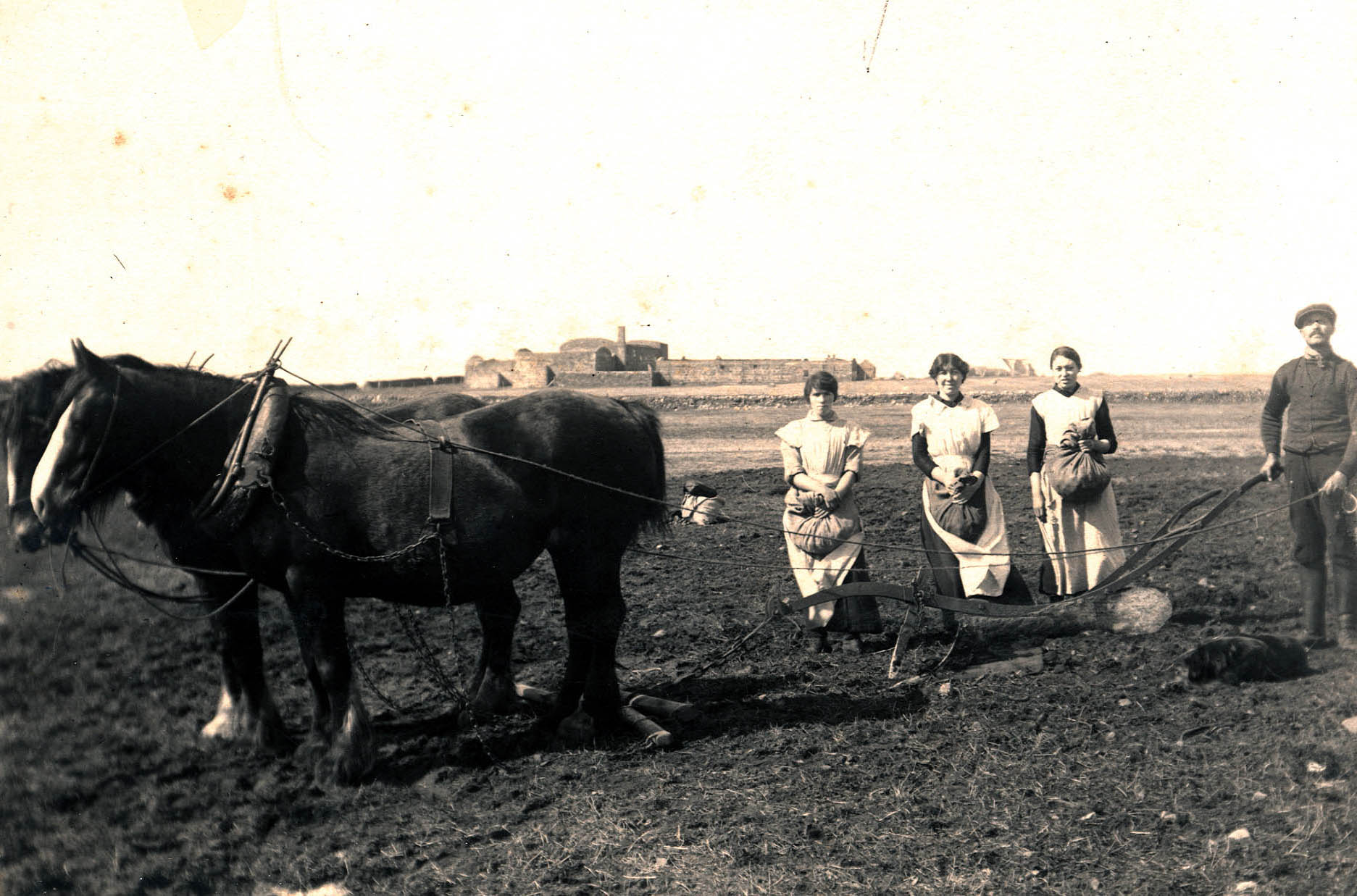
Planting potatoes at Middleton in the 1920s

Photograph of Alasdair MacDonald planting potatoes with Lizzie MacArthur, Effie and Mary Ann MacDonald at Middleton in the 1920s.

k48.jpg

Courtesy of Mr Lachie MacDonald

Taken in the 1920s, the photograph illustrates a standard plough used to prepare the ground for sowing corn. Because of the fine sandy soil in most of Tiree, a ridger was not successful.

The women followed in the furrow planting potatoes from the supplies heaped in their sack aprons and the ploughman made a second furrow to cover them. This process was repeated leaving a 45 cm space between the planted furrows for the grubber.

The Middleton seaweed factory operated by the North British Chemical Company can be seen in the background. Known locally as the Glassary, it ceased operation in 1901 and was demolished during World War II.

Black and white photograph of Alasdair MacDonald planting potatoes at Middleton in the 1920s.

Planting potatoes at Middleton, with the Glessary (as it was known) in the backgound in the 1920s. L-R: Lizzie MacArthur, Middleton and Greenhill – aunt of John MacArthur, Middleton Farm; Effie MacDonald, married to the late Archie Walker, Coll and Kenovaay, Tiree – aunt of Lachie MacDonald , Middleton; Mary Ann MacDonald – aunt of Lachie MacDonald, Middleton; Alasdair MacDonald – father of Lachie MacDonald, Middleton. The photograph illustrates a standard plough used to prepare the ground for sowing corn. Because of the fine sandy soils in most of Tiree, a ridger was not successful. Instead, the standard plough was used and the women followed in the furrow with supplies of potatoes heaped in their sack aprons. The ploughman made a second furrow to cover the potatoes. The same process was repeated thus leaving an 18 inch (45cm) space between planted furrows to allow the grubber to be used.

2003.180.1

S.S. ‘Cygnet’

Postcard of the S.S. ‘Cygnet’ approaching Gott Bay pier.

w20.jpg

Courtesy of Mrs Ishobel MacDonald

Built as a cargo steamer, the S.S. ‘Cygnet’ was launched from Inglis’ Yard on the Clyde in 1904. She received a boiler and the starboard engine salvaged from the MacBrayne steamship ‘Flowerdale’ which was lost off Lismore earlier that year.

Initially on the Glasgow-Inverary route, the ‘Cygnet’ was modified after World War I to accommodate passengers and transferred to the Oban-Coll-Tiree-Castlebay-Lochboisdale route. She was sold in 1930 and broken up the following year.

Alasdair Sinclair of Brock remembers the ‘Cygnet’ as a dreadful wee boat: ‘There was nowhere at all to sit…You just stood on deck ankle-deep in water and watched your luggage floating about.’

Black and white postcard of the ferry approaching Tiree pier.

The ferry `Cygnet` approaching Tiree in the 1920s. The SS `Cygnet` was launched in 1904, relieved the Outer Isles ferries until the end of WWI, then was based in Oban and conducted the Islands mail services until 1930 when she was sold. (Original postcard in Filing Cabinet 8 drawer 2)