


Black and white photograph of a horse-drawn reaper.
Cutting hay with a horse-drawn reaper behind Corrairigh, Cornaigbeg in the 1940s. L-R Donald and Hector Campbell.
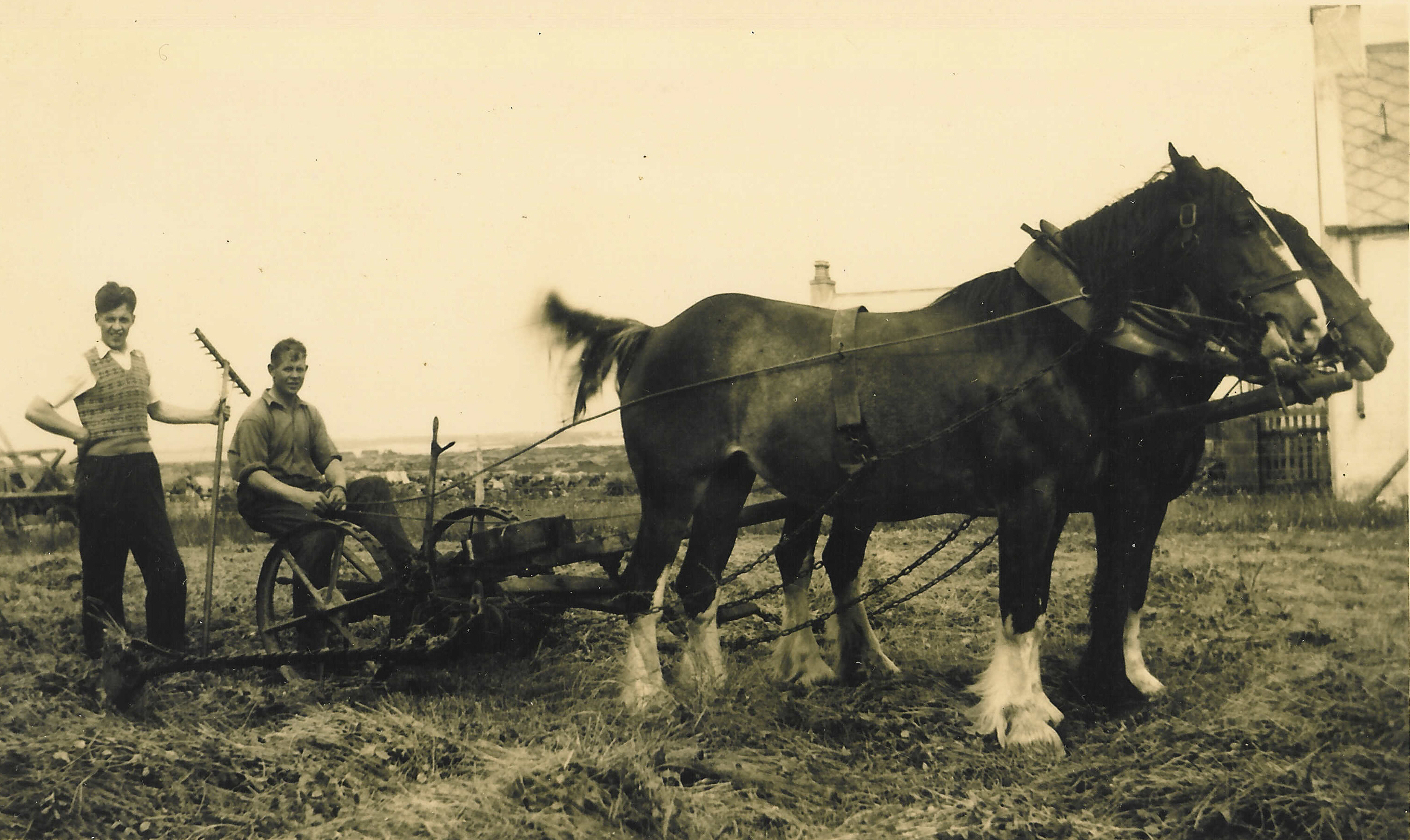

Black and white photograph of a horse-drawn reaper.
Cutting hay with a horse-drawn reaper behind Corrairigh, Cornaigbeg in the 1940s. L-R Donald and Hector Campbell.
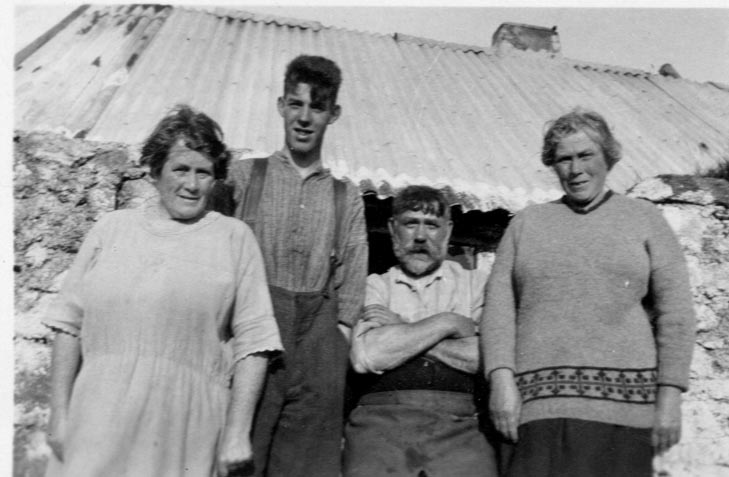
Black and white photograph of the MacEacherns of Cornaigbeg.
The MacEacherns of Cornaigbeg. L-R: Filag, Laypan, Archie and Peggy.
Black and white photograph of Laypan MacEachern and Molly Baron.
Laypan MacEachern of Cornaigbeg with Molly Baron from Shore, Cornaig, in front of Curly MacLean`s car in 1930.

Black and white photograph of the MacEachern family of Cornaigbeg.
MacEachern family of Cornaigbeg in 1924. L-R: (back) Peggy MacEachern; Flora Campbell, wife of Hugh; Mary MacEachern, mother of Hugh, Archie, Janet and Mary Margaret; (middle) Hugh MacEachern; Hugh Campbell, chemist; Granny (bean a` ghobhainn); Mary`s husband John MacEachern; Archie MacEachern; (front) Janet MacEachern (m.s. Wilson) and Mary Margaret MacEachern.

Photograph of a group of young Tiree adults in the 1920s
Black & white photograph of L-R (standing): unknown woman; Donald Archie MacLean, Millhouse; unknown woman; Neil Brown Cornaigbeg; unknown woman; (seated) Alec Hector MacPhail, Clachan; Mary MacPhail, Cornaig PO. Two of the other women are Isobel Stewart, Oban, and Mary Ann MacDonald, Kilmoluaig. Neil Brown was the brother of John Neil Brown`s father. Donald Archie was Archie Dubh`s father. Alec Hector was Willie Clachan`s father.

Photocopied extract from Argyll Estates Tiree Setts with rentals for Cornaigmore and Cornaigbeg in 1862.
Extract from Argyll Estates Tiree Setts with rentals for Cornaigmore and Cornaigbeg in 1862.
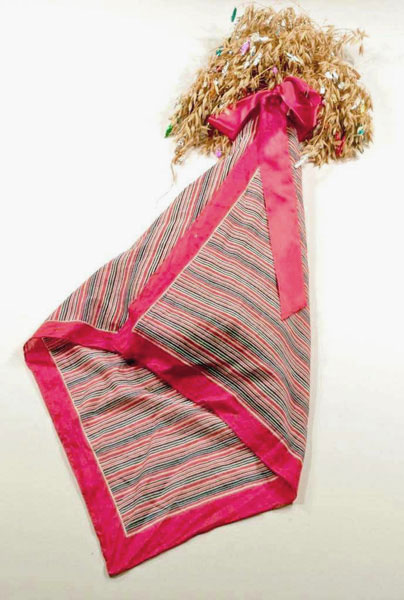
A’ Chailleach Bhuain / The Old Woman of the Harvest made by Hector J. C. Campbell in around 1990.
Courtesy of Mrs Flora MacPhail
On Tiree the last sheaf of corn to be harvested was called A’ Chailleach Bhuain, a tradition that was found all over northern Europe and likely to date from the dawn of farming in Neolithic times. The Corn-spirit was believed to live in the corn, giving it the strength to grow vigorously. As the harvest proceeded, this spirit became concentrated in the remaining crop. The final sheaf to be cut was then regarded as containing its essence. On Tiree, the ‘cailleach’ was fed to the horses before they started the spring ploughing in the belief that the power of the Corn-spirit would be transmitted to the soil for the new year’s growth. This four thousand year old harvest tradition died out before 1910 in Sandaig, in the 1920s in Balinoe and into the 1950s in Heylipol and Balephuil.
Hugh and Archibald Campbell in 1911
Photograph of Hugh and Archibald Campbell in 1911.

Courtesy of Mrs Mairi Brady
Hugh and Archibald Campbell were the sons of John Campbell from Garaphail in Cornaigmore and his wife, Flora MacEachern, a daughter of the blacksmith in Cornaigbeg. Hugh, on the left, became a chemist and worked in Port Glasgow.
His brother Archie, who was born in Johnstone in 1897, played as a full back for Norwich City Football Club, making his debut against Plymouth Argyle in August 1924. Captain of Norwich City’s Reserves, he played his final game for the ‘Canaries’ in 1928.
Archie worked for forty years at Laurence Scott & Electromotors, retiring as an assistant production manager. He died in 1987.
Black and white photograph of Hugh and Archie Campbell of Cornaigbeg.
L-R: Hugh and Archibald Campbell of Cornaigbeg in 1911. Archie (1897-1987) played as full back for Norwich City Football Club. (Original in Filing Cabinet 3 drawer 2)
Letter dated 27/12/1956 addressed to Hugh MacEachern of Cornaigbeg.
Letter to Hugh MacEachern, Cornaigbeg which accompanied the present of `The Blacksmith`s Manual`.
Photocopied petition dated 1893 to Argyll County Council from a group of Tiree cottars.
Petition dated 1893 to Argyll County Council from a group of cottars from Kilmoluaig, Balevullin, Sandaig, Kilkenneth, Moss, Cornaigmore, Cornaigbeg, Kenovay and Barrapol, all wanting to rent land under the Small Holdings Scotland Act of 1892.